
Scientists Tagged Golden Eagles to Find What’s Killing Them. It Led to a ‘Death Vortex’ in Nevada
Published Feb. 20 2026, 7:04 a.m. ET

Scientists have been tracking Golden Eagles using tags for over a decade now. (Cover Image Source: Facebook | @U.S. Geological Survey (USGS))
Las Vegas’ Dry Lake Valley has turned into a death vortex for one of the most majestic predators of North America: golden eagles. In the past, they were seen sky-dancing in undulating patterns, vigilant to catch prey like jackrabbits, cottontails, ground squirrels, and rodents. Often, they were spotted fighting with predators, such as coyotes. Today, however, the valley has turned into a parched piece of white salt flats and cracked mud littered with bony carcasses of these eagles.
Fans of dry dust swirl above the valley, enrobing it in a muted dread. The eagles are dying at an alarming rate, and nobody knows why. When Joe Barnes, a Reno-based biologist with the U.S. Fish and Wildlife Service, investigated the matter, he realized that there isn’t just one cause, but more than that, behind the mystery of dying eagles, according to a report by ScienceNews.
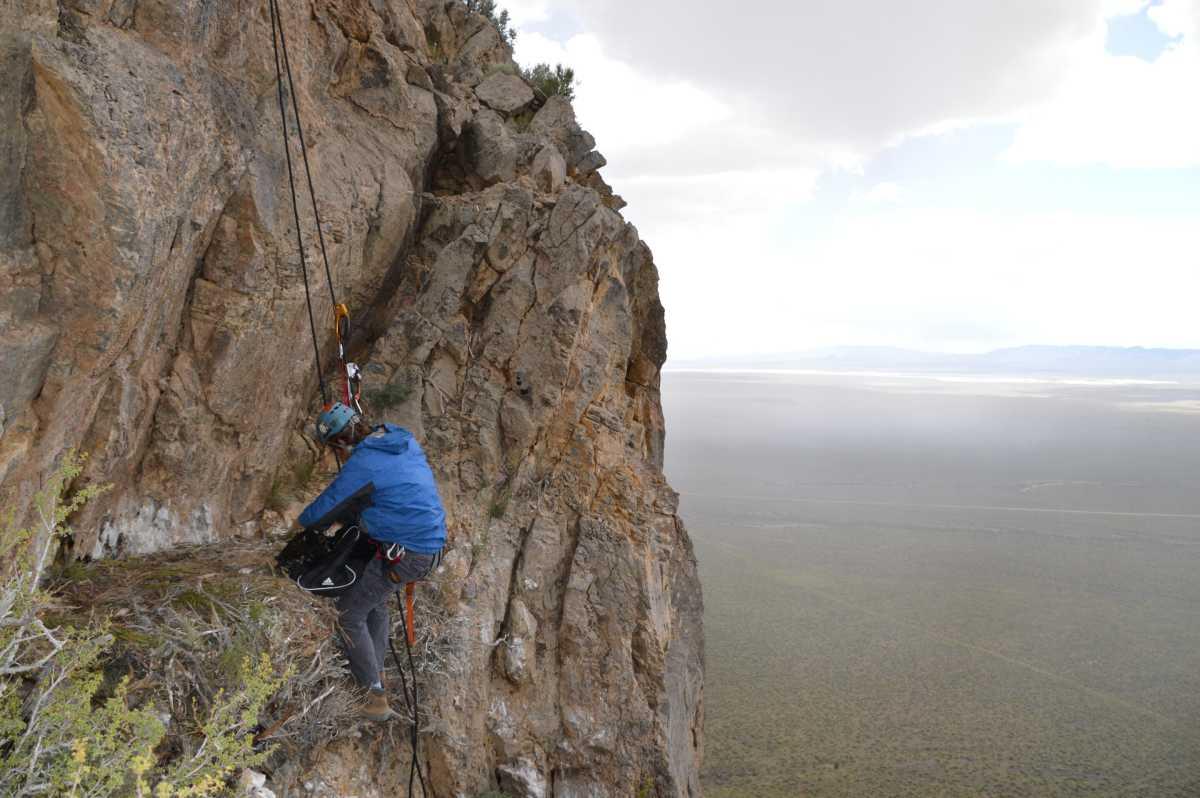
Returning a nestling after tagging to their nest in Dry Lake Valley, Nevada
In 2025, a team of researchers, including Barnes, observed a breeding population of these eagles near a solar energy development area in southern Nevada. In the paper published in the Journal of Raptor Research, they documented the shifting dynamics and trajectory of the population. Observations were extracted from 18 eagle territories spread out through the region “like a necklace.”
A multitude of causes emerged. Disease, starvation, power lines, lead poisoning, wildfires, drought, and a lethal virus that swallowed up their favorite prey, rabbits. The construction of solar energy fields also contributed to the death spiral. Burdened by the collective stress generated by these factors, the eagles stopped breeding. Reproduction, Barnes highlighted, is one of the reasons why their population is dramatically dwindling.
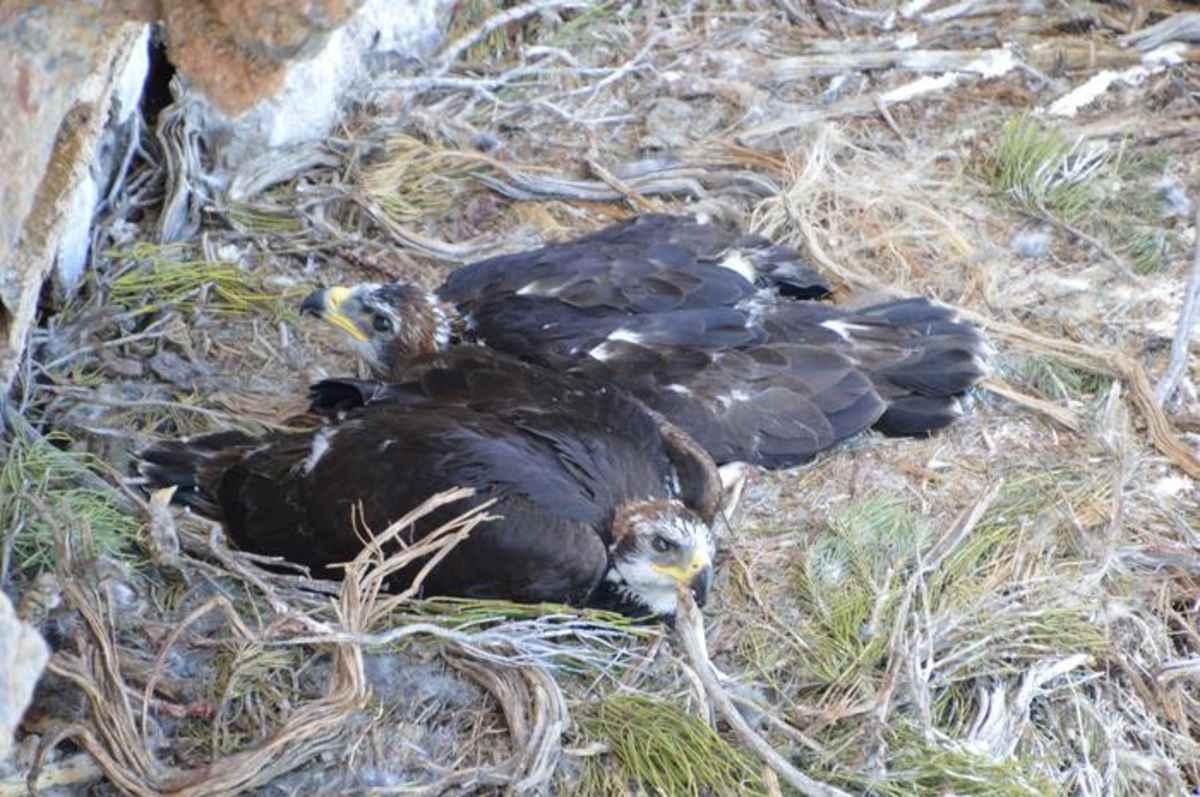
Nestlings prior to transmitter deployment in Dry Lake Valley, Nevada.
“Eagles are unique in that they will take years off. So, if conditions are just awful… the female simply won’t lay eggs that year. And sometimes it’ll be multiple years, half a decade,” he explained. With the breeding rate declining, they can’t reproduce quickly enough to replenish their numbers. As a result, the valley has turned into a “population sink” that is slowly gobbling up the eagles. In 2017, there were around 3,000 eagles in the area. Since 2014, 10% of the population has been lost. For the coming years, Barnes can already visualize the potential for compounding losses. “There’s a 2 percent chance that everyone is happy and healthy, but 98 percent odds that they’re declining, and it’s a fairly strong decline,” he estimated
Barnes has been studying this species for 15 years. From his experience, he shared that tagging these eagles is not at all easy. Golden eagles, he said, are “difficult to detect.” At first, researchers need the cover of darkness and then make sure that they don’t tip off the eagles while strapping transmitters on them. Wildlife researcher James Golden echoed that tagging them requires “guts.”
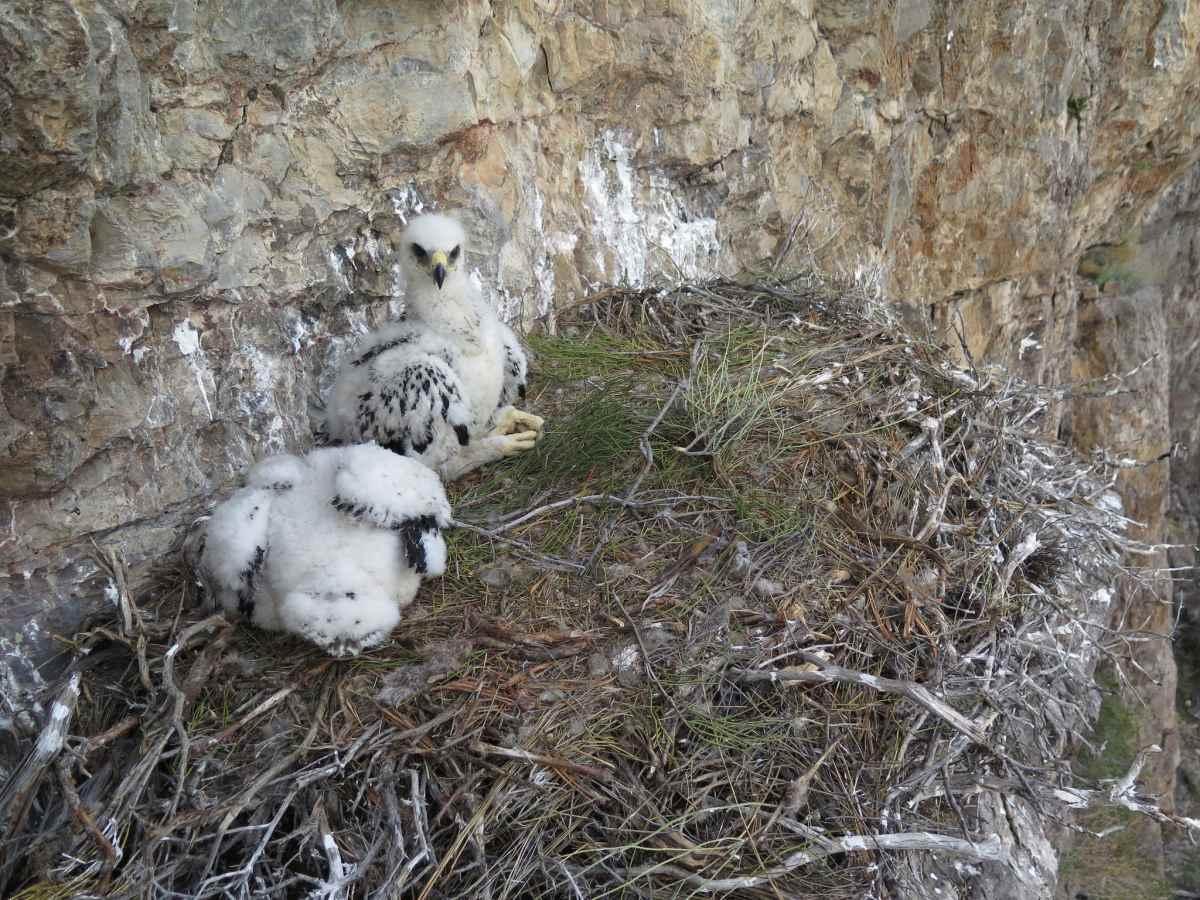
Golden eagle nestlings following banding in the Dry Lake Valley study area
In order to track the eaglets, the scientists rappelled to the nests and attached transmitter-containing backpacks to the birds. So, they rappelled up the cliffs, battled the ripping winds, and carefully tagged around 43 adult golden eagles across Nevada.
Between 2014 and 2024, the transmitters delivered them details like the speed, direction, location, and altitude of the eagles. They also tracked the territories of individuals, which birds died, and which ones arrived from nearby areas. Using this data, they created a model to project their future population. The numbers were grim, as shared by the Raptor Research Foundation. Meanwhile, the non-breeding adults, called “floaters,” were even more difficult to track.