
Mountain Goats in Glacier National Park Have Lost 45% Population. And Scientists Don't Know Why
Published Feb. 5 2026, 5:51 a.m. ET

Mountain goats in Glacier National Park
The terrain should be cold, not too hot. But it shouldn’t have too much snow. Little snow patches here and there are okay. These help cool down on hot days. Most importantly, the terrain should be open, preferably with cliffs where the young mountain goats can hop, skip, and jump if a predator pops up. Also, salt licks are necessary. They provide minerals that these goat kids need for body building, particularly for their bones and horns. And although every season is perfect in its own way, the rains are the best. Generous rains mean more plants and grasses, which means more food for the mountain goats.
These are some of the basic requirements the alpine-adapted mountain goats demand in their real estate. However, they can’t move on to a new property dealer if humans fail to fulfill these requirements. As a result, they suffer. They become weak. They stop breeding. Or die. Sadly, this anthropogenic failure has worsened in recent years, and the population of mountain goats is nearing collapse in Montana’s Glacier National Park (GNP), as scientists documented in Animal Ecology.
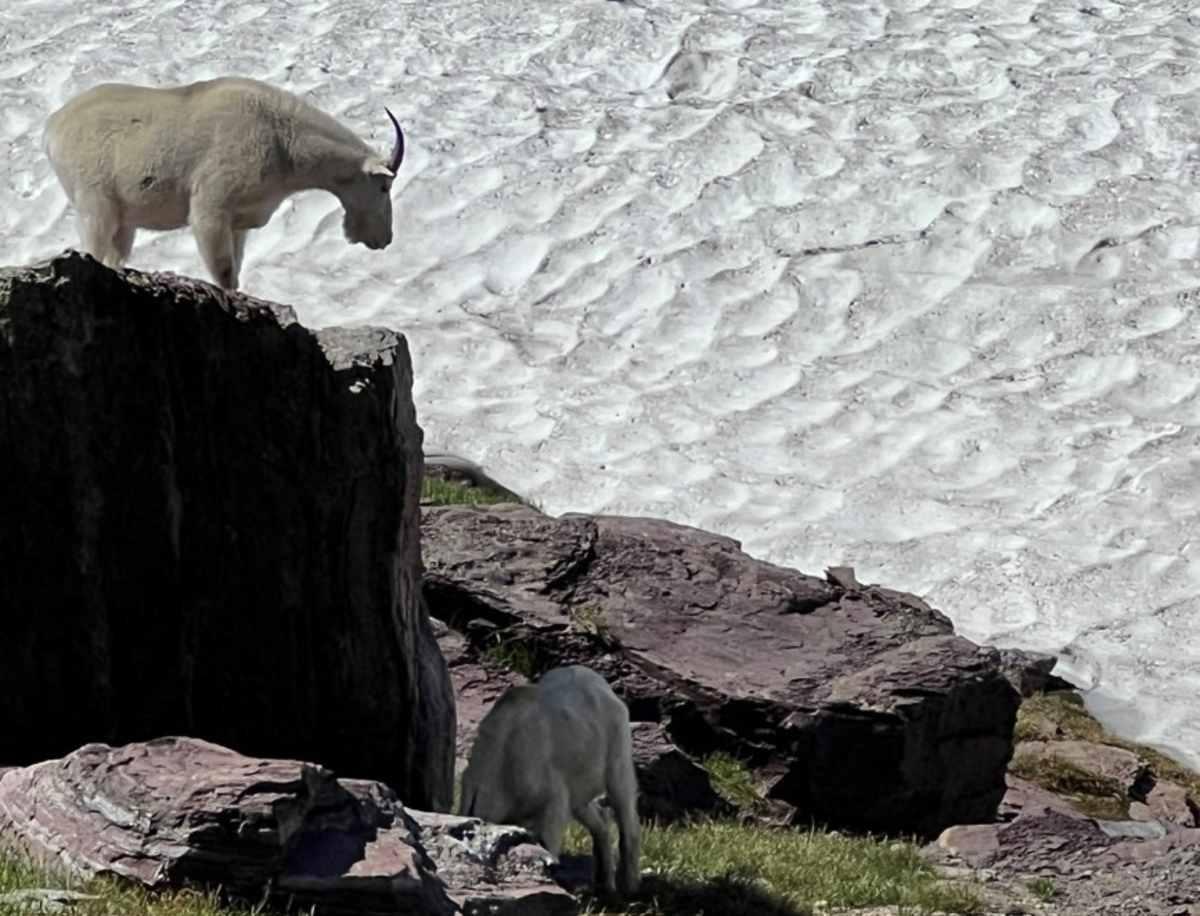
Mountain goats in Glacier National Park
The reproduction clockwork of mountain goats adds another layer of tragedy to their disappearing population. Unlike deer, mountain goats don't have offspring until they are at least 4 to 5 years old. This slow recovery impacts their breeding frequency, further shrinking their population. In the last decade, visitors and staff at GNP have reported fewer goat sightings with each passing year. One reason is the park’s uneven and troublesome terrain. The areas where goats roam are some of the remotest in the park and also rugged and crumbly. This makes collaring goats highly expensive and inaccessible. Factors like weather, migration, and the ability of goats to elude detection make things even more difficult.
In this study, USGS scientists teamed up with National Park Service biologists to analyze data collected by GNP’s High Country Citizen Science Program between 2008 and 2019 at 37 sites across the park. The 12-year data was coupled with monitoring methods and Bayesian N-mixture modelling to analyze the population metrics of mountain goats.
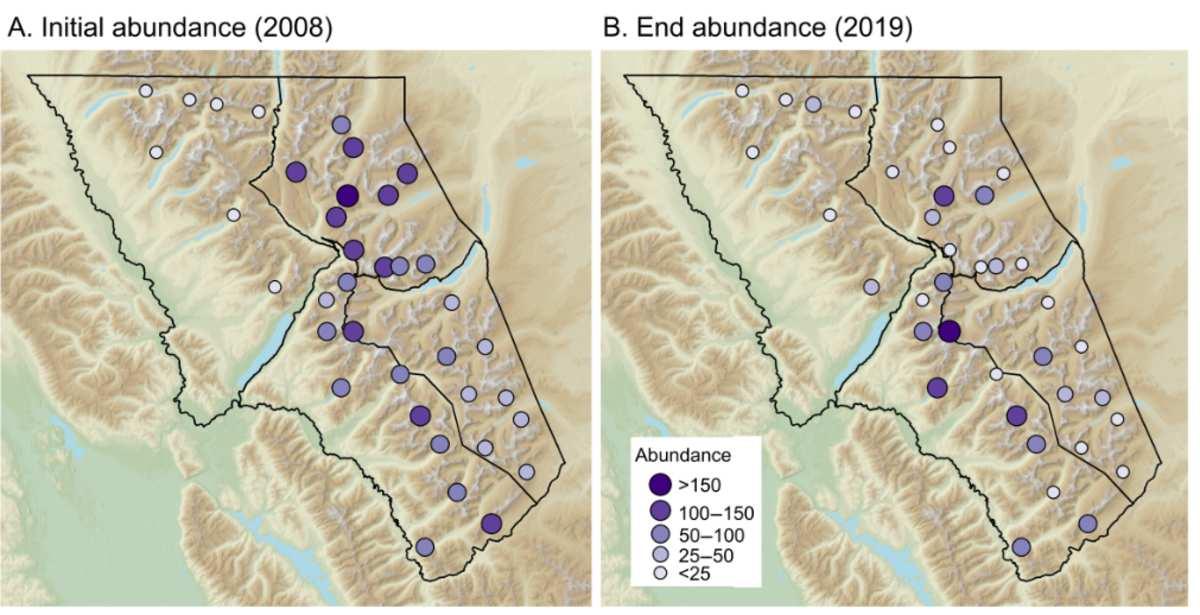
Median site-level goat abundance for 2008 and 2019. Outlines indicate the four regions in Glacier National Park, Montana, USA, used to define covariates in this study. Basemap from NASA 30 m Digital Elevation Model
Volunteers fanned out across the landscape, meticulously scanning the steep peaks, glaciers, glacial lakes, moraines, and cirques to count these elusive white ghosts of the mountains. They found out that detection increased with retention of observers with experience, the use of binoculars, goat habituation, and the conducting of surveys at lower temperatures and earlier dates.
Between 2008 and 2019, the population experienced a steep 45% decline. In 2008, the median number of goats across 37 sites was 77.8, but in 2019, it dipped to 42.3. In 2009, the number of mountain goats in GNP was between 1,397 and 2,657, according to Hungry Horse News. By 2020, it was estimated that the park has as few as 600 mountain goats or as many as 1,800. Although the decline stabilized between 2015 and 2019, the International Union for Conservation of Nature’s criteria deemed the species as "vulnerable."
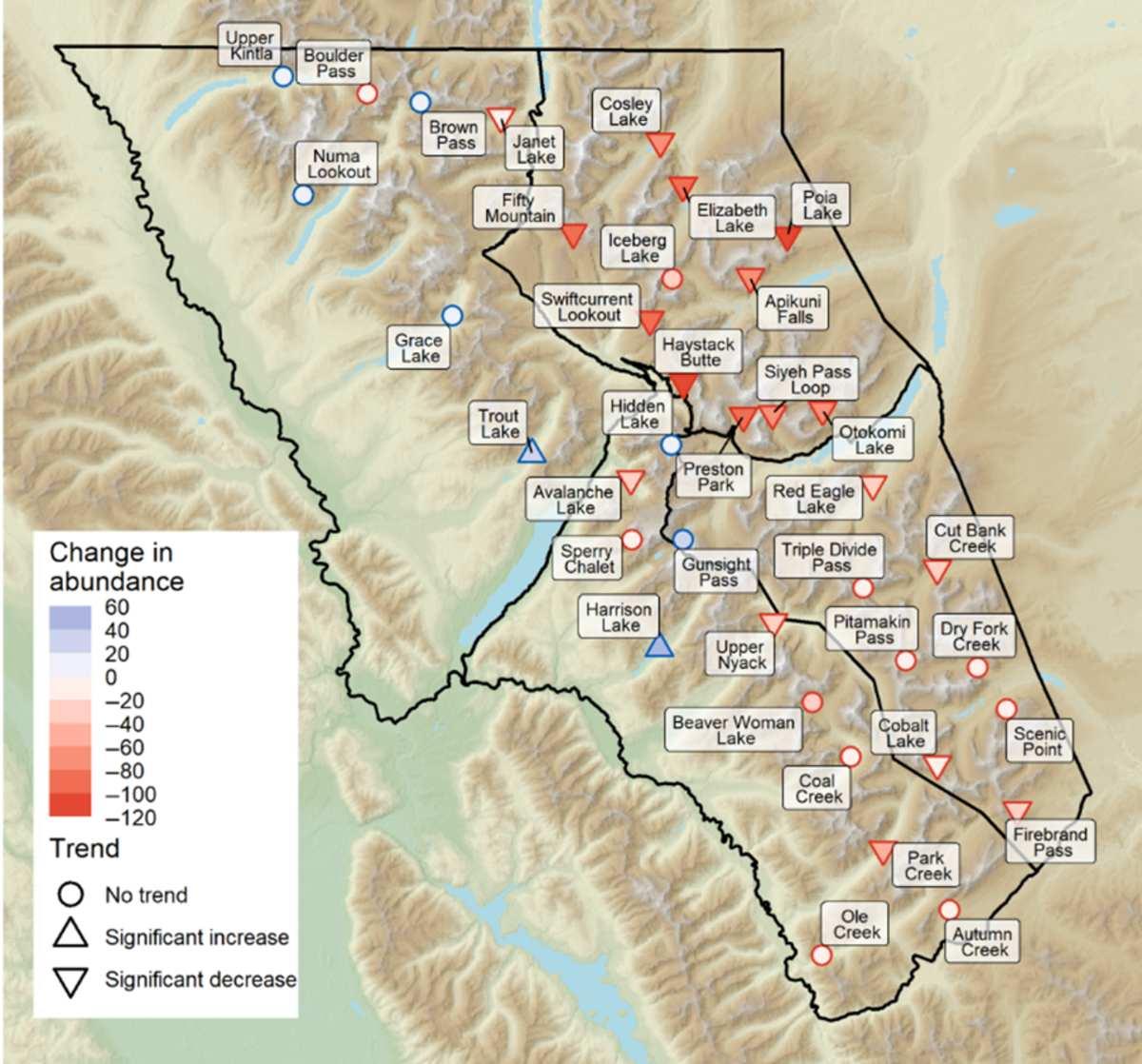
Predicted site-specific change in mountain goat abundance 2008–2019. Site names reflect local features. Outlines indicate the four regions in Glacier National Park, Montana, USA, used to define covariates in this study. Basemap from NASA 30 m Elevation Model
“This is the first robust evaluation of change in the number of mountain goats over time for Glacier,” Jami Belt, a Glacier National Park biologist and co-author on the paper, told SFGate. Various factors and variables emerged as primary drivers behind the dwindling population. Weather, for example. Temperature and precipitation, especially, play the top role. Since the goats prefer an exact environment that is neither too hot nor too cold, it’s an “unsatisfying full story,” Tabitha Graves, a co-author on the paper and a research ecologist, remarked. No one has any idea how much warming they need in different seasons. Human interference could be another factor, biologists noted in the study, particularly due to the salt in their urine, sweat, and the roads they travel.