
New Comet Could Light Up Our Daytime Skies in April. But It’s Got a Deadly Obstacle In Its Way
Published March 13 2026, 8:09 a.m. ET

A newly discovered comet is rapidly brightening and could become visible from Earth
A new comet has been discovered by astronomers that could put on a pretty impressive sky show in the next few weeks. Officially called C/2026 A1 (MAPS), the object might even turn into an “Easter comet” if it survives the flyby past the scorching Sun. It was first photographed on January 13 at the AMACS1 Observatory in San Pedro de Atacama, Chile. Four French astronomers, Alain Maury, Georges Attard, Daniel Parrott, and Florian Signoret, discovered the space rock. Together, they run a program dedicated to hunting near-Earth asteroids. The program is called MAPS, named using the initials of their last names.
When it was first detected, the comet was about 191 million miles from the Sun and in the constellation Columba. At that point, it was an 18th-magnitude object, meaning it was way too dim for most amateur telescopes to see. However, the comet has brightened dramatically, about 600 times brighter than before. It is now around magnitude 11, which means it is bright enough for amateur astronomers to pick up using 8 to 10-inch telescopes. It will keep getting brighter, leading up to a very close and intense pass by the Sun on April 4.
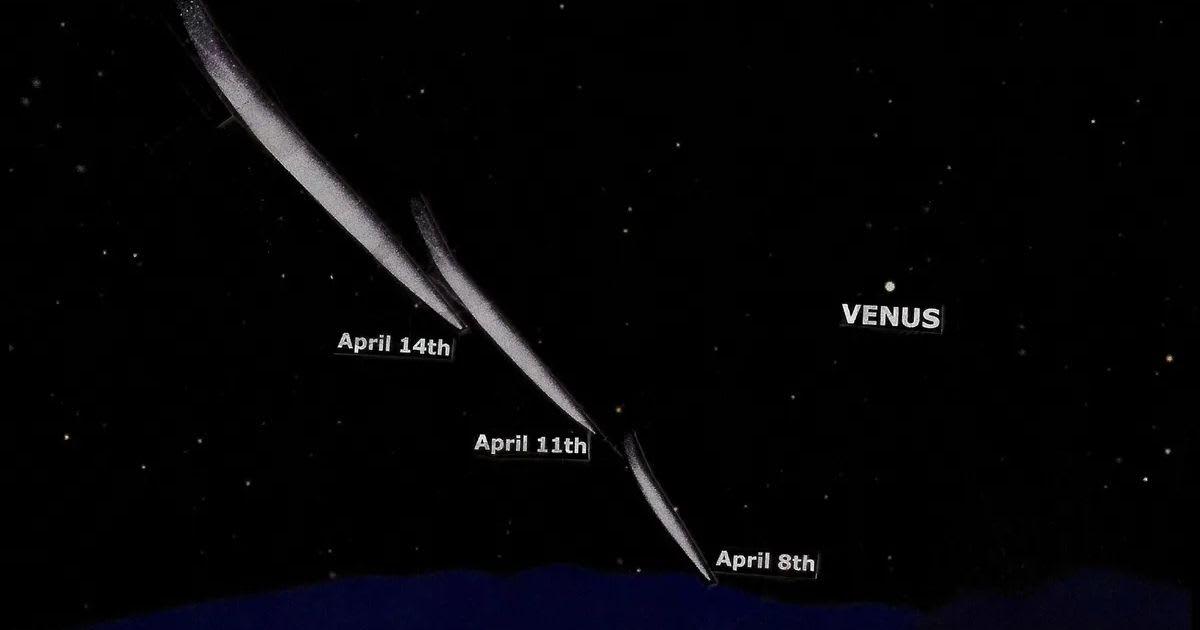
The probable direction and length of the comet's tail
Comet MAPS is special because it belongs to a group called the Kreutz sungrazers. Some of the brightest comets ever recorded have come from this family, including the Great Comets of 1843 and 1882, Comet Ikeya-Seki in 1965, and Comet Lovejoy in 2011, which also put on an impressive show. Comet MAPS is expected to reach perihelion, the closest point to the Sun, around 10 AM EDT on April 4. At that moment, it will pass just about 99,000 miles above the Sun’s surface, which is incredibly close in space terms.
But that close approach comes with a risk. The comet will travel through the Sun’s super-hot outer atmosphere, called the corona, where temperatures can reach around 2 million °F. Because of that intense heat, combined with the Sun’s powerful gravity, there is a chance the comet could break apart or completely burn up. Still, it might survive. The comet is not expected to slam directly into the Sun. If it makes it through, it will whip around the star on a sharp curve at more than 1 million miles per hour before heading back out into space.
It might be tempting for some people to spot the comet as it will appear very close to the Sun, but experts warn that this is very risky. The real danger is not the comet but accidentally looking at the Sun itself. Even a quick glance can let powerful infrared rays burn the retina, causing permanent eye damage without any immediate pain. And things like sunglasses, telescopes, or binoculars won’t protect your eyes from that kind of damage.
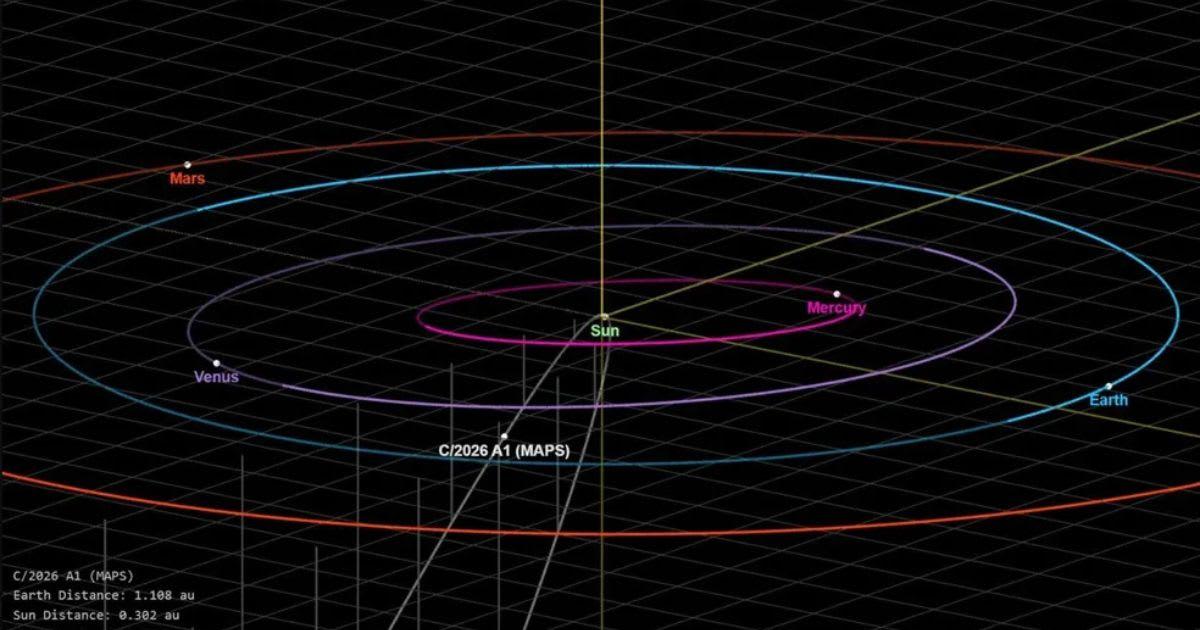
This view shows Comet MAPS position on March 31
The safest way to watch the comet’s close encounter with the Sun is actually from the computer screen. Astronomers recommend following it through images from the Solar and Heliospheric Observatory (SOHO), a spacecraft that constantly watches the Sun. Scientists are hoping to capture some amazing views using SOHO’s LASCO C3 camera, which blocks out the bright disk of the Sun so nearby objects, such as comets, can be seen.