
Can We Stop a ‘Planet Killer’ Asteroid from Hitting Earth? A NASA Experiment Tested It
Published March 9 2026, 8:04 a.m. ET

Most detailed observations of NASA’s DART impact aftermath to date
NASA intentionally crashed a spacecraft into an asteroid a few years ago as part of its planetary defense test. Scientists have discovered that the impact actually nudged the asteroid onto a slightly different path around the Sun. It was reported that the findings could help researchers understand how to deflect a dangerous asteroid if one is ever headed toward Earth. It is the first time that humans have intentionally changed the orbit of a celestial body around the Sun. In a study published in Science Advances, researchers said, “This study marks a notable step forward in our ability to prevent future asteroid impacts on Earth.”
However, the change was extremely small. Scientists say the asteroid’s trip around the Sun became shorter by just a tenth of a second and about half a mile (720 meters). Usually, the asteroid takes about two years and covers hundreds of millions of miles. “Even though this seems small, a tiny deflection ... can add up over decades and make the difference between a potentially hazardous asteroid hitting or missing the Earth in the future,” lead author Rahil Makadia of the University of Illinois Urbana-Champaign said, per AP News.
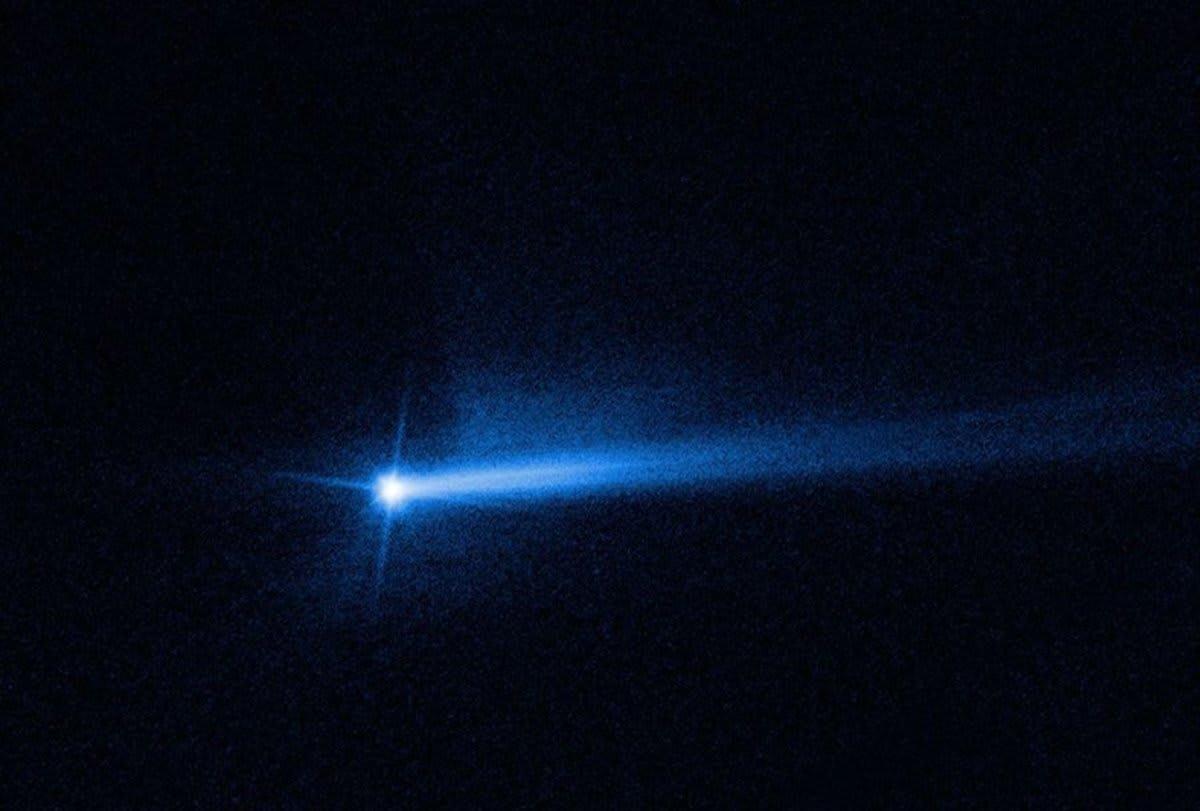
The tail of material that formed behind Dimorphos after DART impact
NASA’s DART spacecraft intentionally slammed into the asteroid Dimorphos in September 2022. It hit the asteroid at a speed of about 15,000 miles per hour, and the goal was to test a technique called a kinetic impactor. It is basically smashing a spacecraft into an asteroid to see if it can slightly alter its path. Soon after the impact, observations showed the experiment had worked. Launched in 2021, DART targeted Dimorphos, a small asteroid that circles a larger one called Didymos. Dimorphos is about 525 feet (160 meters), and Didymos is about a half mile (780 meters). Together they orbit the Sun and do not threaten Earth.
Initially, Dimorphos took 11 hours and 55 minutes to complete one orbit around Didymos. But after the impact with NASA’s DART spacecraft, that orbital time dropped to about 11 hours and 23 minutes. The change is approximately 33 minutes. Scientists did not expect such a change, and they confirmed that the impact successfully altered the asteroid’s motion. However, the team also discovered that the crash did not just change Dimorphos’ orbit around Didymos, but also it slightly shifted the entire asteroid system’s path around the Sun. Both the asteroid’s solar path changed by about 0.15 seconds, and its speed shifted by around 11.7 microns per second.
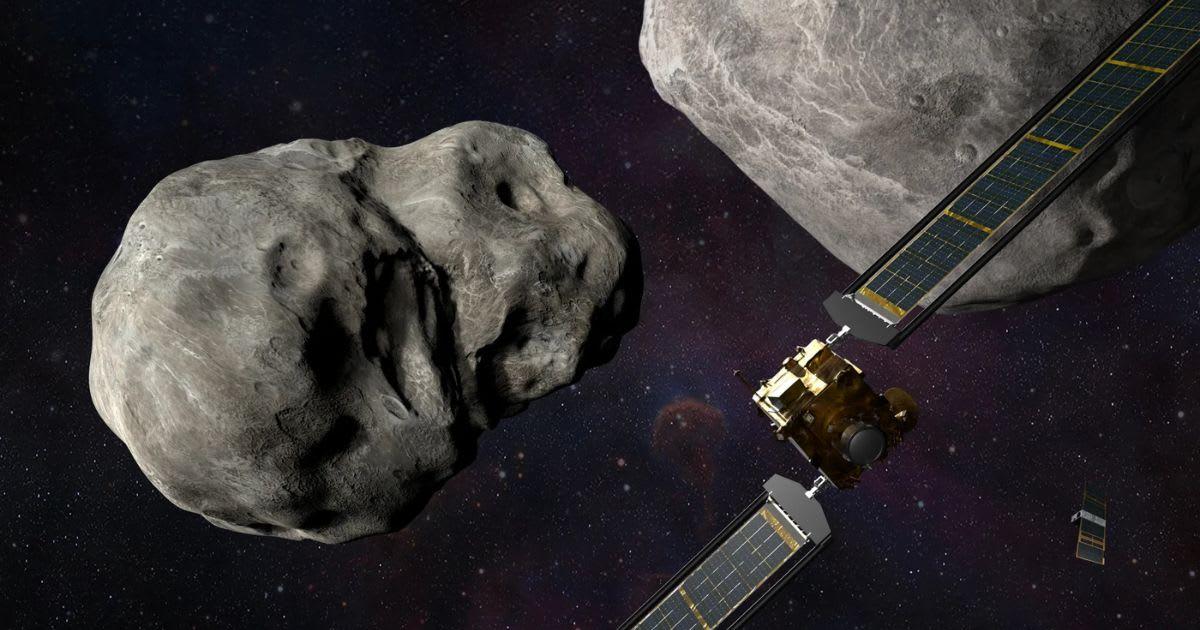
An illustration of NASA’s DART spacecraft
Scientists explained that when the spacecraft slammed into Dimorphos, it blasted out a huge amount of rocky debris. That debris ended up acting like a natural push, helping shove the asteroid a little more after the crash. In other words, the flying rubble added extra force to the impact and made the deflection stronger. Scientists call this effect “momentum enhancement.”
The good news is that even with these small changes to the asteroid system’s path, Earth is still completely safe. Steven Chesley of NASA’s Jet Propulsion Laboratory said that the Didymos–Dimorphos system was chosen on purpose because it does not pose any threat to our planet. “While it is just a single experiment, it is nonetheless an important data point that will be relevant to any future asteroid deflection missions,” he said.