
A Ghostly Triangle of Light Will Takeover The Sky Around Equinox. Here's How To Spot Zodiacal Light
Updated March 24 2026, 1:36 a.m. ET

The Submillimeter Array of radio telescopes at night, lit by flash, with the Zodiacal Light (false dawn) in the background.
This month, around the equinox, an eerie pyramidal band of light could be seen amid the darkness of night. According to IFL Science, this is the best time to see the ghostly light shaped like a pyramid known as the "zodiacal light," which appears within the belt of constellations that make up the zodiac signs. You may have seen the zodiacal light before and mistaken it for light pollution from the city, as it can appear quite faint and be easily overlooked. Or perhaps you did notice a strange band of light but cooked up alien invasion theories to explain it. Astronomer Geza Gyuk told National Geographic in 2010 that there's a way to tell the zodiacal light apart.
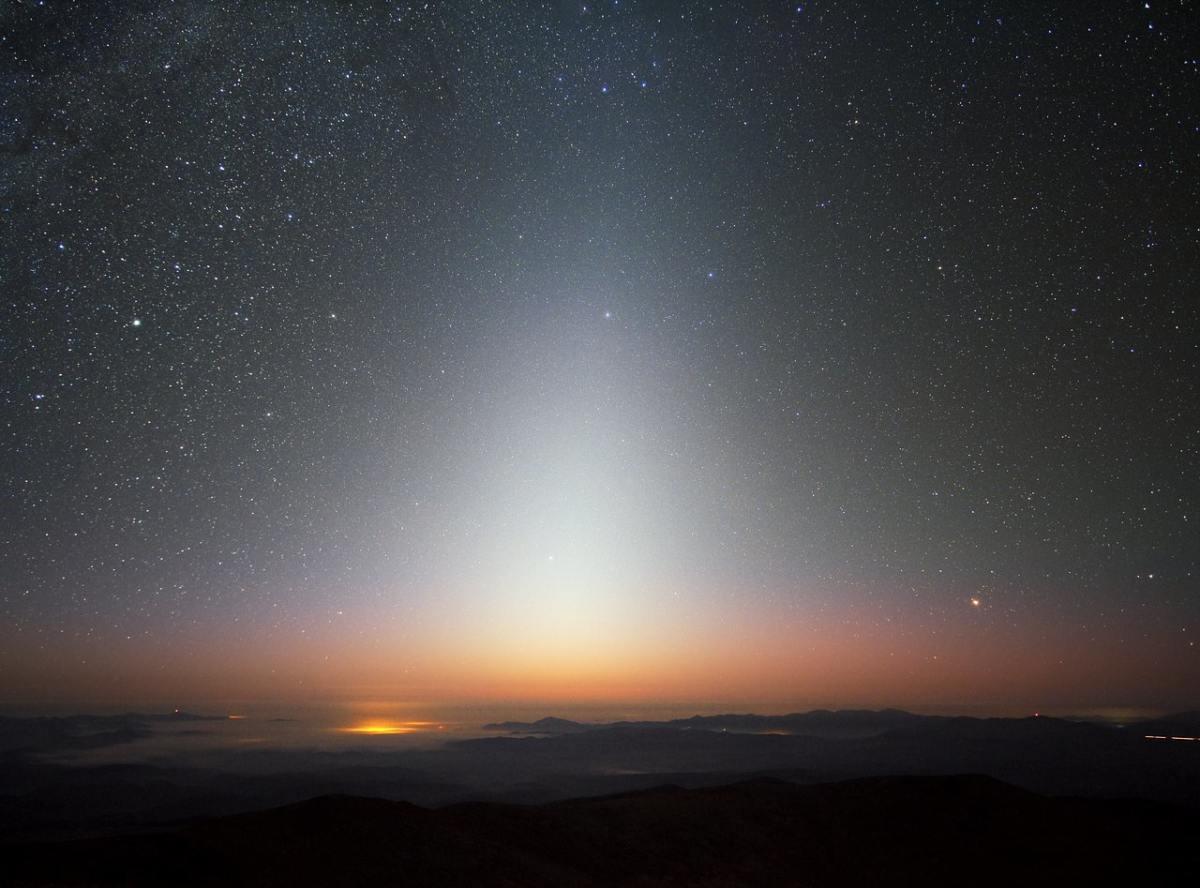
The beautiful zodiacal light, a triangular glow seen best in night skies free of overpowering moonlight and light pollution.
"It will look like a mostly vertical column or pyramid” with “a soft, triangular, pearly glow,” he explained. The phenomenon is often mistaken for remnants of a sunset and is sometimes addressed as “false dusk" or "false dawn." However, Gyuk clarified that true dusk is "horizontal" while the zodiacal light is visibly elongated with its vertical axis tilted to the horizon. If you wish to witness the phenomenon, gaze at the western skies and try to spot “a cone-shaped wedge of light rising from the sunset point in the evening,” said Brian Skiff, a research scientist and astronomer at Lowell Observatory. As we are heading closer to the spring equinox, experts believe it to be the perfect time for zodiacal light sightings. Just gaze at the western skies for 90 minutes to 2 hours after sunset, and you will be among the lucky ones to witness the phenomenon.
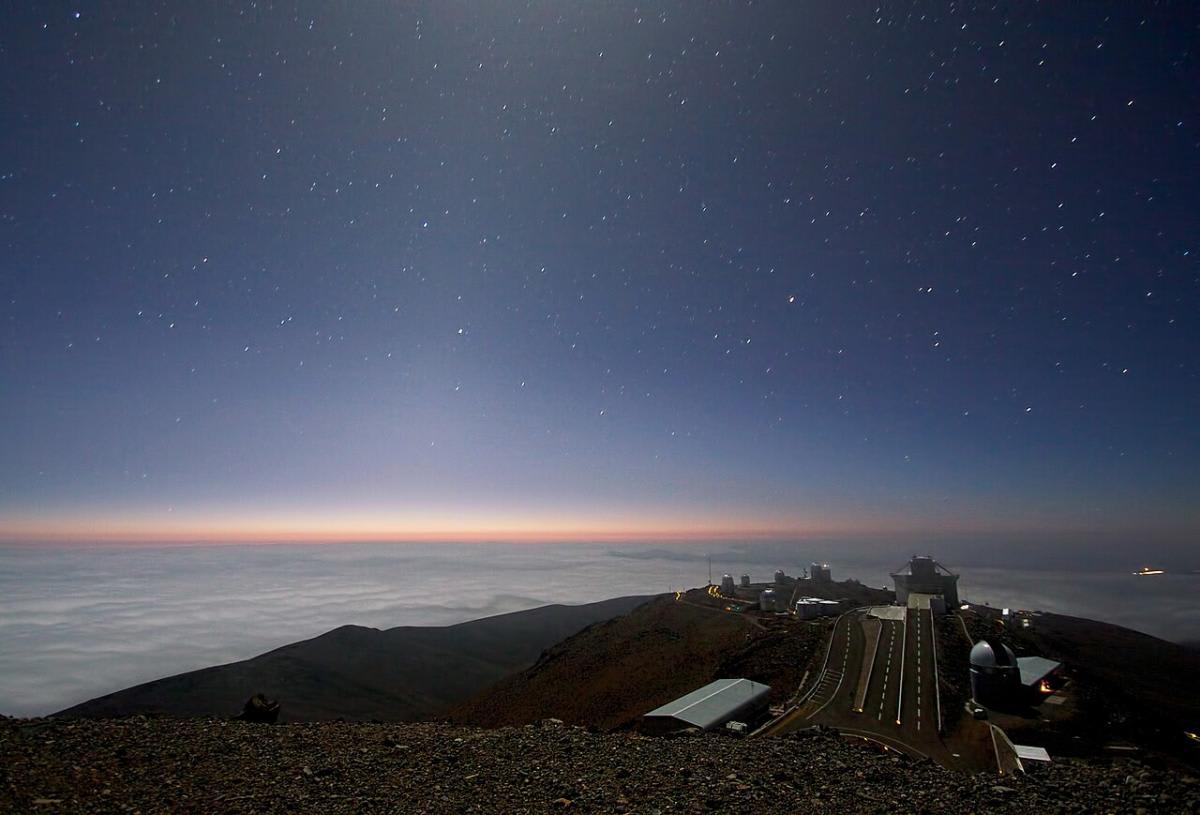
Moonlight and zodiacal light above La Silla Observatory.
Skiff advised opting for a clearer and less polluted sky to increase the chances of sightings. The mentions of "glowing beams" in ancient Greece and Rome and the “wings of the morning” in the Tanakh are believed to represent the zodiacal light. Astronomer Giovanni Domenico Cassini thought he'd discovered the phenomenon for the first time in 1683 and elaborately documented it in a report. “One of the rarest spectacles ever observed in the sky[:] A light similar to that which whitens the path of milk, but brighter in the middle and fainter towards the extremities, spread by the signs that the Sun must traverse in this season," he wrote of the sighting.
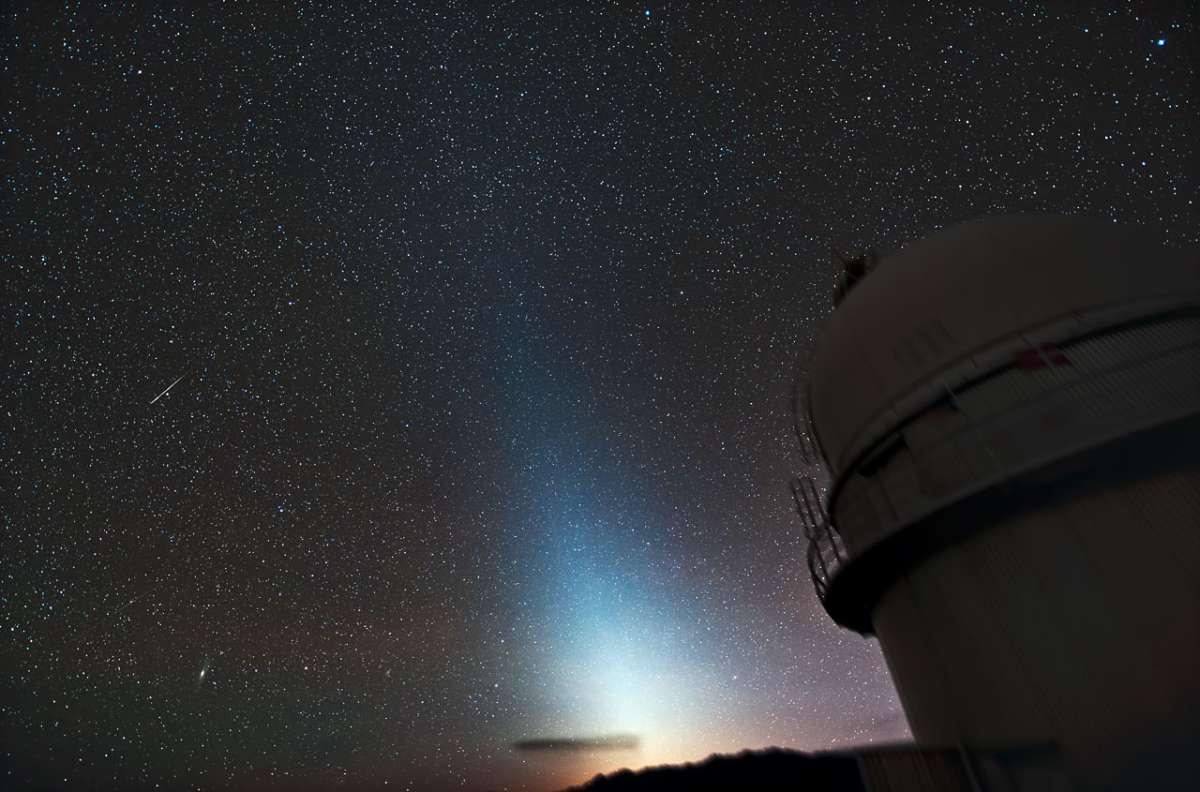
Zodiacal light at La Silla. (Image Source: Zdeněk Bardon (bardon.cz)/ESO)
What causes this band of vertical light to form? In 1684, mathematician Nicolas Fatio de Duillier proposed that the zodiacal light was formed as a result of sunlight reflecting off particles orbiting the Sun. This year, Skiff confirmed that de Duillier's explanation wasn't entirely off. But Skiff suggested the reflective particles be a cloud of interplanetary dust, “roughly the size of cigarette smoke particles,” roaming within the inner Solar System between Mercury and Jupiter. However, there's still uncertainty around the origin of the hypothesized cloud of interplanetary dust. Asteroid collisions were suspected of causing the dust cloud, but due to certain loopholes, the theory was ruled out. In 2010, experts narrowed down on the most likely source of the interplanetary dust cloud: comets passing through the solar system.
The theory was confirmed by various NASA missions until another 2020 discovery bowled the scientists over: some of the dust appeared to originate from Mars. “We thought, ‘Something is really wrong,’” said John Leif Jørgensen, a professor at the Technical University of Denmark who accidentally discovered while trying to track the path of NASA’s Juno spacecraft. “The images looked like someone was shaking a dusty tablecloth out their window," he added.
Cover Image Source: TripOfALifestyle.com