
Utah Park’s Rare Waterfall Has Appeared Only Thrice in 15 Years. It’s Now Visible Again, But Not For Long
Published March 16 2026, 4:06 a.m. ET

Cascades of foamy water flowing in the rare Gunlock Falls in Southwestern Utah.
Roaring cascades of foamy white water are flowing through the undulating curves of rugged valleys carved in red stone. Winding chutes of a liberated reservoir are rushing down the slopes to collect at the bottom in pools of crimson. The dry, hot desertscape, which would have been invaded by hissing lizards and sprays of scarlet monkeyflowers, has undergone a dramatic transformation with the burst of this rare waterfall in Gunlock State Park, tucked in southwestern Utah.
About 20 miles northwest of St. George, the melodic burbles of this waterfall can be heard, along with the oohs and aahs of humans watching it. Left in awe, hundreds of visitors are sharing clips and photos of this rare spectacle on social media. Meteorologist Matthew Johnson (@ksl_matt) says this is only the “9th time in the last 30 years Gunlock Falls is FLOWING!” All thanks to the delicious alignment of snowpack and rain. Experts are urging locals to put this on their bingo cards and “better hurry” because the falls may not last the entire spring.
“Right now has become a busy time,” Northwest Fire and Rescue Chief Charley Guthrie told KSL. “The falls are running...which is absolutely a beautiful thing.” This is only the fourth time the rare waterfall has appeared in the last 15 years, according to Men's Journal.The cause of this rare occurrence is attributed to the reservoir that sits atop the Santa Clara River, which feeds both the waterfall and the surrounding water treatment supplies. Johnson predicted in a February post that this could happen, given that the reservoir went from 24% to 104% capacity in just four months.
The mystery behind the overflowing reservoir lies in the rains. From October to January, massive torrents of rain hit Gunlock and pushed the reservoir beyond the emergency spillway banks, triggering this waterfall. Precipitation and snowmelt from surrounding mountains, including the Bull Valley and Pine Valley Mountains, further fed this spillage. With headwaters of the Santa Clara River feeding this reservoir, the reservoir rose a whopping 75-80 feet in a couple of months.
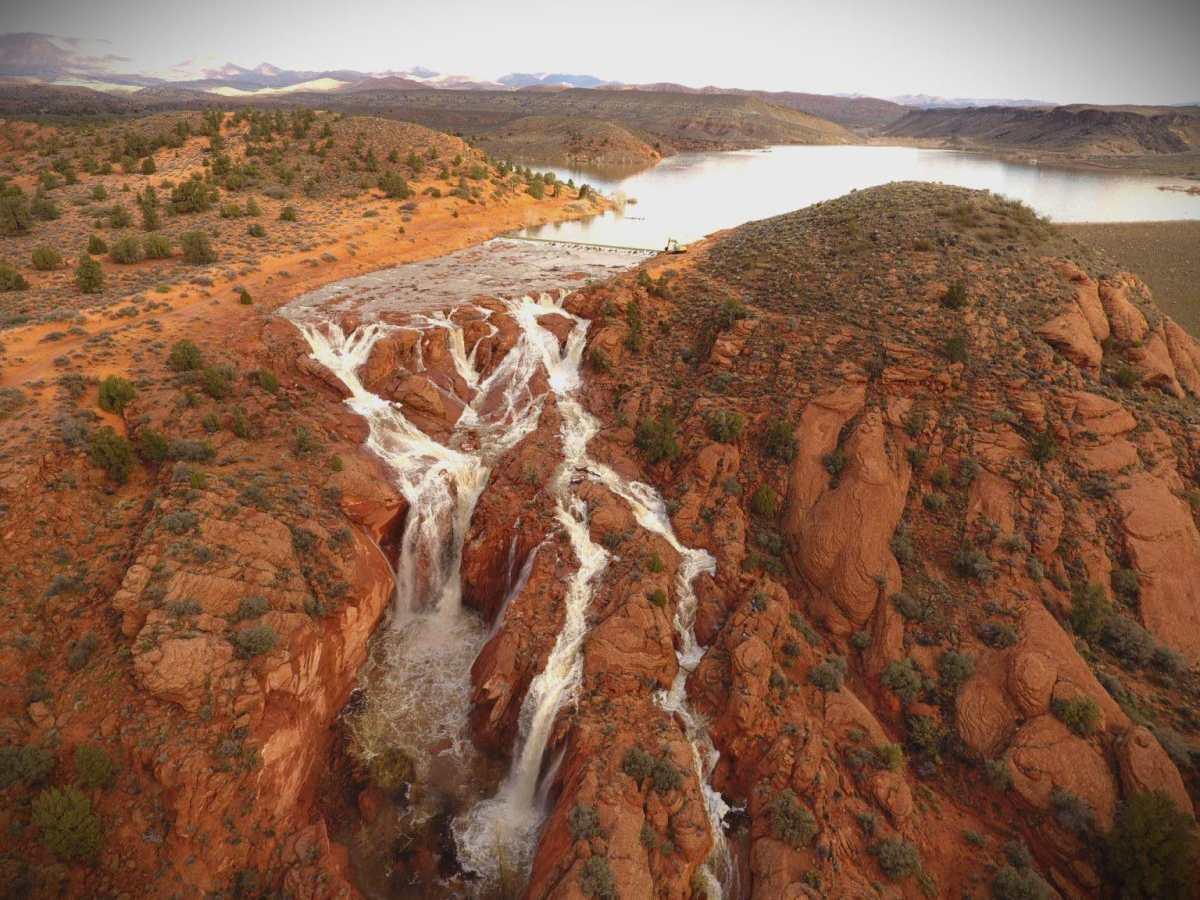
Sculpted by rugged formations of red sandstone, the Gunlock Dam stores water from the Santa Clara River.
Another factor was, probably, that there wasn’t sufficient vegetation to hold the water of the reservoir, so it tumbled downwards and started flowing, according to Zach Renstrom, the Washington County Water Conservancy District general manager, per the Salt Lake Tribune (SLT). The Forsyth Fire, which charred up the nearby Pine Valley last June, also stripped away the vegetation and shrubs from the surrounding steep mountain slopes, creating conditions for the waterfall.
Amidst this influx of wild waters, experts are urging visitors to remain cautious. The seemingly enchanting sight could turn into a horror movie, as the inundation can make the slopes slippery and the red rocks slick. As Guthrie pointed out, it’s a “bittersweet” experience. “We love it, but we get a lot of people, and we can get some injuries out here that can be kind of problematic,” he said. According to SLT, two women visitors were reported to have slipped while hiking the falls. One of them had to be taken to the hospital.
Additionally, Guthrie advises people to wear their shoes wisely, as inappropriate footwear can cause them to twist their ankles while navigating the falls. And, lastly, don’t jump the falls, experts say. The rock, Guthrie said, is not called “slickrock” for no reason. “If it gets wet, it gets really, really slick," he said. As for the water supply, Renstrom admitted that while the waterfall might cause some disruptions, "we will have reliable drinking water this summer," he said. “Water is water, and we will take it,” said Johnson.