
What Did NASA’s Voyager 1 Discover, and Is It Still Transmitting 50 Years Later?
Voyager 1 launched in September 1977.

Published Dec. 11 2025, 8:48 a.m. ET

Though the National Aeronautics and Space Administration (NASA) Voyager 1 and Voyager 2 Twitter accounts have been archived since Summer 2025, the decades-old spacecrafts have made history with each successive day they remain in operation. Any time NASA missions and projects reveal stunning discoveries, our global knowledge base collectively grows as we admire these groundbreaking findings.
Many are wondering about what Voyager 1 has discovered, and if it is still transmitting data.
If you have not followed the history of the Voyager 1 spacecraft, buckle in, because you are in for a fascinating journey through time and space. Below, we report on what Voyager 1 has discovered during its time in space, if it is still transmitting data, and if it is scheduled to end its mission any time soon.
Continue reading to learn all about Voyager 1 so that you can foster an appreciation for this remarkably amazing spacecraft.
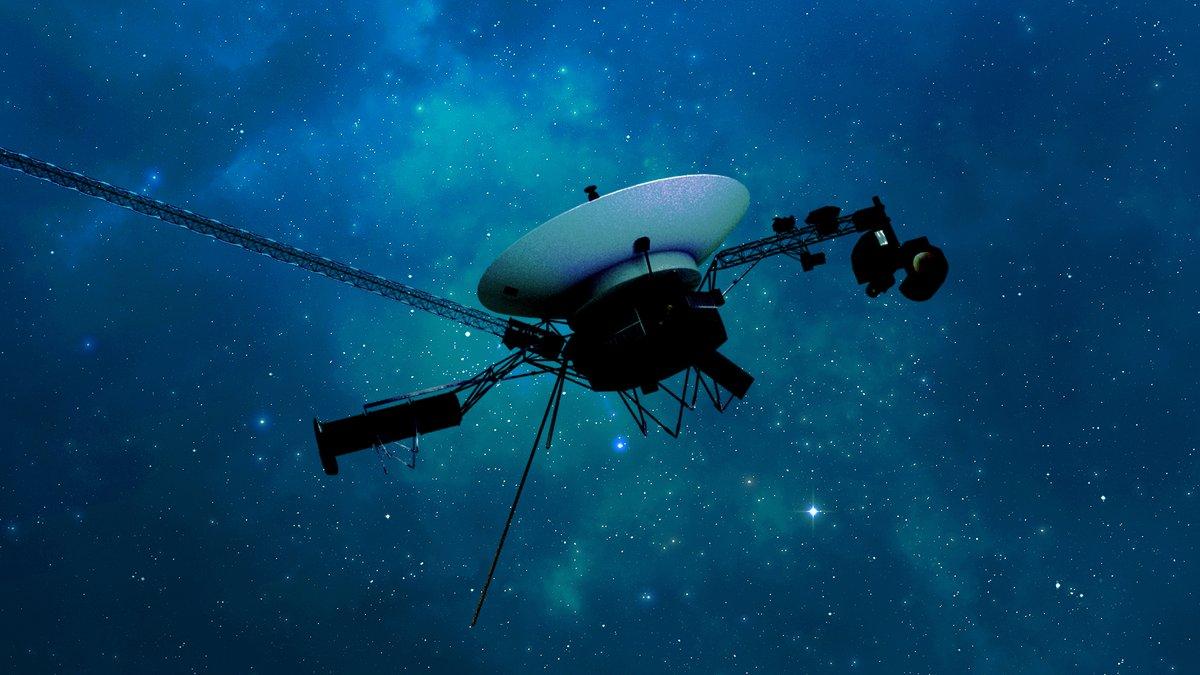
What did Voyager 1 discover?
According to NASA's Voyager 1 mission webpage, Voyager 1 actually launched after Voyager 2 on Sept. 5, 1977, but eventually overtook its twin spacecraft by Dec. 15 of that year. By April 1978, Voyager 1 was "studying" the planet Jupiter, taking pictures of the planet every 96 seconds to create a movie.
By 1979, Voyager 1 discovered a ring system around Jupiter, as well as many of Jupiter's moons.
"Spectacular close-up photos of the moons opened up completely new worlds for planetary scientists. The spacecraft discovered two new moons, Thebe and Metis," according to the NASA webpage.
By November 1980, Voyager 1 made its closest approach to the planet Saturn. During its flyby of Saturn, Voyager 1 discovered an astounding five new moons, as well as a new ring and ring structures.
Voyager 1 took photos of several of Saturn's moons, including Titan.
"Images of Titan showed a thick atmosphere that completely hid the surface," per the NASA webpage. "The spacecraft found that the Titan’s atmosphere was composed of 90% nitrogen. Nitrogen, methane, and more complex hydrocarbons indicated prebiotic chemical reactions might be possible on Titan."
A "solar system family portrait" in 1990 — the first of its kind — proved to be the final 64 images ever photographed by Voyager 1, which "inspired the 'Pale Blue Dot' made famous by Voyager science team member Carl Sagan."
Is Voyager 1 still transmitting?
Yes, Voyager 1 is still in operation. As NASA explains, "Voyager 1 continues to communicate with NASA’s Deep Space Network and send data back from four still-functioning instruments — the cosmic ray telescope, the low-energy charged particles experiment, the magnetometer, and the plasma waves experiment."
As CNN reported, once the calendar hits November 2026, Voyager 1 will be one light-day from Earth, which is the equivalent of 16 billion miles.
In other words, "If I send a command and say, ‘good morning, Voyager 1,’ at 8 a.m. on a Monday morning, I’m going to get Voyager 1’s response back to me on Wednesday morning at approximately 8 a.m.,” Suzy Dodd, the Voyager project manager at NASA’s Jet Propulsion Laboratory, told CNN.
When will Voyager 1 die?
It's a natural question to ask, given Voyager 1's remarkable run of almost 50 years in operation. According to NASA's frequently asked questions page, "Engineers expect to begin turning off fields and particles science instruments one by one, starting in 2020 for Voyager 2...Engineers expect each spacecraft to continue operating at least one science instrument until around 2025."
Additionally, as the Voyager spacecrafts lose power over time, NASA asserts that "The two Voyager spacecraft could remain in the range of the Deep Space Network through about 2036, depending on how much power the spacecraft still have to transmit a signal back to Earth."