
NASA Detected a Black Hole Devouring a Star — and the Explosion Was Record-Breaking
Published Dec. 9 2025, 9:24 a.m. ET

Animation illustrating a proposed explanation for the origin of GRB 250702B.
More than 100 million light-years away from Earth, a monstrous black hole turned ravenous this summer. It ended up gulping down a star. This feeding event was so intense that it lasted for at least seven hours, the longest ever recorded. NASA scientists didn’t even have a high-energy monitor that could record the whole event, which they named GRB 250702B. The footage of the event shows this supermassive black hole feasting on a star until its sparkle is shredded and reduced to a mere wisp of gas. All the while, it ejected enormous jets of dazzling gamma rays that created shooting showers of glitter in the dark space. Scientists documented the event on the arXiv server.
Discovered on July 2, the record-setting cosmic outburst was actually a gamma-ray burst (GRB), the most powerful class of cosmic explosions, according to NASA. While most explosions last for a few hours, this one lasted way longer than any of the earlier events. The event was detected with the help of multiple NASA spacecraft, including the Gamma-ray Burst Monitor, Burst Alert Telescope, Russian Konus instrument on NASA’s Wind mission, and Neutron Spectrometer on Psyche.
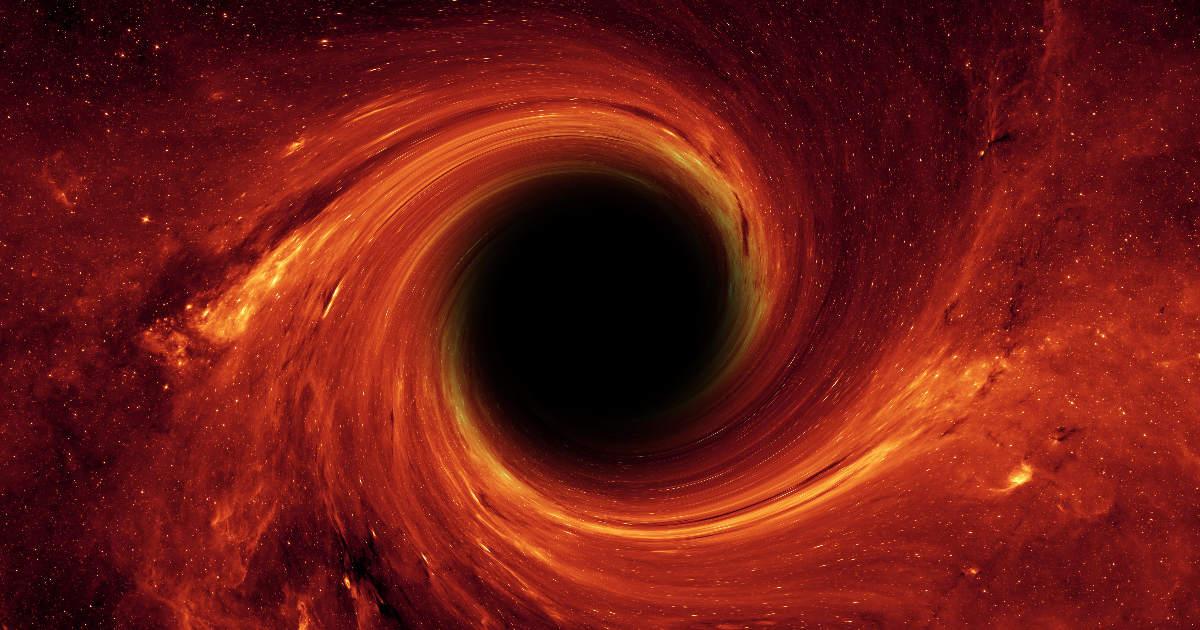
Black hole, nebula, and galaxy in deep outer space
The footage of the black hole eating the star opens with the camera zooming through a bluish space. A glowing blue-white star emerges from the clouds. The star appears to be possessed by some invisible force that’s pulling on its sparkly material. About 11 seconds into the video, the culprit emerges. A super-hungry black hole, with its bluish accretion disk. The glittering gassy material being pulled from the star explodes towards the black hole’s disk. With clouds of gas erupting in every direction, the black hole spins erratically, flings around the star in its orbit, and soon traps it inside. The starry victim gets surrounded by a wispy disk of bluish-white gas. Instead of gulping it down, the black hole disintegrates it until there’s no sign of the star that once was.
As the star dies inside the mouth of the black hole, it emits a striking jet of light in colors of magenta, purple, blue, and white. The center of the black hole’s disk emits a pearly white glow while the light jet shoots upwards like liquid electricity. Eventually, the black hole’s disk magnifies and fills up the screen in a blinding flash.
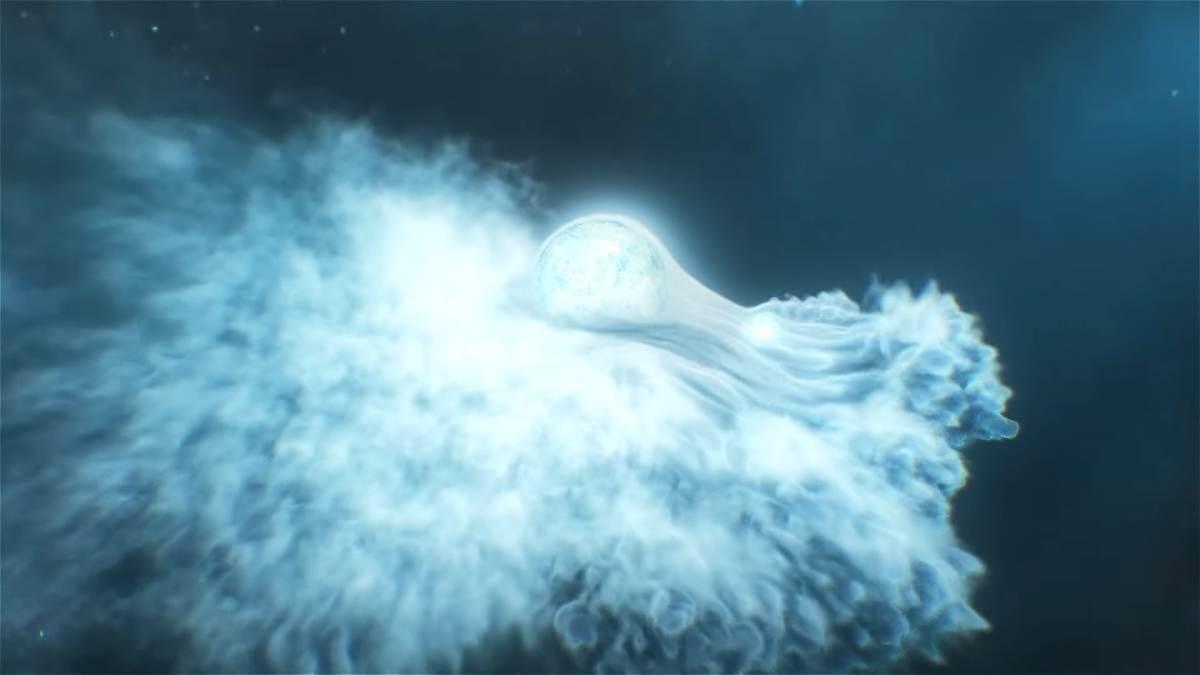
Animation illustrating a proposed explanation for the origin of GRB 250702B.
In general, GRBs happen when either two city-sized neutron stars merge or when a massive star collapses after running out of fuel. A report by SYFY calls it the “helium merger model.” Researchers speculated that this ultra-powerful explosion of energy didn’t happen where most gamma-ray explosions do, at the centers of galaxies. This explosion occurred outside the galactic center. The star that got eaten up was likely part of a binary system. While the other star in the system was already swallowed up by the black hole, this one couldn’t resist getting pulled close to it. The star was aging.
Each event produces a new black hole. Humongous bursts of energy launched from the feeding activity are channeled into jets of particles that stream out at speeds similar to or greater than that of light. In this case, the jets have unlocked a new book of puzzles for scientists. Observations from this record-breaking release have revealed that the winds blasting from the event resemble the Sun’s coronal mass ejections (CMEs) or solar flares. “This is certainly an outburst unlike any other we’ve seen in the past 50 years,” Eliza Neights at George Washington University said, “The initial wave of gamma rays lasted at least 7 hours, nearly twice the duration of the longest GRB seen previously, and we detected other unusual properties," Neights added.
You can watch the video here.