
Colossal Foundation: $100 Million Fueling a Biotech Revolution to Save Life on Earth
The numbers are terrifying: Global wildlife populations have dropped by nearly 70%.

Published Dec. 17 2025, 3:54 p.m. ET

Our climate crisis is a runaway train, with the accelerating loss of biodiversity as the freight car carrying endangered species over the cliff. For decades, the environmental movement has fought this decline with passion, policy, and protection. But now, in a critical admission that these noble methods alone are no longer enough, a powerful new player armed with unprecedented capital and sometimes controversial technology has entered the fray.
The Colossal Foundation, the nonprofit arm of the biotech company pursuing de-extinction, Colossal Biosciences, has just secured an additional $50 million in funding. This surge brings their total resources in just over a year to a formidable $100 million, declaring a high-tech war on extinction—not in some distant future, but right now.

The numbers are terrifying: Global wildlife populations have dropped by nearly 70%. Ecosystems are unraveling. Extinction rates are more than 100 times the natural background level. The conventional conservation sector, though fiercely dedicated, is fundamentally underfunded. The Foundation argues that this ecological crisis requires more than just traditional habitat preservation; it demands a radical expansion of the conservation toolkit. They are deploying the same frontier bioscience that allows for the theoretical resurrection of extinct species to instead serve as a rapid, resilient genetic safety net for those still struggling to survive.
As Executive Director of the Colossal Foundation Matt James puts it: “Traditional conservation remains essential but is no longer sufficient on its own. With wildlife populations plummeting and ecosystems unraveling, relying solely on conventional methods is unsustainable. We at the Colossal Foundation have found emerging tools that expand the conservation toolkit, increasing resilience, restoring lost functions, and preventing future extinctions. This new funding allows us to expand the conservation toolkit and embrace science and technology not as replacements for nature, but as instruments to help recover it. We are at a critical moment that demands seeing de-extinction and breakthrough biotechnologies not as fringe concepts, but as frontline strategies in the fight for biodiversity.”
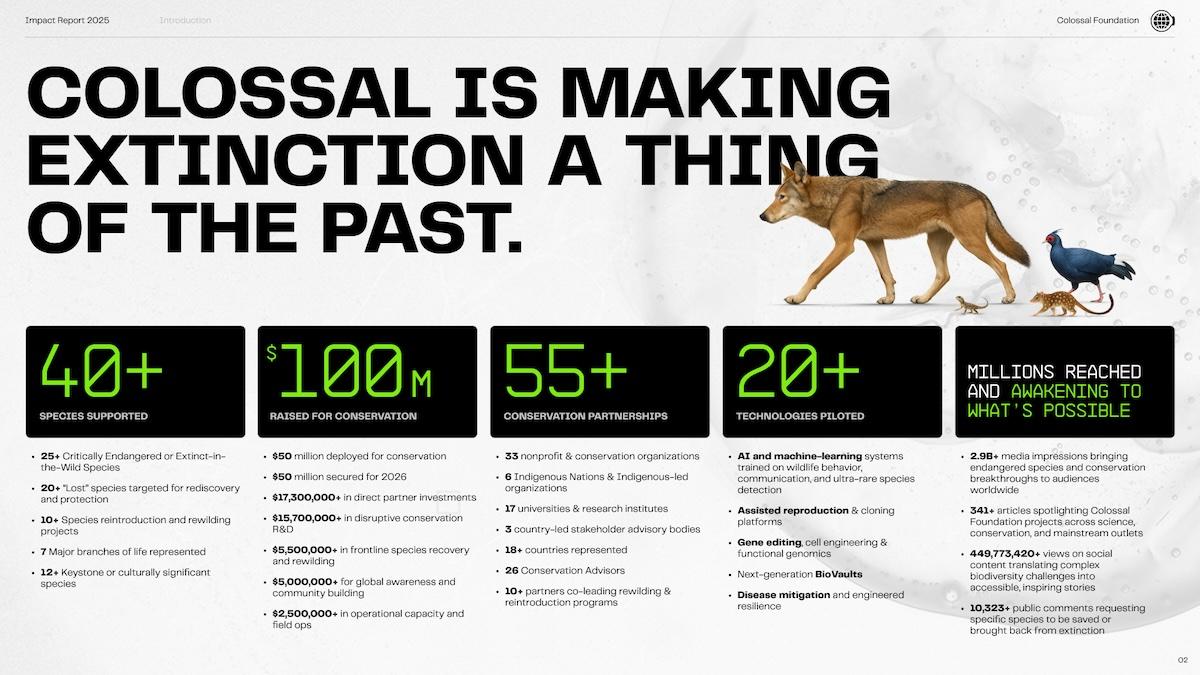
Colossal’s approach is a stark departure from the familiar image of boots-on-the-ground activism. It is an investment in genetic rescue and engineered resilience—intervening directly at the molecular level to stabilize populations and ward off new threats.
Their work, now scaled by the $100 million, touches every corner of the globe and covers a wide array of high-tech programs:
- Genetic Firefighting: For the critically endangered Red Wolf, which suffers from severe inbreeding, the Foundation achieved a major breakthrough. They cloned the world’s first “ghost” red wolves, using genetic material from deceased individuals to reintroduce desperately needed diversity into the gene pool. This is the ultimate genetic lifeboat.
- Vaccines for Wildlife: They are accelerating the development of the world’s first mRNA vaccine to protect elephants from the devastating EEHV virus, which is responsible for the majority of juvenile elephant deaths.
- Biological Armor: The Foundation is actively using genetic approaches to create new resilience against invasive species and diseases. This includes engineering amphibians to resist the deadly Chytrid fungus—a scourge that has decimated frog populations worldwide—and helping Australia's threatened Quolls develop resistance to the lethal toxins of the invasive Cane Toad.
- AI Listening Posts: Conservation must be smart. In Yellowstone, they are using AI-enabled bioacoustic sensors to monitor and decode wolf howls, creating next-generation, non-invasive wildlife tracking and monitoring systems.
Colossal CEO Ben Lamm’s message is one of urgency: “In just 12 months, we’ve doubled the Colossal Foundation’s funding, allowing us to massively expand our partners and projects—and deliver immediate impact for conservation. As our technology advances, our role is clear: move these tools into the hands of those on the front lines of biodiversity loss, and scale conservation innovation fast enough to matter.”
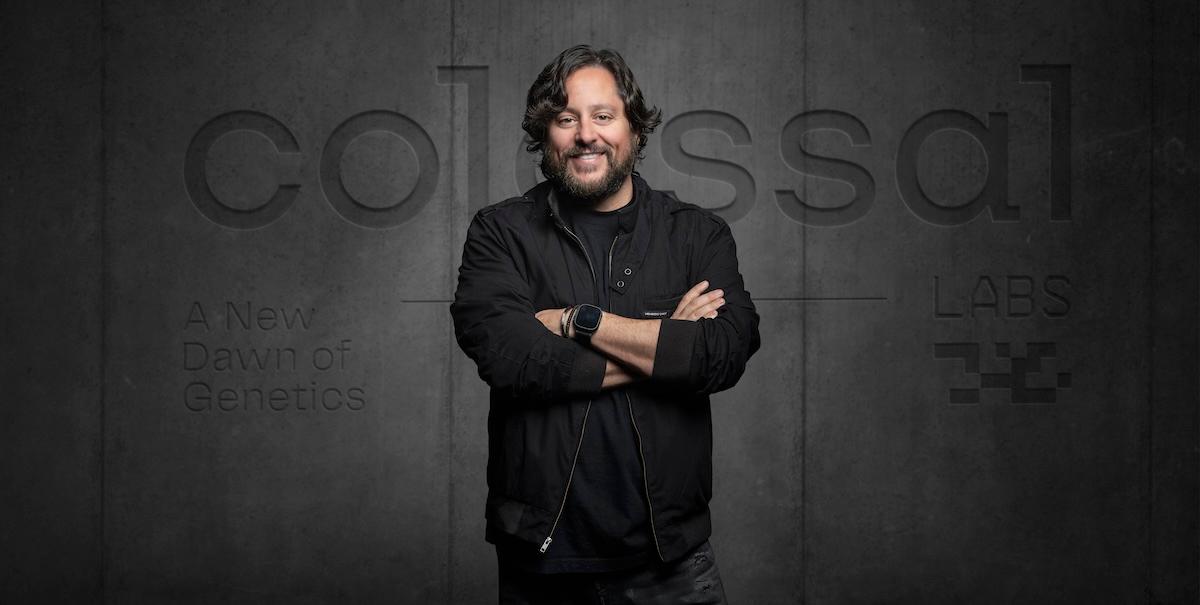
Colossal CEO Ben Lamm
By acquiring and integrating the cloning and biobanking expertise of ViaGen, the Foundation is showing it intends to be a permanent, scalable force. “No other company comes close to what Viagen has achieved,” said Lamm. Their unmatched expertise and cloning technology stack have become the world’s standard, and their application of these critical, proprietary technologies to endangered species conservation makes them an invaluable partner in advancing our global de-extinction and species preservation mission.”
The message is clear: the moment demands seeing these biotechnologies not as futuristic novelties, but as essential, frontline strategies in the fight for a healthy, resilient planet. The $100 million signal is unmistakable: the battle for life on Earth has just entered a new, high-tech chapter, and the environmental movement must now determine how to incorporate this powerful, complex toolset into its vision for a sustainable future.