
NASA's Hubble Offers New Clues That May Finally Explain Betelgeuse's Strange Behavior
Published Jan. 7 2026, 7:26 a.m. ET

An artist’s concept shows the red supergiant star Betelgeuse and an orbiting companion star. (Cover Image Source: NASA, ESA, Elizabeth Wheatley (STScI); Science: Andrea Dupree (CfA))
Something strange happened that made scientists question the influence of companion star Siwarha on Betelgeuse's surrounding gas. Observations from NASA’s Hubble Space Telescope and other ground-based observatories helped scientists of the Center for Astrophysics | Harvard & Smithsonian (CfA) study the changes around Betelgeuse, as per the agency. The result showed that the tiny companion star indeed influences the surroundings of Betelgeuse. Although the companion star was suspected to be around the giant red star, it was never fully accepted before. But in the recent observation, when researchers found a streak of gas in the atmosphere of the giant star, they hinted that it was due to the "wake" of the Siwarha, the companion star. For years, scientists were dumbfounded by the unusual changes in the brightness of Betelgeuse.
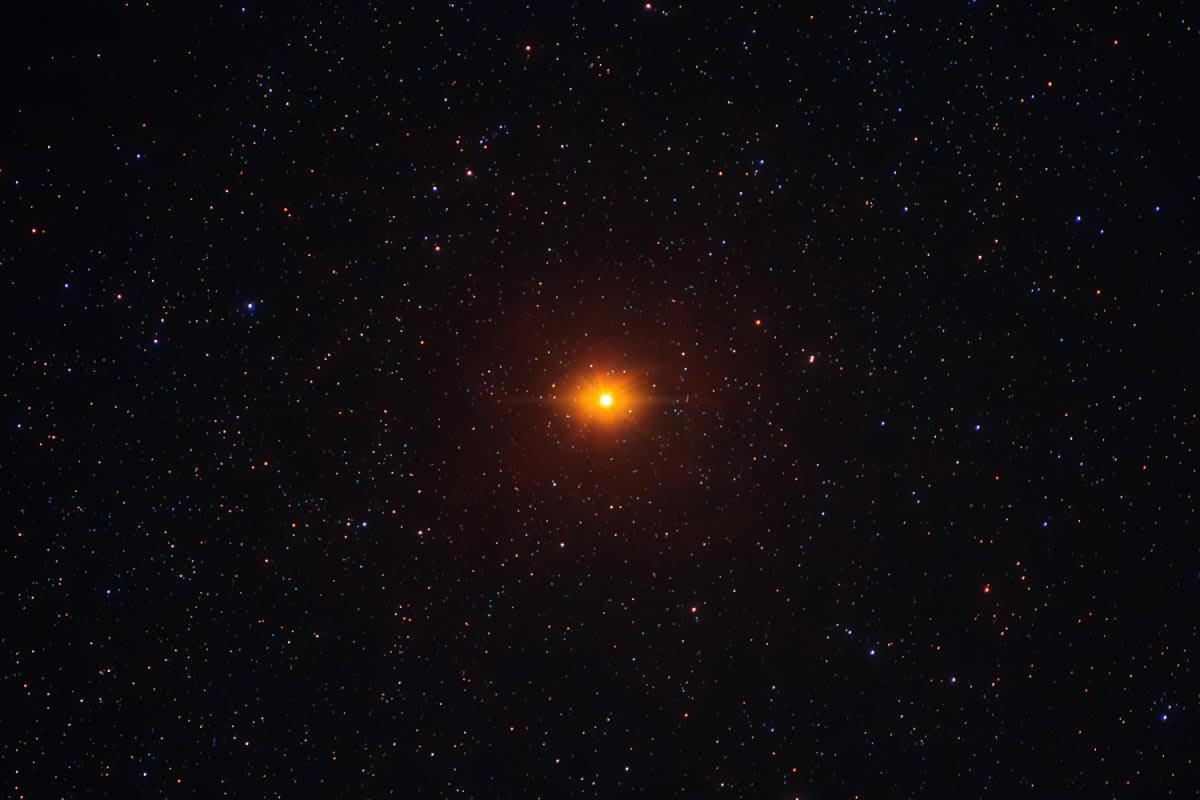
Betelgeuse, a red supergiant star shining in the night sky.
The detection of the gas streak around Betelgeuse and its extended atmosphere finally explained why the giant star's brightness varied non-uniformly. Scientists detected the "wake" of the Siwarha by carefully analyzing the changing brightness of the star in the last 8 years. "These changes show the effects of the previously unconfirmed companion as it plows through the outer atmosphere of Betelgeuse," says NASA. "This discovery resolves one of the biggest mysteries about the giant star, helping scientists to explain how it behaves and evolves while opening new doors to understanding other massive stars nearing the end of their lives," the agency added. The stunningly large Betelgeuse sits quite far from the Earth, about 650 light-years away in the Orion constellation. Despite being so far, the star and its surrounding atmosphere can be observed by astronomers.
It's one of the very few distant stars that are accessible for research on Earth because of their giant size. The supergiant star is so huge that it can accumulate about 400 million Suns inside it. That's why any new observation related to Betelgeuse is key to understanding other distant stars that are not large enough to be directly observed. NASA’s Hubble and ground-based telescopes at the Fred Lawrence Whipple Observatory and Roque de Los Muchachos Observatory helped a team of researchers not only detect Betelgeuse's behavior but also confirm the existence of a long-suspected companion star. They observed major changes in the star's spectrum, the speed, and direction of the gases. These changes could have occurred either by the "wake" of Siwarha or the denser gas trail that was detected in the atmosphere.
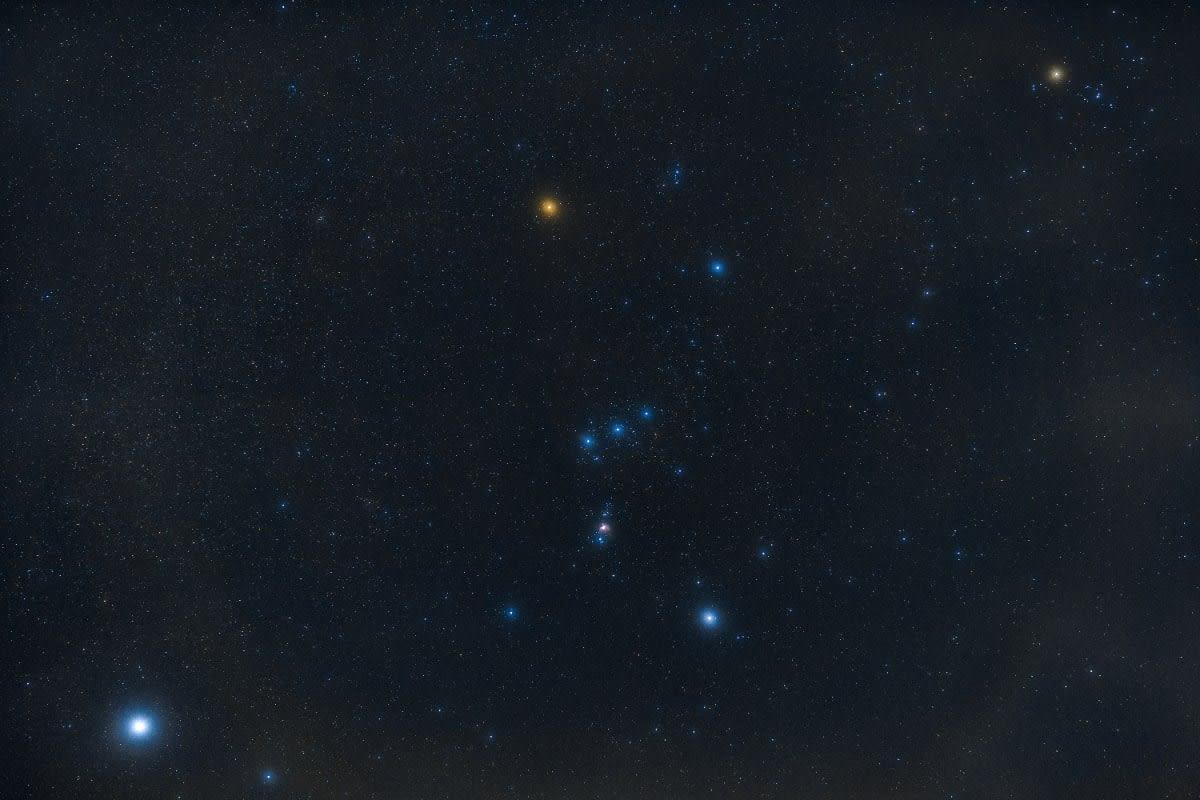
Betelgeuse star visible in the Orion Constellation, photographed from Mannheim in Germany.
The team revealed that the dense gas trail appeared after the companion star crossed from ahead of the supergiant star every six years. “It’s a bit like a boat moving through water. The companion star creates a ripple effect in Betelgeuse’s atmosphere that we can actually see in the data,” said Andrea Dupree, an astronomer at the CfA, and the lead study author. “For the first time, we’re seeing direct signs of this wake, or trail of gas, confirming that Betelgeuse really does have a hidden companion shaping its appearance and behavior," she added. The discovery solved the mystery of Betelgeuse's unusual behavior and found proof of the suspected companion star.
“The idea that Betelgeuse had an undetected companion has been gaining in popularity for the past several years, but without direct evidence, it was an unproven theory,” Dupree said, adding, “With this new direct evidence, Betelgeuse gives us a front-row seat to watch how a giant star changes over time." The study posted in arXiv has been accepted for publication in The Astrophysical Journal.