
Scientists Finally Observe a Black Hole Twisting Spacetime — Just as Einstein Once Predicted
Published Jan. 5 2026, 6:27 a.m. ET

(L) An illustration of a blackhole. (R) Two scientists observe an experiment. (Representative Cover Image Source: (L) Pixabay | AlexAntropov86, (R) Pexels | Pavel Danilyuk)
Scientists might have found the first direct evidence of Einstein's centuries-old prediction. According to his theory of relativity, rotating black holes can twist spacetime around them. In a new study, published in Science Advances, astronomers observed wobbles around a fast-spinning black hole. The phenomenon called Lense-Thirring precession, or frame-dragging, explains how a rotating black hole can pull nearby objects in, disrupt the paths of stars, make the gas in the space wobble, and cause a twist in the spacetime. The National Astronomical Observatories at the Chinese Academy of Sciences, along with the support of Cardiff University, conducted the research where they studied the AT2020afhd, a tidal disruption event (TDE) in which a star was destroyed by an active supermassive black hole.
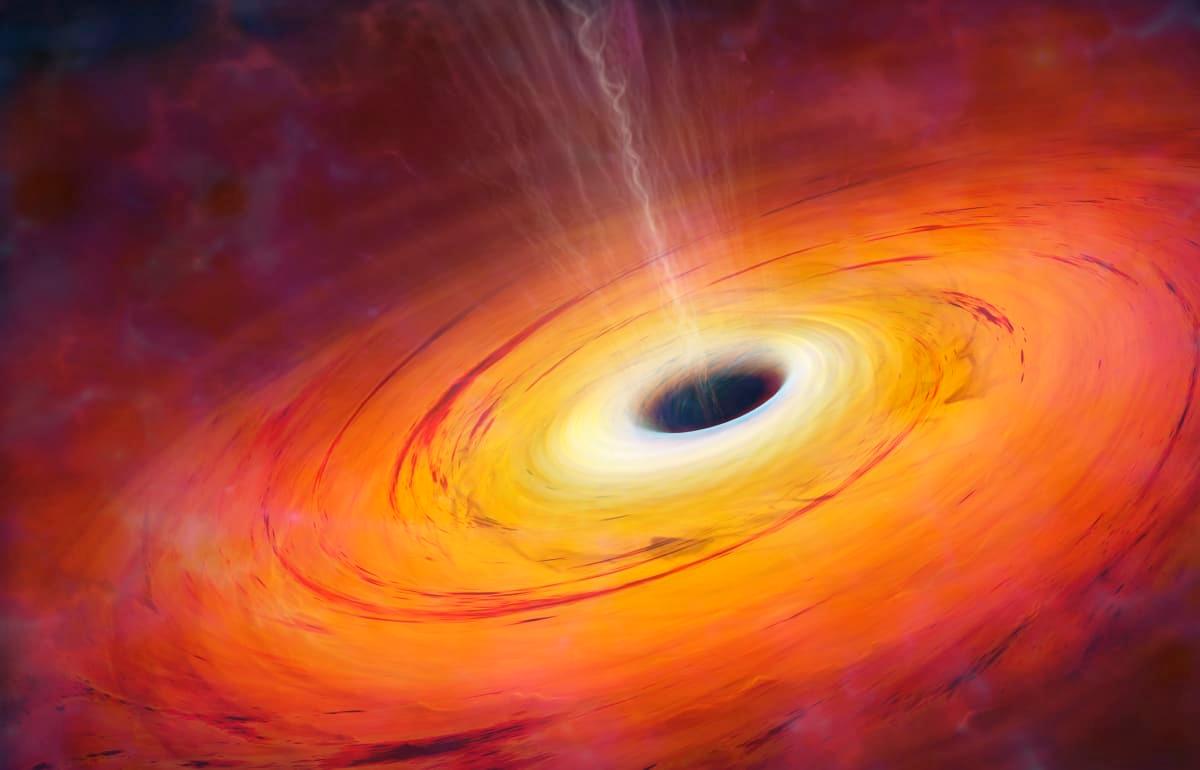
In the aftermath, the star debris collected on a fast-spinning disk around the black hole, which was simultaneously emitting jets almost at the speed of light. The researchers studied the X-ray and radio signals coming from the accelerating disk and the jets and observed that the patterns repeated after every 20 days, reflecting a wobble in the orientation of the disk and the jets. The wobble is believed to have occurred due to a twist in spacetime caused by the spinning black hole. So far, this is the strongest evidence yet for "disk-jet co-precession in the TDE AT2020afhd," which was predicted to be the consequence of spacetime drag near a spinning black hole. “This is the first time that disk-jet co-precession has been clearly observed in a black hole system, which is truly exciting,” said co-corresponding author Huang Yang, Associate Professor at the University of Chinese Academy of Sciences.
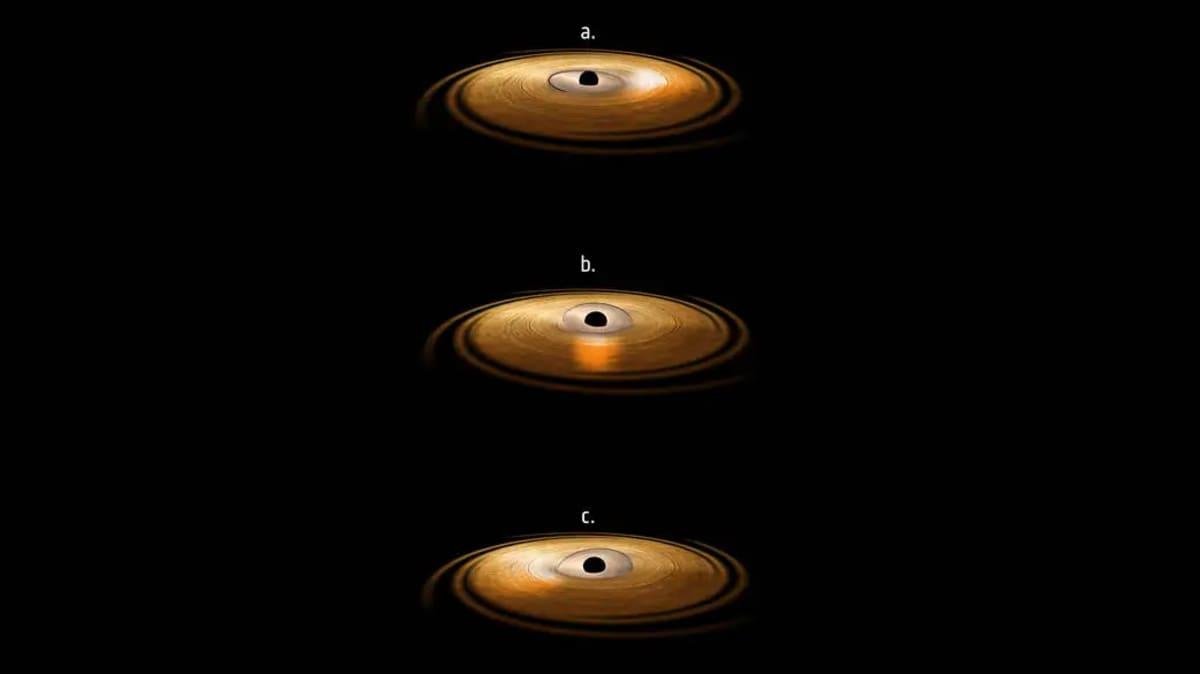
This artist's impression depicts the accretion disc surrounding a black hole, in which the inner region of the disc precesses. "Precession" means that the orbit of material surrounding the black hole changes orientation around the central object.
The disk and the jet spinning in a pattern that repeated every 20 days, mirrored something called a quasi-periodic oscillation. “Such cross-band, high-amplitude, quasi-periodic synchronous variability strongly indicates a rigid coupling between the accretion disk and the jet, precessing like a gyroscope around the black hole’s spin axis,” said Wang Yanan, the study's first author. Although this is the first ever evidence of the spacetime twist potentially caused by a black hole, Einstein had predicted it long ago. He proposed the idea in 1913, which was later mathematically explained by Lense and Thirring in 1918, as per a press release. The recent observation has confirmed the relativity prediction, leaving scientists curious to further explore the phenomenon.
Black hole, nebula, and galaxy in deep outer space
Dr. Cosimo Inserra, one of the paper’s co-authors, believes that the recent finding is the "most compelling" evidence yet of a Lense-Thirring precession. "A black hole dragging space time along with it in much the same way that a spinning top might drag the water around it in a whirlpool," the researcher added. Previous tidal disruption events showed steady radio signals in contrast to the signals of the AT2020afhd TDE, which constantly changed pattern after a short period. "This further confirmed the dragging effect in our minds and offers scientists a new method for probing black holes," Inserra said. This also explains why the energy release from the black hole didn't change despite it sending an unusual radio signal pattern.
"So, in the same way a charged object creates a magnetic field when it rotates, we’re seeing how a massive spinning object – in this case a black hole – generates a gravitomagnetic field that influences the motion of stars and other cosmic objects nearby," Inserra added.