
NASA's Hubble Finds 'Cloud-9' — the First Confirmed Detection of a Failed Galaxy
Published Jan. 6 2026, 2:30 a.m. ET

Image showing location of Cloud-9, 14 million light-years from Earth. (Cover Image Source: Science: NASA, ESA, VLA, Gagandeep Anand (STScI), Alejandro Benitez-Llambay (University of Milano-Bicocca); Image Processing: Joseph DePasquale (STScI))
NASA's Hubble Telescope captured something unusual and came up with an accurate nickname. The newly discovered astronomical object appeared to be a starless cloud containing gas and dark matter. The object, identified for the first time in the universe, that earned the nickname "Cloud-9," is believed to be a remnant of a galaxy. Scientists believe that discovering the "building block" of a galaxy might prove insightful about the origins of the early universe and the behavior of dark matter, according to findings published in The Astrophysical Journal Letters. “This is a tale of a failed galaxy. In science, we usually learn more from the failures than from the successes,” the program’s principal investigator, Alejandro Benitez-Llambay of the Milano-Bicocca University in Milan, said in a statement.
"In this case, seeing no stars is what proves the theory right. It tells us that we have found in the local universe a primordial building block of a galaxy that hasn't formed," Benitez-Llambay added. Andrew Fox of the Association of Universities for Research in Astronomy/Space Telescope Science Institute (AURA/STScI) for the European Space Agency, claimed that the "cloud is a window into the dark universe." While the existence of dark matter is well-known, there's still considerable research scope. The dark matter in space doesn't emit any light, making it hard to detect even through some of the most powerful telescopes. "Cloud-9 gives us a rare look at a dark-matter-dominated cloud," Fox added.
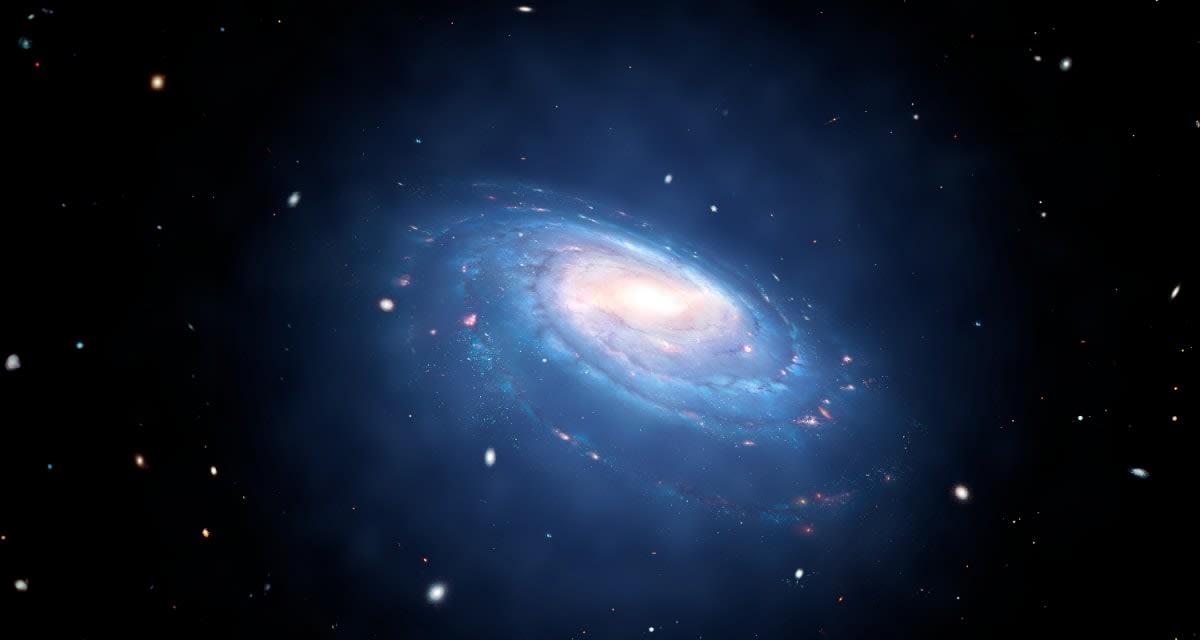
A dark matter halo surrounding a galaxy.
While "Cloud-9" is an easy-to-remember nickname, the object has officially been named Reionization-Limited H I Cloud, or "RELHIC.” According to the agency, it's an elusive relic from the early universe, and the "H I" in the name denotes neutral hydrogen. The failed galaxy is an isolated pocket of neutral hydrogen that couldn't support star formation. For years, the RELHIC model existed in theory until the researchers turned on the Hubble Telescope towards a starless cloud. “Before we used Hubble, you could argue that this is a faint dwarf galaxy that we could not see with ground-based telescopes," said study lead author Gagandeep Anand of STScI. "They just didn't go deep enough in sensitivity to uncover stars. But with Hubble’s Advanced Camera for Surveys, we're able to nail down that there's nothing there,” he added.
Low-angle view of a galaxy featuring a glowing epicenter, star clusters, and swirls of blue and red nebulae swirling around it
The discovery of RELHIC made researchers believe that there might be other such "failed galaxies" somewhere abandoned in space. Since the object doesn't have any stars, it seems to be an anomaly body which is dominated by dark matter and other similar substances, in contrast to the usual star-containing objects. The massive cloud of gas and dark components acts like a magnifying glass to dark matter that is difficult detect and study. Now, researchers could use "Cloud-9" as a reference to identify the known and possibly unknown dark components of the universe. The astronomical object was first discovered three years ago by the Five-hundred-meter Aperture Spherical Telescope (FAST) in Guizhou, China, as part of a radio survey. The Green Bank Telescope and the Very Large Array in the U.S. later confirmed the finding.
However, the researchers at the time couldn't definitively tell if the object really had no star at all. Thanks to the recent efforts through NASA's Hubble, they could finally confirm the finding. As for "Cloud-9," it could potentially grow bigger and form a galaxy in the future.