
Experts Are Finally Getting a Look at How the Universe Builds Its Most Common Planets
Published Jan. 9 2026, 6:46 a.m. ET

Artist's illustration of four baby planets in the V1298 Tau system
Formation of planets is a chaotic process, usually. Gigantic clouds of dust and gas collapse under their own gravity, birthing a star. All the scrap material that doesn’t go into the star’s body gathers around it in a disk. Over millions of years, the particles in this material start clumping together, first as tiny as pebbles, and ultimately as planets. From the tiniest of planets to ones bigger than our gas giant Jupiter, all planets follow this mechanism as they materialize. As they progress in age, the planets tend to grow or shrink depending on the forces exerted by the star they are orbiting.
In a study published in Nature, astronomers documented the discovery of a four-planet system around a star named V1298 Tauri (Tau). Still in its childhood, the planetary system reveals remarkable insights about how planets form and how they change during their lifetime.
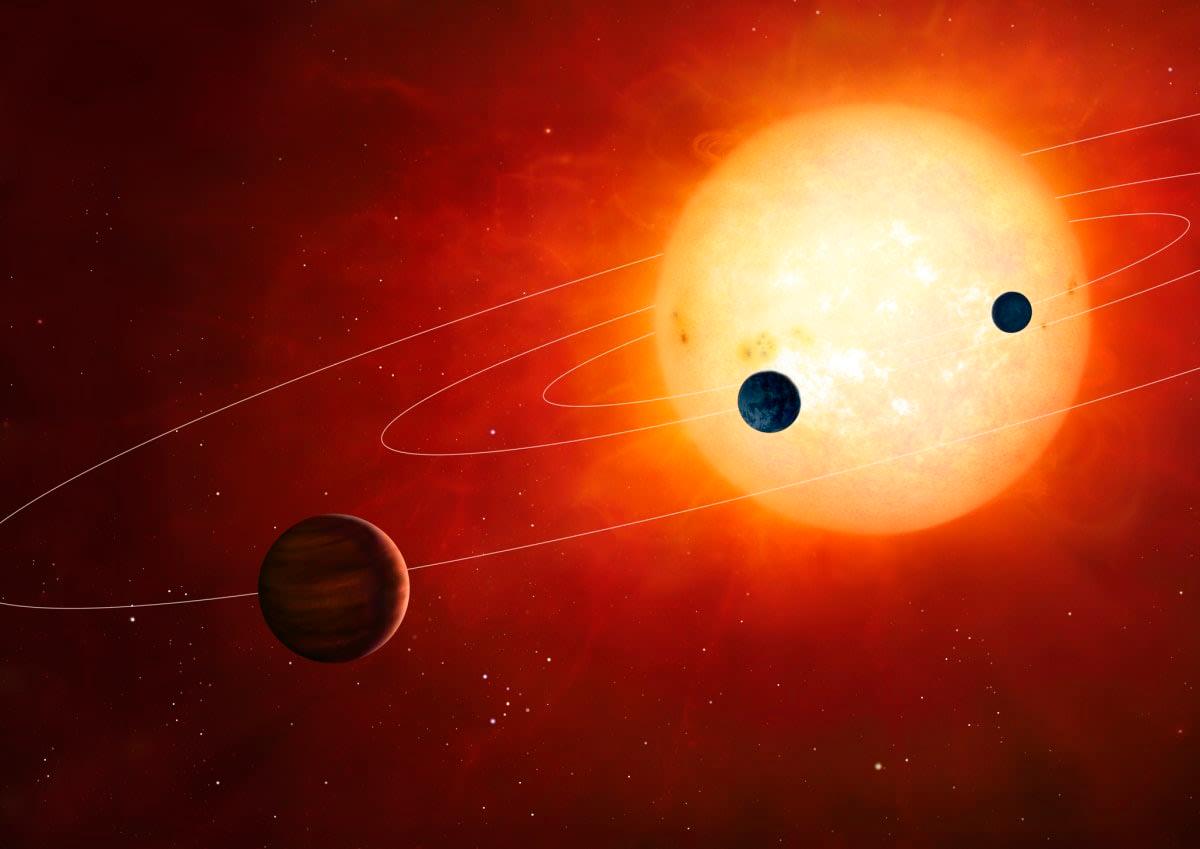
Artwork of a hypothetical planetary system around a sun-like star.
About 354 light-years away from Earth, this star, V1298 Tau, is young, only about 20 million years old. When UCLA astrophysicist Erik Petigura first spotted it in 2019, along with his fellows, he likened the Sun-like star to the “Lucy” fossil, our ancestor who lived 3 million years ago and was one of the “missing links” between apes and humans. V1298 Tau, too, is the missing link that unravels some interesting mysteries of the cosmos. The mystery lies in how the planets encircling it were formed and the clues they offer to their future transformations. The star, Petigura said, provides a “critical link between the star- and planet-forming nebulae we see all over the sky.”
The planets, they found, are unusually large for such a young star system, yet quite puffy, indicating a bulk of gas and dust. The team employed the Transit Timing Variations (TTV) technique to obtain insights into their organization. Between 2019 and 2024, they locked several space and ground-based telescopes to record the transit timing of the planets to determine a set of measurements and numbers that would provide them valuable information about the faraway planetary system.

Depiction of planets orbiting in a pool of stars and dark space
The transit timing is the timing of a planet to circle its star, briefly dimming its light. The telescopes targeting the planets take advantage of this brief interval to study the dynamics and the chemistry of the planets. In a multi-planetary system, as the planets bump into each other while circling, their gravity exerts push-and-pull forces, changing each other’s timings. By combining these telescope observations with computer models, the team whittled down two transits separated by several years. Another transit data arrived on Petiguara’s screen as a Slack message from Liverpool. “Hey, we got it from the ground!” He became excited. Then came a little bit of math work. While the transit timings revealed the radii of the planets and their orbit, the timings revealed their masses. The planets appeared to be puffy, like Styrofoam, with masses only five to 15 times the Earth's, while the radii were five to 10 times the Earth’s radius.
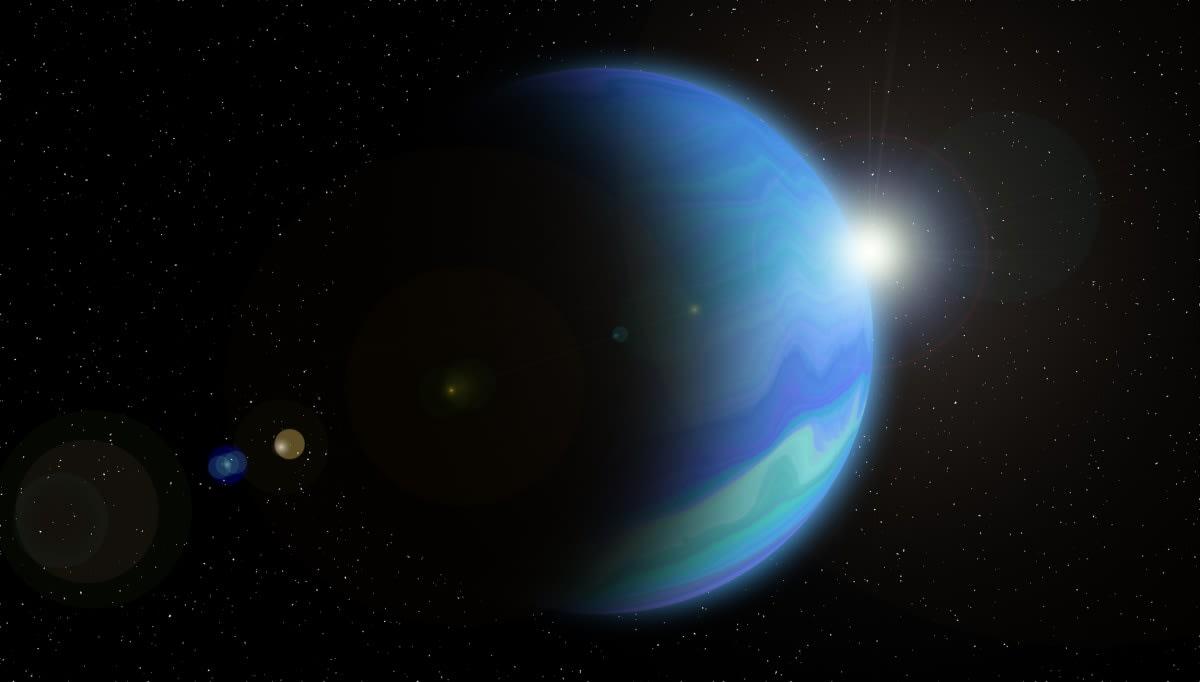
Neptune planet - the icy giant
Observations revealed that the formation of these planets was not a violent process, but rather a tranquil one, something that challenged the long-standing assumption that planet formation is a messy process. The four exoplanets are the precursors of super-Earths and Neptune-like planets, meaning they are likely to turn into planets that are larger than Earth but smaller than Neptune. Some of these planets will contract across the gap to form Super-Earths, and some will become super Neptunes.
This is an opportunity that scientists can’t miss, because they won’t find it in our solar system. For decades, scientists have felt frustrated because our Sun doesn’t host any super-Earth or sub-Neptune. So when their instruments detected V1298 Tau’s system, they had a rare chance to understand the evolutionary process of a new type of planetary system never studied before.