
Scientists See Black Hole Shred a 'Super Sun' in One of the Most Powerful Cosmic Events
Published Jan. 8 2026, 2:18 a.m. ET

Black hole eating a star. Elements of this image furnished by NASA.
About 1.1 billion light-years away from Earth, an unfortunate star strayed too close to a black hole and was ripped apart to death. While the star, a.k.a. “super Sun,” was 30 times the mass of the Sun, the giant was hundreds of millions of times the mass of the Sun. The ill-fated star might be playing around in space when its edges brushed against the boundary of the black hole. The black hole had found its next victim for the day’s "lunch," according to researchers. With enormous mass concentrated in its heart, the black hole yanked the star from its playground and tossed it inside its gravitational field.
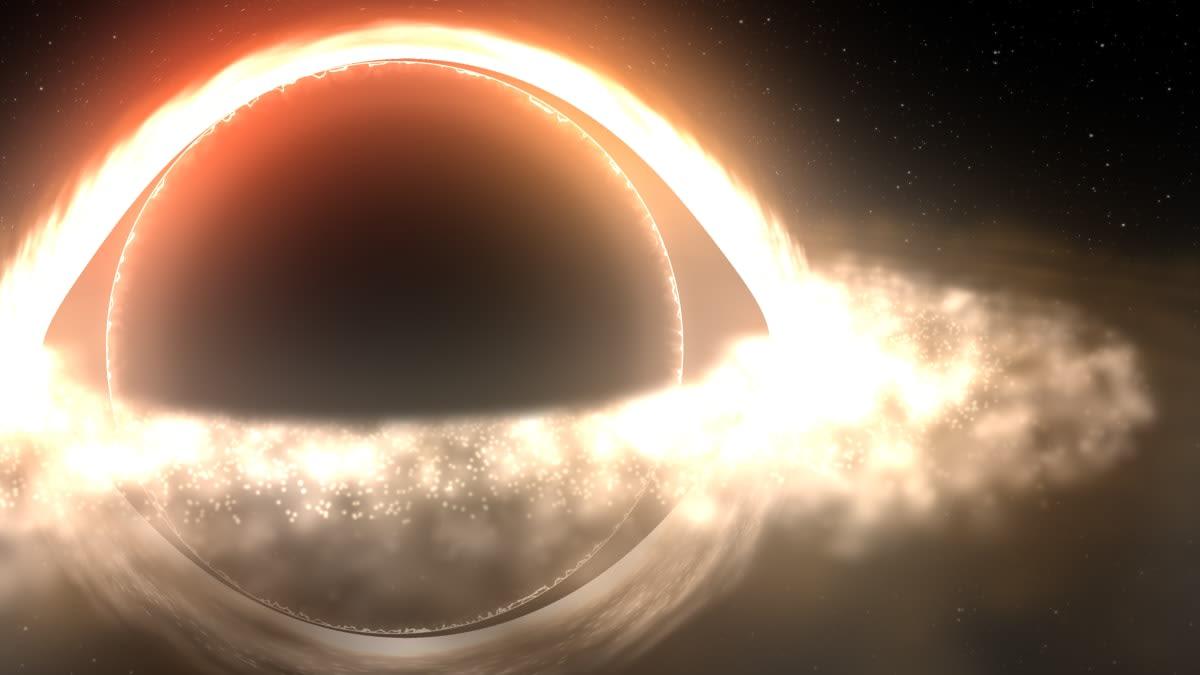
Black hole surrounded by a glowing accretion disk at its boundary
While the star whirlpooled like a puppet in the vortex of its tidal forces, the black hole started shredding it bit by bit, and ultimately devouring it up in its mouth. In a press report, Daniel Perley, an associate professor of Astrophysics from Liverpool John Moores University, said that this casual snack time of the black hole proved to be one of the most energetic cosmic events in history, depicting the destruction of a star. "It’s a rare and awe-inspiring phenomenon," he said.
Named AT2024wpp or Whippet, the event revealed itself through its light that was first detected at the Zwicky Transient Facility at Palomar Observatory in California. Apart from Perley, Anna Ho, an assistant professor of astronomy at Cornell University, investigated the event and recorded a wealth of details about it, which will be published in the Monthly Notices of the Royal Astronomical Society. Scientists announced the event at the American Astronomical Society’s annual meeting, happening between January 5 and 8.
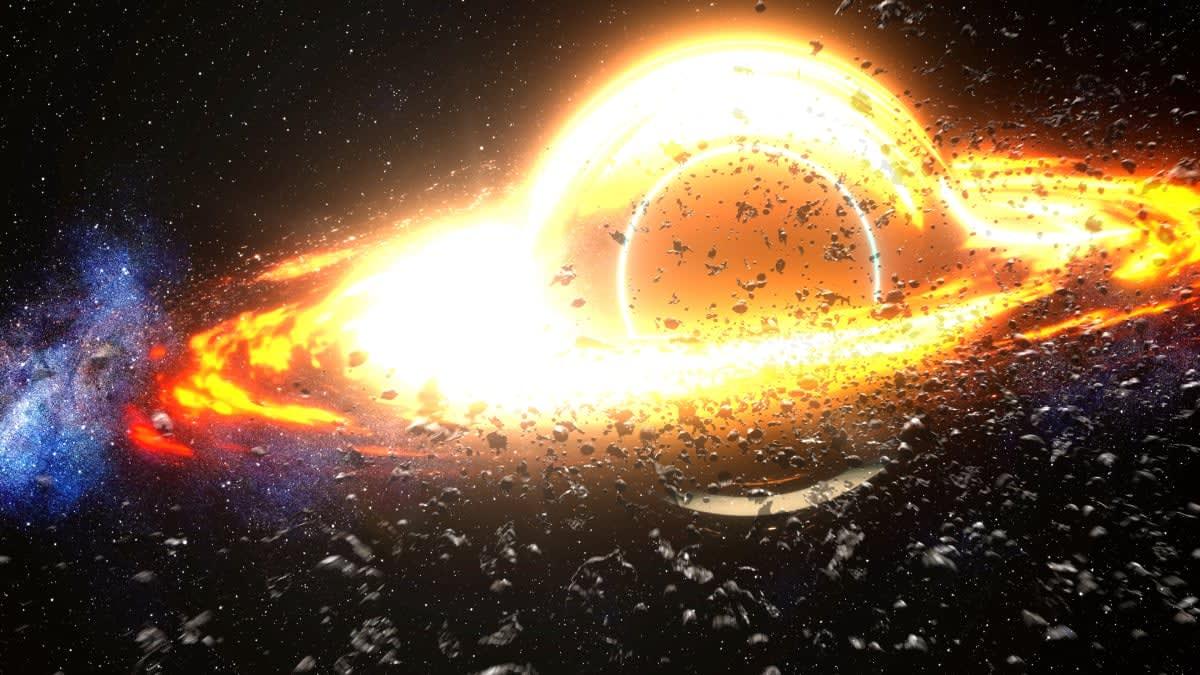
Burst of debris released as a black hole shreds a star
The main reason why the Whippet is being described as one of the most powerful cosmic events in history is the whopping amounts of energy it released as the unlucky star met its doom. In an event like this, typically known as the Tidal Disruption Event (TDE), the fragments splitting from the dying star accumulate around the black hole’s boundary and form an accretion disk. All the debris and gassy material from the star starts to spiral inwards with a vigorous pull. As the material tumbles inwards, it gets heated up at extreme temperatures and starts emitting a luminous glow plus a spectrum of radiations that spread out into the space, casting a radiant glimmer across the galaxy for several months or years. In Whippet, the star released energy around 400 billion times that of the Sun, exceeding even the most powerful known supernovae.
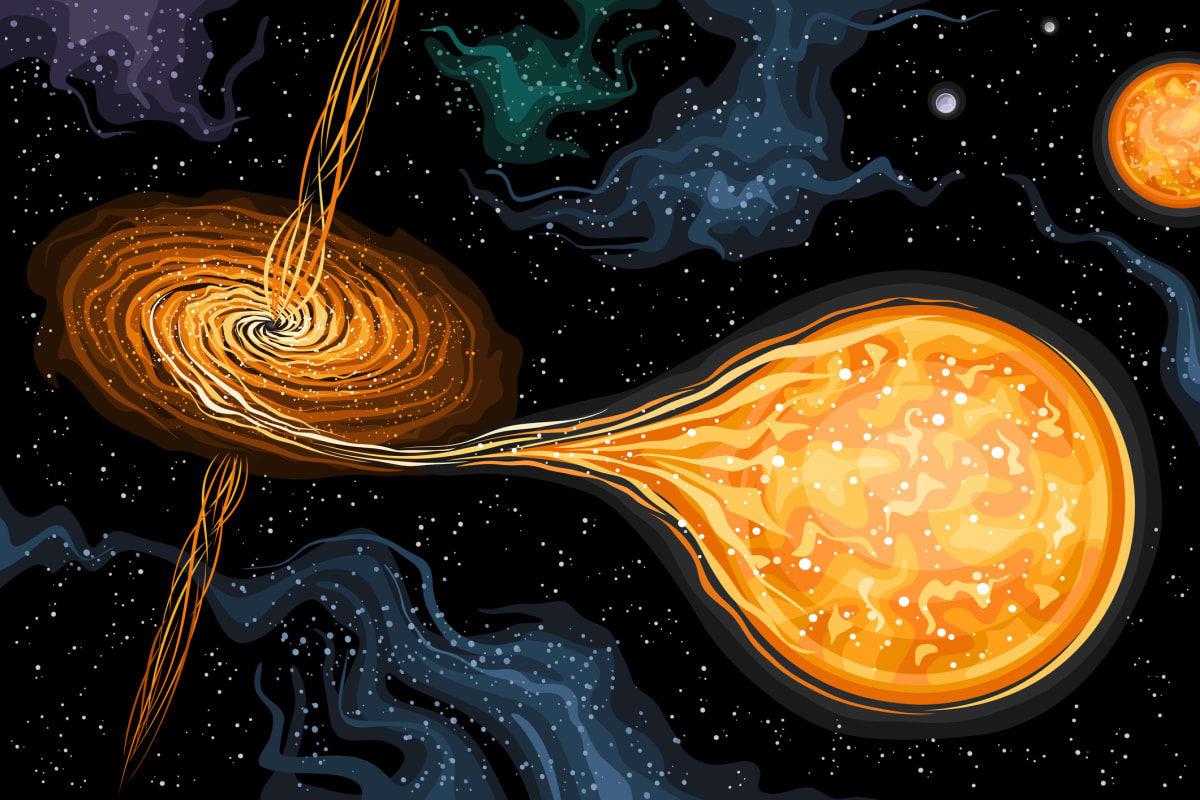
Depiction of a black hole eating a star
Astronomers suspect that the event might be a Luminous Fast Blue Optical Transient (LFBOT), a lesser-known type of visual event associated with the destruction of stars. Using NASA’s Swift satellite and Liverpool Telescope in the Canary Islands, scientists confirmed that the event indeed displayed properties of an LFBOT. The radiant blue glow streaking out was smeared with X-rays, two of the main characteristics of an LFBOT.
Further investigation also revealed that the event was likely initiated by a powerful shockwave that drifted at one-fifth the speed of light into the dense gas wafting from the star, before finally fizzling out in half a year. Perley reflected that Whippet-like events enable scientists to gain a deeper understanding of the physics and mechanisms behind a black hole’s behaviors.