
NASA's Webb Found an Unlikely Element in Cosmic Dust — and Scientists Didn't See It Coming
Published Jan. 9 2026, 5:50 a.m. ET
![Images from NASA’s James Webb Space Telescope of the dwarf galaxy Sextans A. [Cover Image Source: NASA, ESA, CSA, Elizabeth Tarantino (STScI), Martha Boyer (STScI), Julia Roman-Duval (STScI); Image Processing: Alyssa Pagan (STScI)]](https://media.greenmatters.com/brand-img/RanPhMTWn/2160x1130/pn/786675/uploads/e9a7cee0-ed2f-11f0-a6c1-933ac941905e_1200_630.jpeg?position=top)
Images from NASA’s James Webb Space Telescope of the dwarf galaxy Sextans A. [Cover Image Source: NASA, ESA, CSA, Elizabeth Tarantino (STScI), Martha Boyer (STScI), Julia Roman-Duval (STScI); Image Processing: Alyssa Pagan (STScI)]
Cosmic dust makes up a large part of the universe and is a solid companion to galaxies. For the longest time, astronomers believed there was a fixed recipe that formed these dust grains. A recent observation by NASA's James Webb Space Telescope made an astonishing discovery. Apparently, heavy elements—previously believed to be the main ingredients—are not essential to form dust grains. Scientists studied the dwarf galaxy Sextans A, one of the earliest or primitive known galaxies that acts as an analog to galaxies formed in the early universe. “Sextans A is giving us a blueprint for the first dusty galaxies,” said Elizabeth Tarantino, postdoctoral researcher at the Space Telescope Science Institute and lead author of the study. Located about 4 million light-years away, the galaxy's metal content is only 3 to 7 percent of that of the Sun’s.
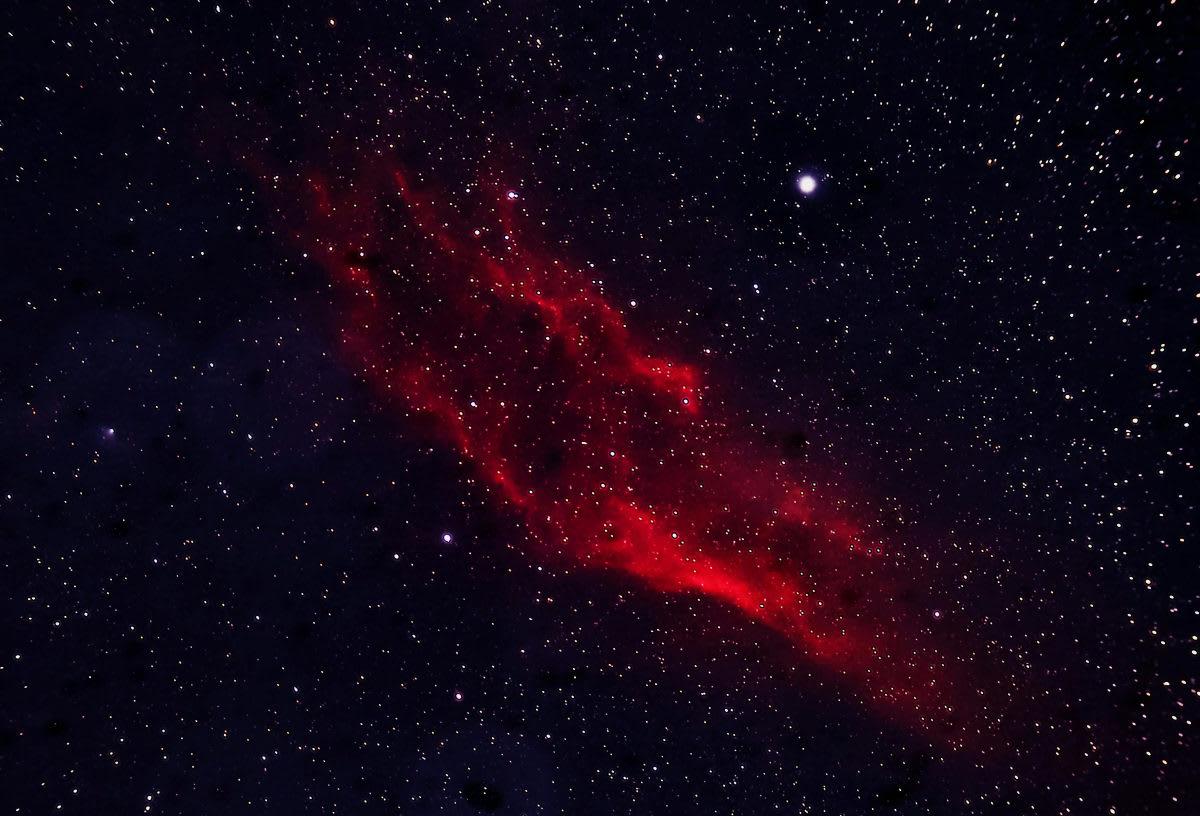
A crimson-red galaxy glowing with stars and bright celestial objects
The lack of metal content, or metallicity, suggests that elements heavier than hydrogen and helium might not constitute the dwarf galaxy. Since dwarf galaxies are small in size and have low gravitational pull, they can't retain heavy elements like iron, silicon, and oxygen that supernova and aging stars release. In a study published in The Astrophysical Journal, Webb’s MIRI (Mid-Infrared Instrument) helped scientists carefully analyze the chemical makeup of half a dozen stars, or the asymptotic giant branch (AGB) stars. These stars were observed to have low metallicity which meant that they would lack cosmic dust in their vicinity. At least that's what the scientists thought.
“One of these stars is on the high-mass end of the AGB range, and stars like this usually produce silicate dust. However, at such low metallicity, we expect these stars to be nearly dust-free,” said Martha Boyer, associate astronomer at the Space Telescope Science Institute. “Instead, Webb revealed a star forging dust grains made almost entirely of iron. This is something we’ve never seen in stars that are analogs of stars in the early universe,” Boyer added.
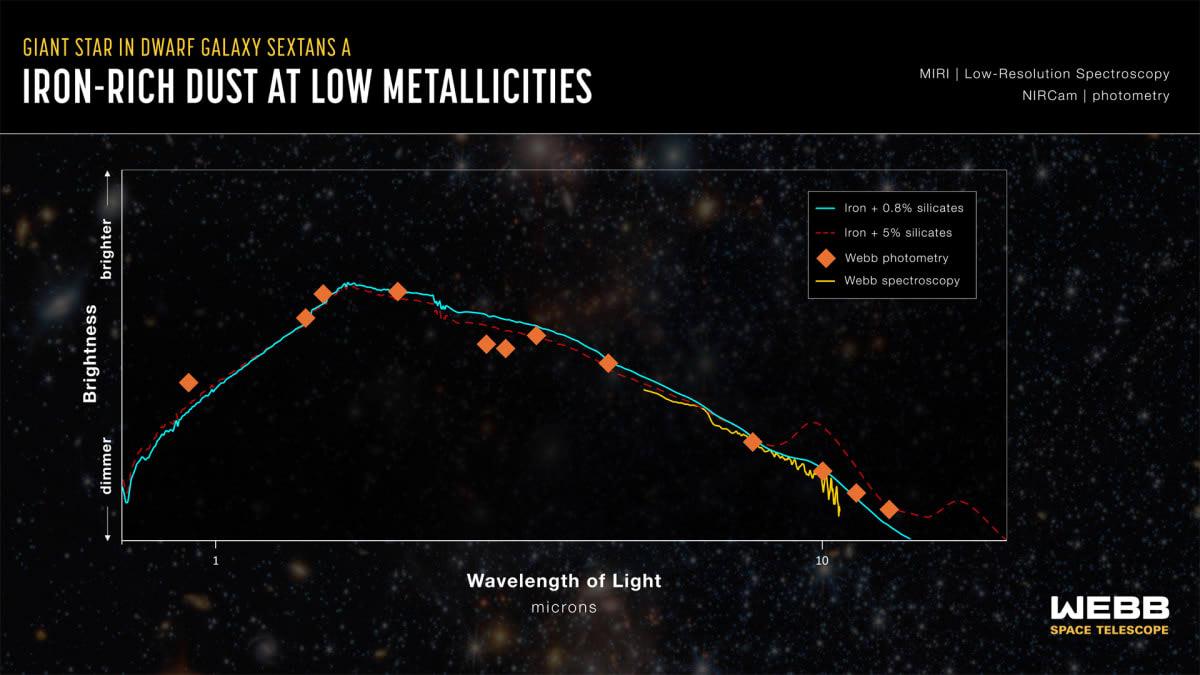
This graph shows a spectrum of an Asymptotic Giant Branch (AGB) star in the Sextans A galaxy. (Image Source: NASA, ESA, CSA, STScI, Joseph Olmsted (STScI))
Primitive galaxies like Sextans A lack heavier elements like silicon, carbon, and iron, that was believed to be the ingredients behind an ideal dust grain. But the evidence of dust grains around these primitive galaxies proved that other elements could also do the job perfectly well. Although the finished product was the same, the recipes and ingredients differed completely. Since these primitive galaxies provide a window into the galaxies of the early universe, right after the Big Bang, this discovery highlights the distinct chemical makeup of early galaxies and those of today. “Dust in the early universe may have looked very different from the silicate grains we see today,” Boyer added.
The dust grains in Sextans A were made up of iron dust, silicon carbide, and tiny clusters of carbon-based molecules. The findings suggest that the galaxies in the early universe, before aging stars enhanced the metallicity of space, were still able to produce dust grains. “These results help us interpret the most distant galaxies imaged by Webb and understand what the universe was building with its earliest ingredients," Tarantino added. Boyer revealed that these iron-clad dust grains don't leave "spectral fingerprints" behind, but they can be great additions to the dust reservoirs in faraway galaxies. In another study, which is still under review, scientists found polycyclic aromatic hydrocarbons (PAHs) in Sextans A’s interstellar medium.