
WATCH: Biologist Captures Rare Footage of Endangered American Marten Playing on a Tree in Wisconsin
Published March 12 2026, 8:34 a.m. ET

The endangered American marten was spotted sitting on a tree branch in Wisconsin.
A candid moment caught on camera! A critter was spotted lurking on a tree branch in Wisconsin, a discovery that took biologists by surprise. That's because the wild creature was an American marten, an endangered mammal of the mustelid family that is rarely sighted. It was a biologist for the Wisconsin Department of Natural Resources (WDNR) who spotted the rare animal carousing in the wild earlier this winter. On Tuesday, March 10, the department shared the official footage of the playful critter on Facebook. "Earlier this winter, a DNR biologist came across a once-in-a-lifetime wildlife encounter!" the caption read. The mammal, seemingly in a chirpy mood, kept moving from one branch of the tree to another, allowing experts to get a glimpse of their natural behavior in the wild.
The biologist who captured the unusual sight stumbled upon the creature while tracking martens in the wild. “I observed the mustelid on the road and got out to see if I could see where it had gone, only to hear it had run up the large aspen tree near the road and was vocalizing at me,” the biologist revealed. As heard in the footage, the marten was chirping and squeaking while moving from branch to branch. According to the WDNR, "American martens are a state endangered species that depends on mature forests of the Northwoods." In appearance, they might resemble minks, but their habitats are quite distinct, almost contrary to one another. While the minx are found in coastal areas, martens reside mainly in the uplands, as per the Alaska Department of Fish and Game.
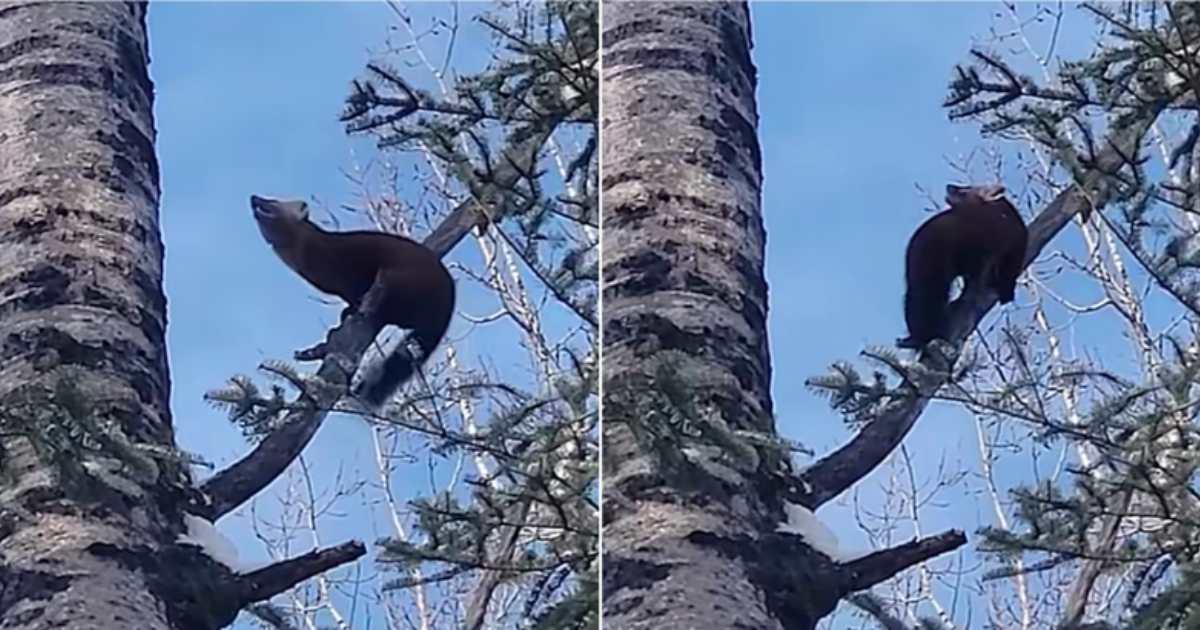
The American marten spotted in Wisconsin was caught being playful on camera.
In South Alaska, the American marten covers a vast area of habitat, all the way up to the northern and western portions of the state. Their fur coat is soft and dense, but the color varies from pale yellow to dark brown. Measuring somewhere between 19 and 25 inches in length, excluding the tail, these creatures are quite small in demeanor. They also weigh not more than four pounds, making them agile and quick enough to move through tree branches without losing balance. According to WXPR, the short legs and long bodies make it easier for martens to navigate through deep snow. The outlet also revealed that the Wisconsin Department of Natural Resources (DNR) is planning to keep a close eye on these endangered creatures.

An American marten travelling on snow through Crater Lake National Park.
The DNR, along with the Forest Service and UW-Madison, has begun collecting more insights on the martens by placing "hair snares" in their habitat. The authorities have planted tubes with treats on the other end. So whenever a marten enters the tube, it would pass a brush that will collect hair samples without it knowing. The hair sample would be sent to the lab for further analysis, which would hopefully provide a better understanding of the marten population. In a few trees in areas where the marten population could possibly be, authorities have attached hair snares, hoping to collect more samples. With enough samples, the experts would have a rough idea of not only the marten population but also where they are residing.
Such information is crucial given the vulnerable status of the critters. Since these creatures heavily depend on snow, they are especially vulnerable to climate change. The lack of snow would reduce their competitive advantage over other mammals in the winter, making them unprotected from larger predators, as per the National Park Service.