
This Young Galaxy Died Early — and Its Own Supermassive Black Hole May Be to Blame
Published Jan. 13 2026, 11:30 a.m. ET

The galaxy, called GS-10578, is nicknamed 'Pablo's galaxy' after the astronomer who first observed it in detail.
A galaxy named GS-10578 is known by the aphorism “Live fast, die young.” A majority of its stars formed between 12.5 and 11.5 billion years ago. Nicknamed Pablo’s Galaxy, this galaxy has been existing around three billion years after the Big Bang. As young as it is, it should have been churning out bright super-Suns flaring with energetic vigor; it should have been whipping up new baby stars that would cheer up the galaxy with their luminous glitter. But sadly, the galaxy is “dead,” which means there is no star formation going on here anymore.
Puzzled by the young galaxy’s mysterious death, astronomers gazed at it for seven long hours, hoping to detect just one trace of cold gas, the raw material for star formation. They found none. The culprit, they discovered, was the galaxy’s own black hole sitting at the center of its heart. What was most cruel was the fact that the black hole didn’t just assault its parent galaxy right away, but rather choked it to a slow, quiet death, as scientists documented in Nature Astronomy.
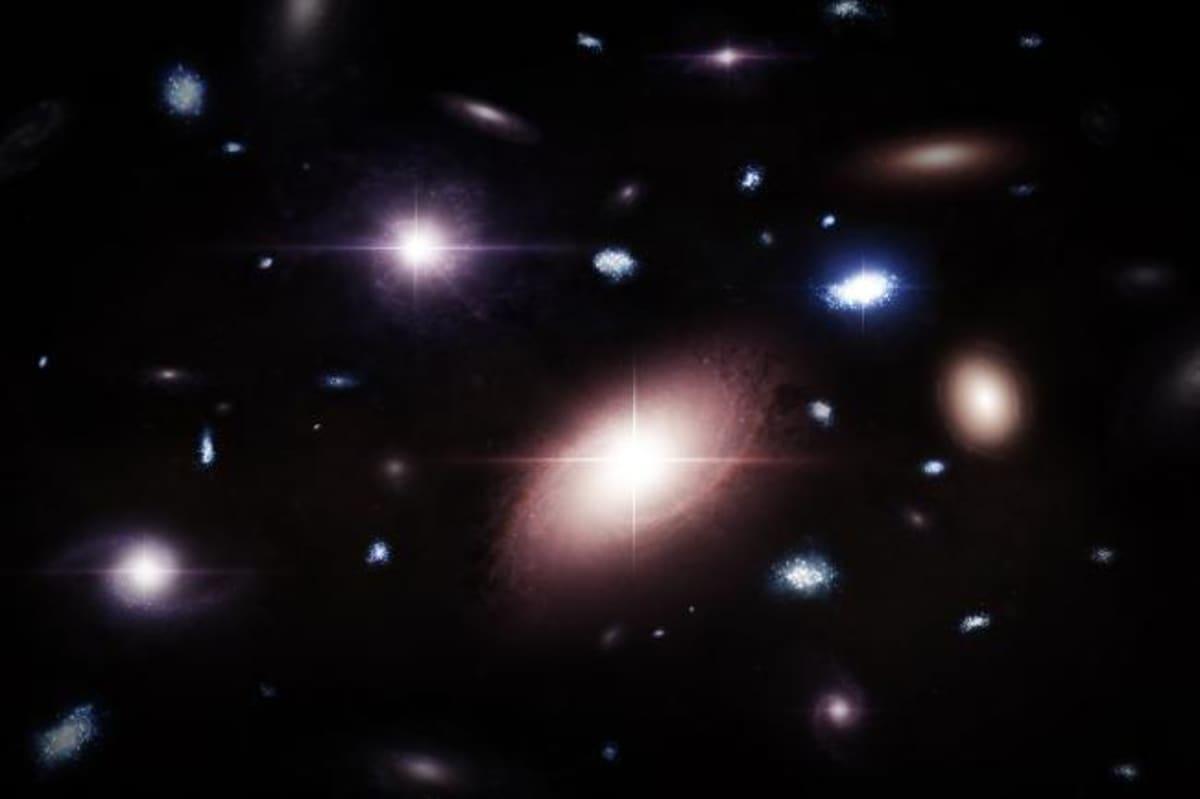
This artist’s conception captures a snapshot of galaxy sizes and the frequency of black holes within them.
Typically, black holes are not murderers. They, in fact, are cosmic catalysts that regulate a galaxy’s functioning by helping it to contain light for star formation and also regulate the process. However, seeing this treacherous supermassive black hole sitting in the heart of the young galaxy, astronomers had to reframe their understanding of the cosmos. Despite having a mass as big as 200 million times the mass of the Sun, the galaxy seemed to have died a brutal death at the hands of its own black hole. Around 400 million years ago, it stopped forming new stars and hence, was declared dead.
Researchers combined the observations of NASA’s James Webb Space Telescope (JWST) and the Atacama Large Millimeter Array (ALMA) to investigate what had happened to the galaxy. Initially, when they discovered that the galaxy was dead, they had two hypotheses to explain the death. First, a destructive merger, where two galaxies crash into each other to form a bigger galaxy. And second, a one-time rip-off event where a black hole exploded the whole galactic fabric, jostling all the gas outwards and out of the galaxy. None of the hypotheses fit into this case. The young galaxy hadn’t died in a destructive merger or a black hole rip-off. It wasn’t a one-time event that quenched it to death. It was “death by a thousand cuts.”
Depiction of black hole surrounded by glittering stars
Instead of blasting all the gas out in one single go, the black hole employed a more cunning strategy to murder its host. Slowly, subtly, it cut off the power supply of the galaxy, the cold gas, starving it into a slow, gradual death. Without the cold gas, no new stars could be formed. Meanwhile, like a traitorous gatekeeper, the black hole stopped the incoming of new gas supply in the galaxy. Instead, it kept on recycling the old gas over multiple loops, slowly squeezing away the cold gas from the galaxy.
“You don’t need a single cataclysm to stop a galaxy forming stars, just keep the fresh fuel from coming in,” study co-author Dr. Jan Scholtz from Cambridge’s Cavendish Laboratory, described in a press release. “What surprised us was how much you can learn by not seeing something... there was essentially no cold gas left. It points to a slow starvation rather than a single dramatic death blow,” Scholtz exclaimed. JWST’s spectroscopic observations revealed intense winds of neutral gas streaming out of the galaxy’s black hole at 248.5 miles per second. The black hole is secretly removing as many as 60 solar masses of gas every year from the galaxy.
The study hits like an eye-opening bombshell, crumbling away all the understanding scientists had of black holes and their relationship with host galaxies. Are there other black holes, as hungry as dominant, that they might starve younger galaxies to quiet death? Scientists are curious to arrive at the answer to this question. And if yes, then it could explain why some galaxies live fast and die young.