
A Black Hole 450 Million Light-Years Away Is Firing Strange S-Shaped Jets, Puzzling Experts
Published Jan. 9 2026, 10:13 a.m. ET

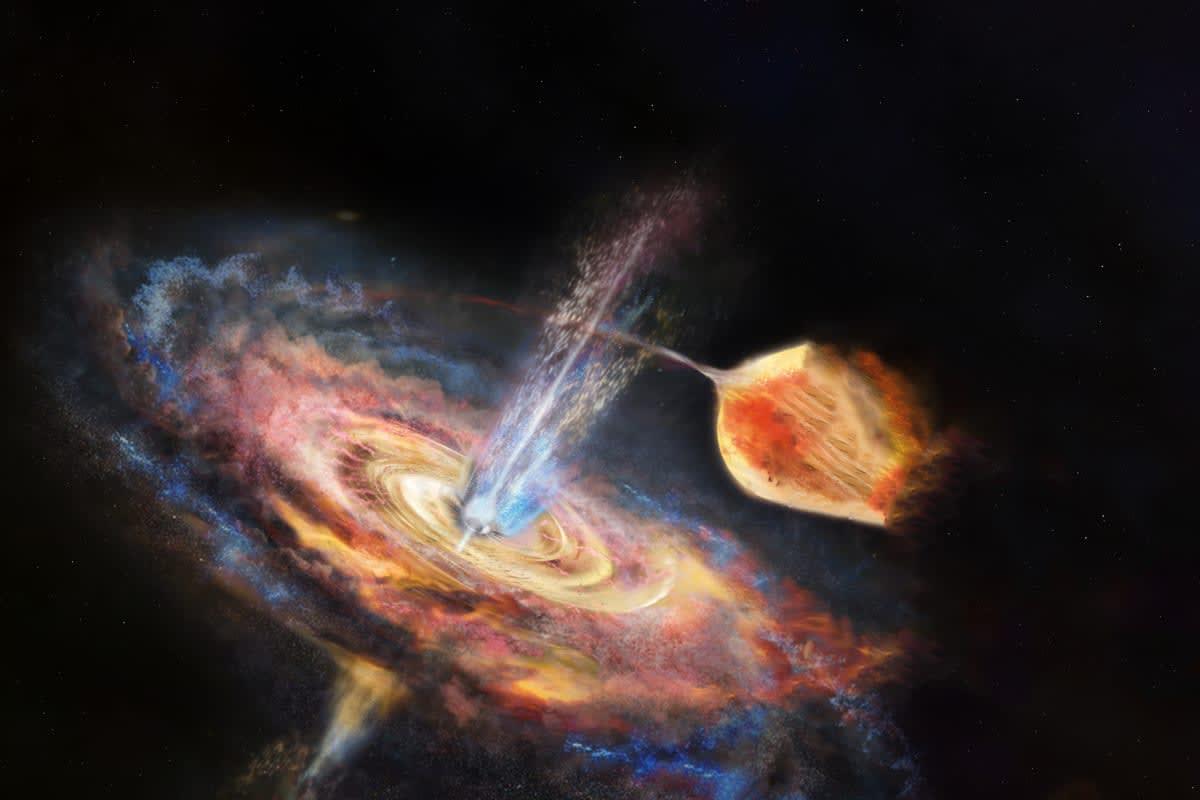
This artist’s rendering illustrates a precessing jet erupting from the supermassive black hole at the center of galaxy VV 340a.
Supermassive black holes are notorious for gobbling up young stars and burping out powerful jets of gas as they finish the snack. Scientists call this mechanism “jet precession.” Typically, only two types of jet streams are observed by the astronomers during this process. One is the radiative mode where a white-hot incandescent accretion disk heats up the gassy material, and the superheated gas pushes out the cooler gas outwards. Another mode, as Scientific American describes, sees firehose-like jets of gassy particles trundling from the black hole’s edges and shooting outwards, creating stellar nurseries within the galaxy. About 450 million light-years away, a black hole in a galaxy is shooting jets that resemble none of these modes.
As if destabilizing, this insane black hole is shooting jets in mysterious S-shapes. In a study published in Science, scientists document the enigma behind these unusual jets, suggesting that one of the reasons might be a “celestial exclamation mark,” a glowing purple-pink interjection enshrouded in gassy matter.
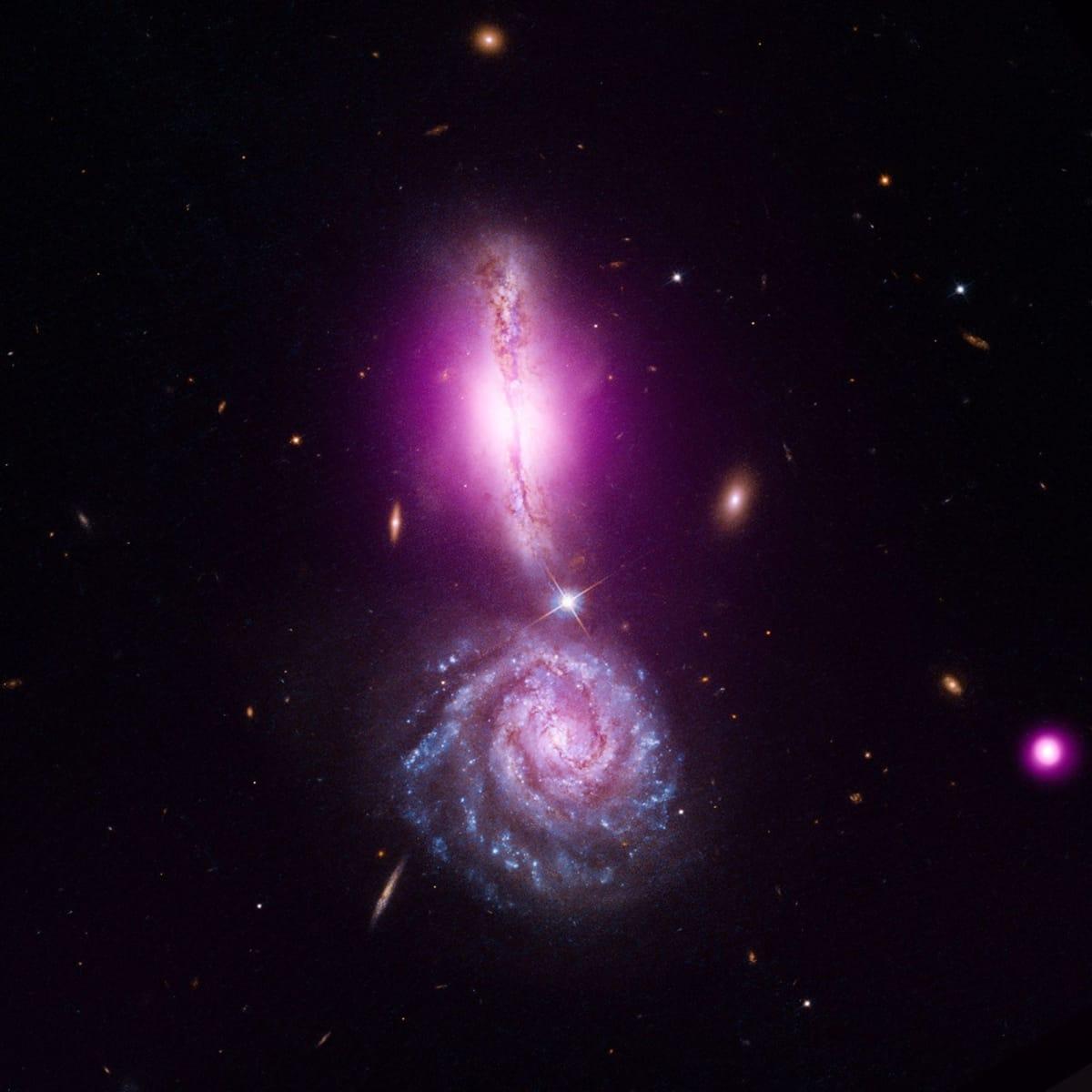
Two galaxies form a celestial exclamation mark as they merge
This celestial exclamation mark dangling in the space is the result of the host galaxy VV 340A merging with another galaxy, VV 340B, with one’s disk becoming the dot and the other becoming the stick. Researchers noted that this merging behavior is wobbling the axis of the black hole’s accretion disk. Meanwhile, the bizarrely shaped jet is spewing truckloads of energy, so much so that it has fanned out to an area exceeding 20,000 light years from the galaxy’s center.
Apart from being the most energetic, the jet is also intriguing in the way it is shooting out of the galaxy and fountaining in the surrounding space. Instead of just pointing in one direction, like most black hole jets, this one is sweeping in a curvy S-shaped pathway, almost like a spinning top or the water coming out from the rotating head of a lawn sprinkler. Apart from the exclamation mark, one of the reasons researchers suggest behind these cosmic jets is the instability of the accretion disk, which is causing the gassy material to tug onto it and tilt the axis. Another reason, they suspect, is that there is not just one black hole inside the galaxy, but two. And while they orbit each other in the binary system, the black holes are provoking the formation of this jet.
Black hole eating a star
Why is it important to the scientists? Well, because the more gas the black hole pushes out of the galaxy, the more it suppresses and hinders the formation of the next generation of stars, by starving it of the raw material, that is, gas. Lead researcher Justin Kader and his team investigated the black hole and the host galaxy in infrared, optical, radio, and submillimeter wavelengths.
For research, the team combined the data from NASA’s James Webb Space Telescope with the Keck II telescope in Hawaii, the Karl G. Jansky Very Large Array (VLA), and the Atacama Large Millimeter Array (ALMA). “This is the first observation of a precessing kiloparsec-scale radio jet in a disk galaxy. To our knowledge, this is the first time we have seen a kiloparsec, or galactic-scale, precessing radio jet driving a massive coronal gas outflow,” Kader shared in the press release.
Another interesting insight that comes out of this research is how black holes influence the stability of their host galaxies. If the black hole jolts out of stability and its disk wobbles from its axis, the resulting jets can push enormous loads of gas out of the galaxy, thereby quenching star formation. Looking ahead, scientists will continue to explore this never-before-seen phenomenon using state-of-the-art tools. Co-author Vivian U exclaimed, “We can’t wait to see what else we will find.”