
This Massive Asteroid Is Spinning at Record Speed — and Somehow Still Staying in One Piece
Published Jan. 8 2026, 10:01 a.m. ET

This artist’s illustration depicts asteroid 2025 MN45.
“This is now the fastest-spinning asteroid that we know of, larger than 500 meters [1,640 feet],” astronomer Sarah Greenstreet revealed at the recent American Astronomical Society’s winter meeting held in Phoenix. Named 2025 MN45, the asteroid was discovered by the NSF–DOE Vera C. Rubin Observatory, and it makes a full rotation every 1.88 minutes. It has been declared as the asteroid that rotates faster than any other asteroid of that size (nearly half a mile in diameter). Its discovery and implications have been mentioned in the first peer-reviewed paper in The Astrophysical Journal Letters based on data from Rubin’s Legacy Survey of Space and Time (LSST) Camera.
Describing the size of the asteroid, Greenstreet said, “If you were standing on it, it would probably be quite the ride to be going around on the outside edge of this thing that’s the size of eight football fields.” Experts were able to measure reliable rotation periods for 76 asteroids. Among them were 16 super-fast rotators (rotation periods between 13 minutes and 2.2 hours) and three ultra-fast rotators (rotation period less than five minutes), with 2025 MN45 standing out as the fastest one with a rotation period of 1.88 minutes.
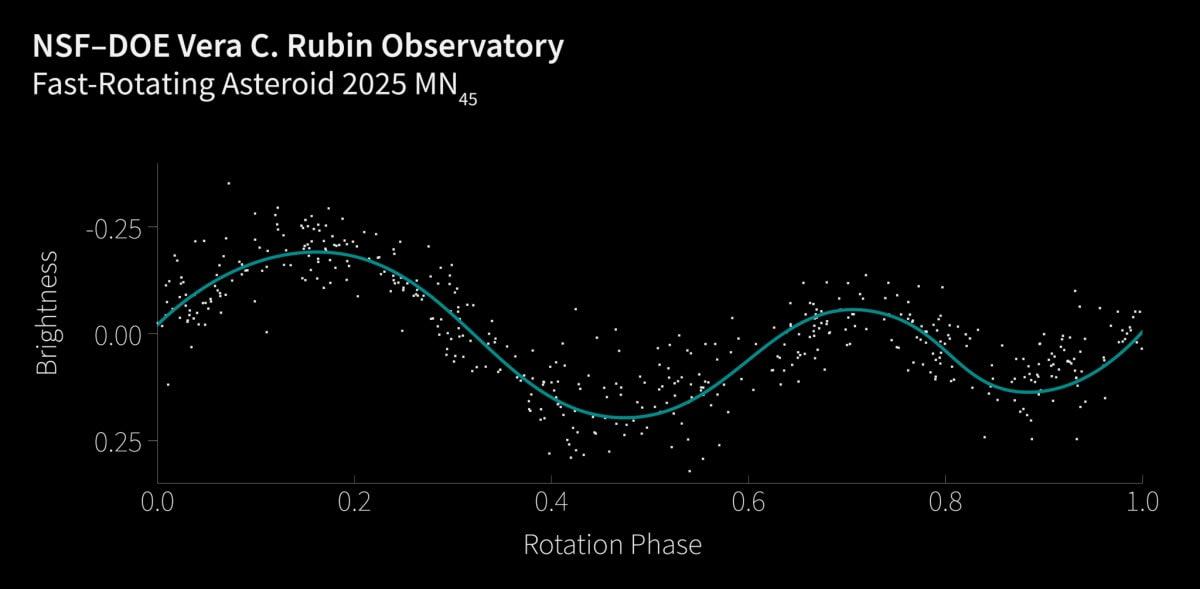
This chart shows the lightcurve of 2025 MN45 (Image Source: NSF–DOE Vera C. Rubin Observatory / NOIRLab / SLAC / AURA/ J.) Pollard
Along with orbiting the Sun, asteroids spin too, and at very different speeds. Those spin rates give scientists valuable clues about how these space rocks formed long ago. It also helps to understand what they are composed of and how they have evolved. Most asteroids are believed to be “rubble piles,” loosely bound collections of smaller rocks held together by gravity. When they spin quickly, it is also possible to fly apart into smaller pieces, called fragmentation.
The fact that 2025 MN45 remains intact indicates it must possess exceptionally high internal strength, behaving more like a solid, cohesive rock. Usually, asteroids of that size spin at a speed of 2.2 hours to avoid fragmentation, which means that 2025 MN45 is structurally very strong. “Clearly, this asteroid must be made of material that has very high strength in order to keep it in one piece as it spins so rapidly. We calculate that it would need a cohesive strength similar to that of solid rock. This is somewhat surprising since most asteroids are believed to be what we call ‘rubble pile’ asteroids, which means they are made of many, many small pieces of rock and debris that coalesced under gravity during Solar System formation or subsequent collisions,” Greenstreet said.
A researcher looks through a telescope.
Most fast-spinning asteroids identified until now have tended to be near-Earth objects (NEOs), largely because their proximity to Earth makes them brighter and easier to study. While similar objects in the main asteroid belt between Mars and Jupiter are harder to detect due to their greater distance and fainter light. However, new observations from the Vera C. Rubin Observatory are changing that picture.
Nearly all of the newly identified fast rotators were found in the main belt, with only one exception being an NEO. This breakthrough is possible thanks to Rubin’s exceptional light-gathering power and precise measurements. “We have known for years that Rubin would act as a discovery machine for the Universe, and we are already seeing the unique power of combining the LSST Camera with Rubin’s incredible speed,” said Aaron Roodman, Deputy Head of LSST.