
Every January, Antarctic Scientists Move the South Pole— Here's Why It Needs to Be Done
Published Jan. 8 2026, 5:36 a.m. ET

Orname metal marker embedded in Antarctic ice near the Amundsen-Scott South Pole Station to represent the South Pole
“It’s old and dirty. Time for a change. Enough of this one,” astrophysicist Denis Barkats remarked in a Nottingham University documentary, while standing in front of a metal stake embedded in Antarctic ice. It was a glowing, sunlit day in 2016, and he was just a stone’s throw away from the Amundsen-Scott South Pole Station, dressed in a fancy jacket, a brown hat, and a pair of shiny black gloves. Except for the station’s silver-grey campus glinting in light and a crowd of scientists in puffy orange jackets, the landscape surrounding him was a fathomless expanse of snow, an ocean of white pearls bathed in the golden glow of the Sun. The goal was to bid farewell to the metal marker and replace it with a new one.
Barkats and his colleagues unwrapped the latest marker, a shiny metallic ball with rings that made the crowd think of Jupiter and Saturn. 2026's marker is a candy-cane-shaped stake, as The Antarctican Society described. All this might sound almost like a mystical ritual, but it is just a ceremony the station’s crew celebrates each year on January 1.

A short ceremony unveiling the 2026 Geographic Pole marker.
More than 9,300 feet above sea level on the Antarctic ice sheet, the ceremony unfolds on the first day of a new year. Sitting at the southernmost point of the planet, a.k.a. the geographic South Pole, the station experiences only one sunrise and one sunset per year. Extreme seasons play out with six months of total sunlight and six months enshrouded in complete darkness. Polar darkness plunges the temperatures so low that the station becomes a sugar biscuit embedded in Antarctica’s giant ice cake, whipped in snowy cream. Vortices of snowflake-carrying winds lash at the station’s campus, while scientists inside conduct experiments on astronomy, atmospheric sciences, climate, and physics. The station is operated and managed by the U.S. National Science Foundation (NSF) as part of the U.S. Antarctic Program (USAP).
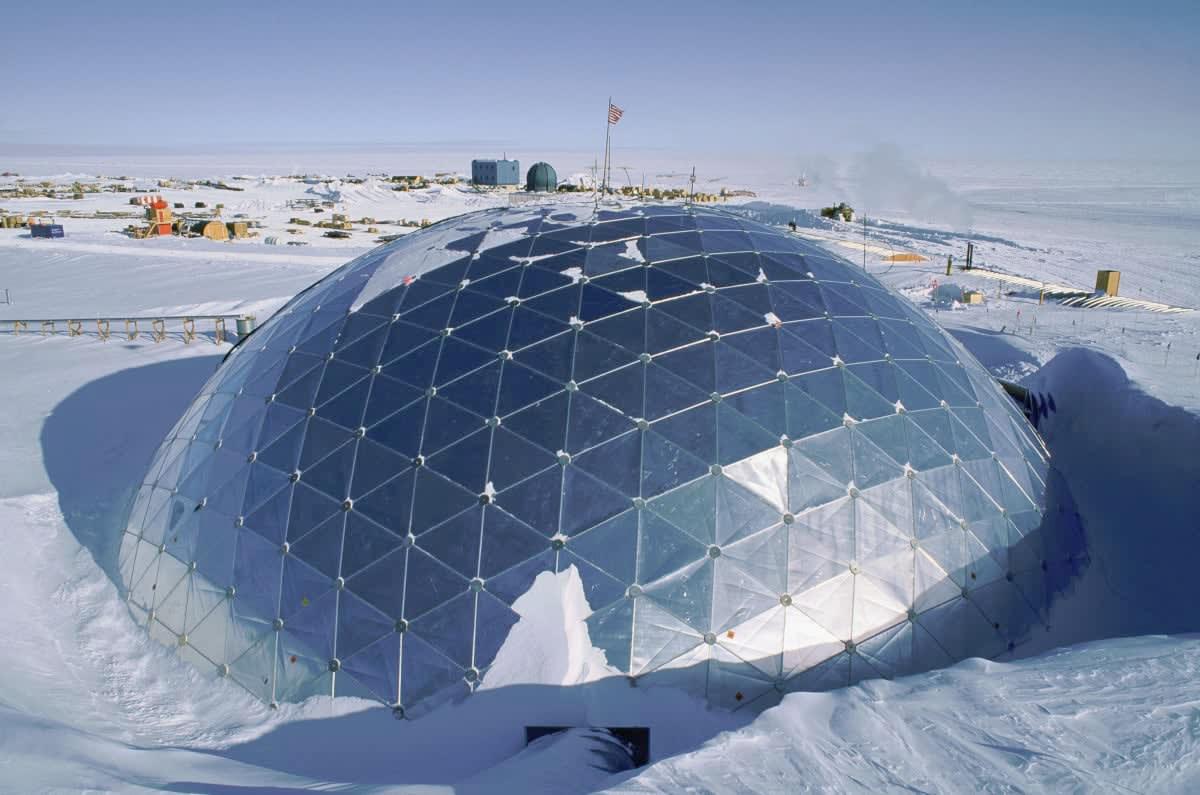
Dome-shaped campus of Amundsen-Scott South Pole Station in Antarctica
While the southernmost point, or the geographic South Pole, remains fixed in its position, it sits on top of a drifting ice sheet, and the ice moves towards the Weddell Sea. Hence, over a period of time, this causes the station and the surface marker rate to move about 33 feet each year, which can be confusing if scientists don’t register this change. Every year, on January 1, the day of the summer solstice, they say goodbye to the previous year’s South Pole marker and replace it with a new one. The old marker stands there for some time, and is then stowed away inside the glass cabinet that encases previous years' markers, while the ice outside continues to slip and dribble towards the roaring Weddell Sea. It's quite like pouring or drizzling syrup over a waffle. It doesn’t just plunk and splash on the surface, but rather flows slowly, swiftly. This constant motion causes the ice sheet to drift a bit each moment.