
A Giant Planet Is Lighting up the Night Sky This Week — Here's How to Spot It
Updated Jan. 9 2026, 10:28 a.m. ET

Woman looking at night sky with a telescope
Skywatchers might have observed a ‘star’ shining bright in the eastern sky recently. However, it is not a star at all but the planet Jupiter, and according to NASA, it will be at its brightest on January 10, 2026. The planet will reach opposition, which is a phenomenon that occurs when Earth lies directly between the Sun and the celestial body. Jupiter will be the most visible planet in the sky on the day, outshining all the other stars in the sky, apart from the Moon and Venus. It can be easily visible to the naked eye, but using a pair of binoculars will help get a clearer view.
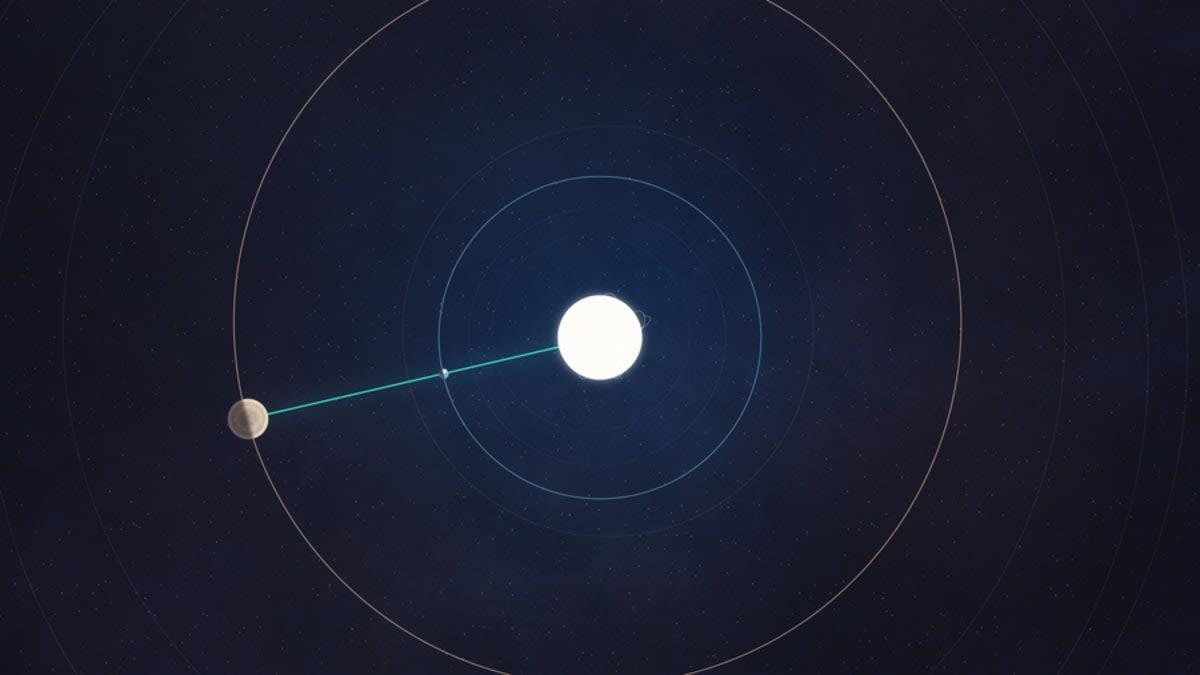
Depiction of Jupiter in opposition
Jupiter will be appearing in Gemini, alongside the constellation’s brightest stars Castor and Pollux. The planet’s diameter is approximately 11 times larger than that of Earth, and its clouds are very reflective, making it appear vivid. Its four largest moons—Io, Europa, Ganymede, and Callisto—can be observed through a basic pair of binoculars. They will appear as points of light on either side of the planet. Moreover, its century-old storm, the Great Red Spot, will also be visible when looked through a telescope if the right atmospheric conditions are met. The upcoming weeks until March 2026 are the best time to look at the bright disk across the sky. However, it will become less noticeable when Spring arrives, and until its next opposition in 2027.
It is sometimes easy to confuse Jupiter with a star because the night sky looks like bright little lights at first glance. Stars are distant balls of gas that produce their own light, and the most important distinction is that they twinkle. It happens because they are far away by trillions of miles, and their light gets bent by the Earth’s atmosphere. On the other hand, Jupiter will look somewhat like a fixed lamp in the sky. Moreover, planets also change their positions, whereas stars remain in the same patterns. The object that looks bright in the sky without twinkling, and slowly shifts positions over a short period of time, is most likely Jupiter and not a star.
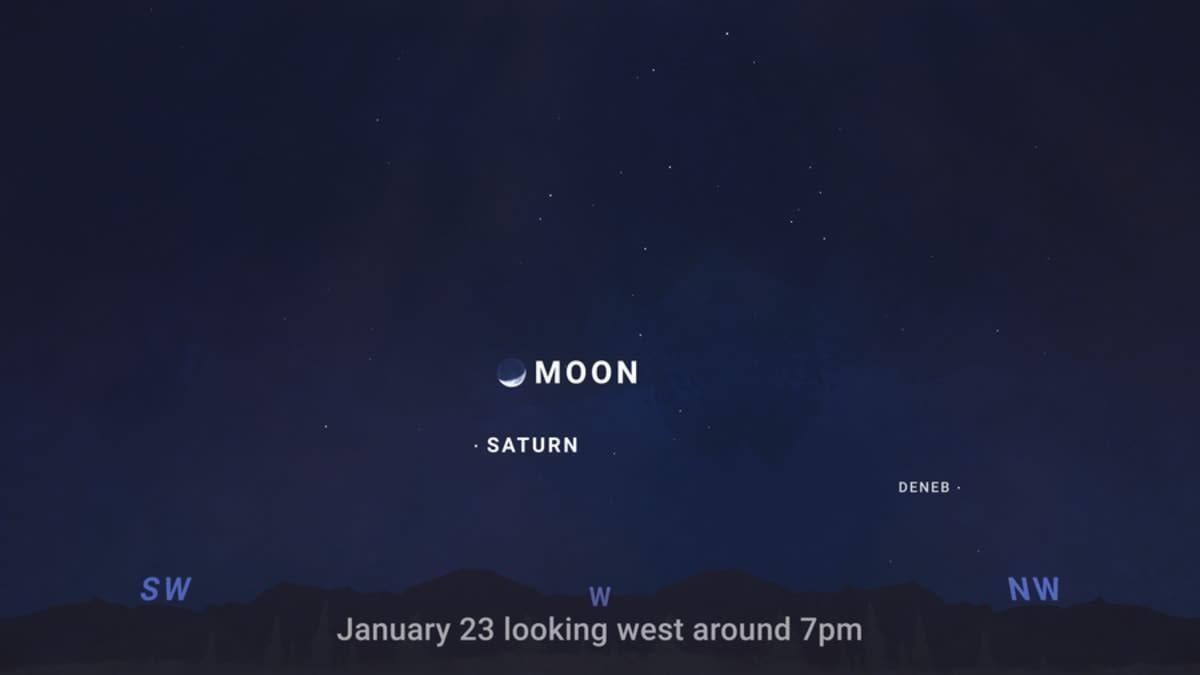
The Moon and Saturn in conjunction
Furthermore, the Moon and Saturn will be forming a conjunction on January 23, 2026. When two celestial bodies appear close together in the sky, even though they are actually far apart in space, that phenomenon is known as a conjunction. The Moon will be in its waxing crescent phase, and Saturn will have a steady golden light. The planet will be shining below the Moon and will be easily spotted with the naked eye. Apart from the bright Jupiter nights, the Moon-Saturn pairing is another highlight for the stargazers.
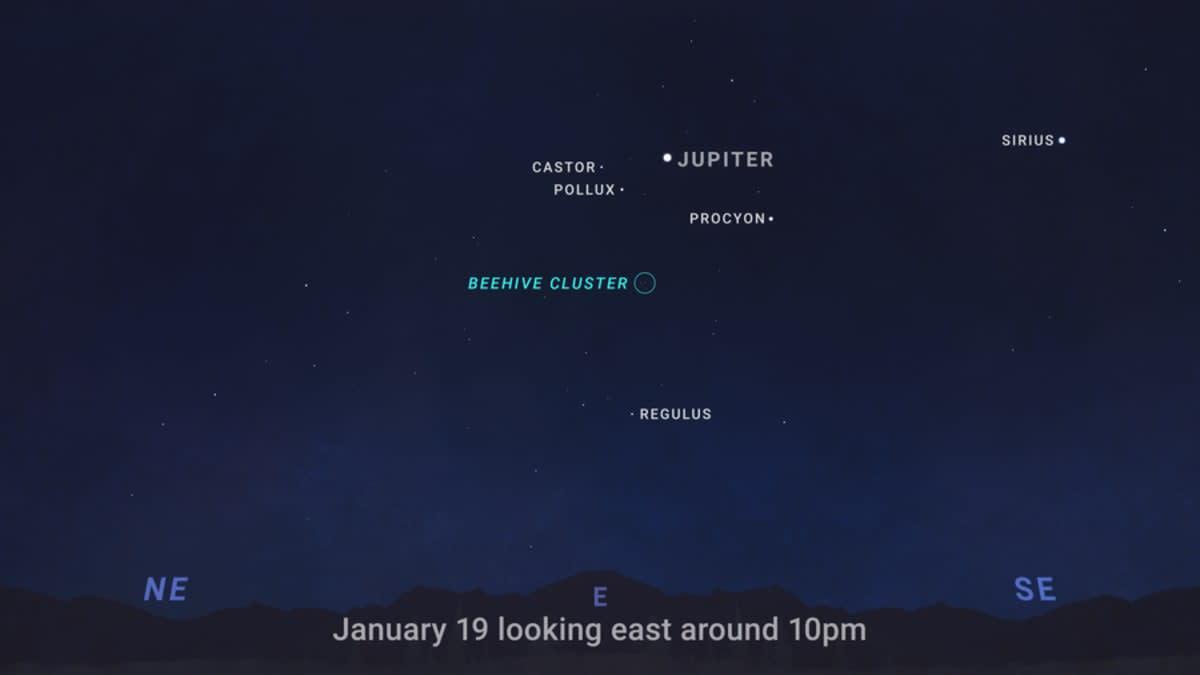
The Beehive Cluster in the night sky
The Beehive Cluster, also known as Messier 44 or Praesepe, will also be observable throughout January. Located in the constellation Cancer, it is one of the most beautiful clusters in the night sky and is around 600-700 million years old (while the Milky Way is thought to be about 4.6 billion years old. The cluster contains around 1,000 young stars grouped together, glittering intensely in a loose formation. The best time to see the cluster is after sunset and before midnight in the eastern night sky around the middle of January.