
Experts Study One of the Most Active Solar Regions for 94 Days Straight — and Find Rare Insights
Published Jan. 7 2026, 7:46 a.m. ET

This graphic was updated in April 2025 to show an image of the Sun taken by Solar Orbiter's EUI instrument.
Studying an active region of the Sun for more than two weeks is tough, as it spins on its axis every 28 days. So, after the time passes, the active sunspot shifts further away from Earth, making observation difficult. But thanks to advanced technology, a breakthrough emerged. The Solar Orbiter mission, launched by the European Space Agency (ESA) in 2020, has allowed astronomers to access a wider view of the Sun, or "broadened" their perspective, as solar physicist Ioannis Kontogiannis puts it. The Solar Orbiter, as its name suggests, orbits the Sun once every six months, making even the farther sides visible for the researchers to observe. According to the study published in the journal Astronomy & Astrophysics, the orbiter followed one of the Sun's most active regions, called NOAA 13664, from April to July 2024.
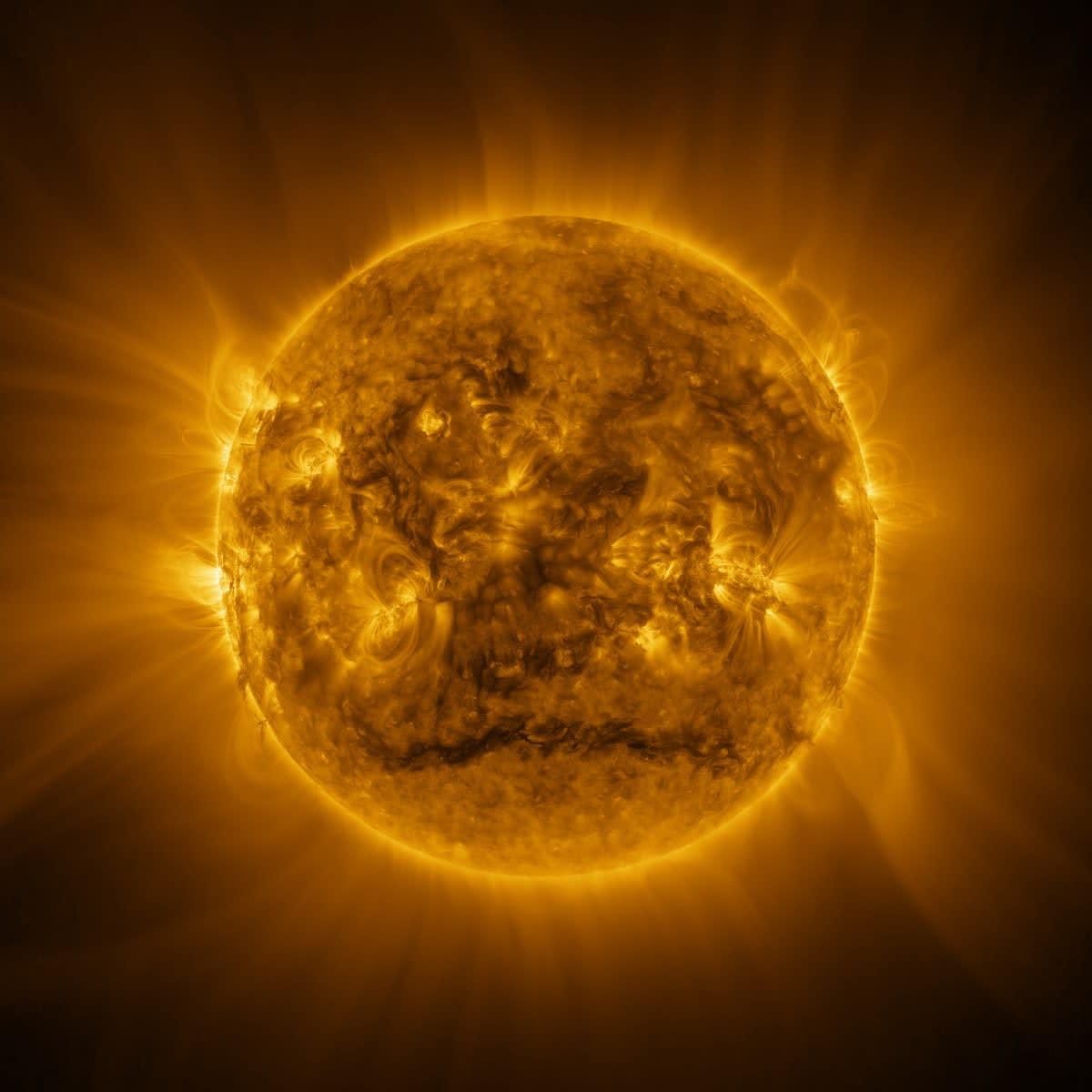
Solar Orbiter’s widest high-res view of the Sun
In May, when the active region rotated into view from the Earth, it projected strong geomagnetic storms towards our planet, prompting the spectacular Northern Lights to grace the sky. “This region caused the spectacular aurora borealis that was visible as far south as Switzerland,” Louise Harra, professor at ETH Zurich and director of the Davos Physical Meteorological Observatory, said in a statement. The exceptional activity in the Sun's region made the researchers curious to explore more. Solar physicist Ioannis Kontogiannis and Harra teamed up with a bunch of international scientists to accumulate all the data they have on the NOAA 13664. They combined the observations from the Solar Orbiter—which tracked the far side of the Sun—with those of NASA’s Solar Dynamics Observatory, which observed the near-side of the Sun. The compilation provided them with data records of 94 days with negligible gaps.
“This is the longest continuous series of images ever created for a single active region: it’s a milestone in solar physics,” said Kontogiannis. The almost 100-day observation saw the birth of the active region NOAA 13664, its activity when rotated facing Earth, and followed along till its gradual vanishing after July 18, 2024. According to NASA, a solar storm is a "sudden explosion of particles, energy, magnetic fields, and material blasted into the solar system by the Sun." The Sun created tangled magnetic fields, which get twisted when the celestial body rotates. Solar storms emerge when these twisted magnetic fields stretch to the point that they snap and reconnect, emitting large amounts of energy as a result of the turbulence. Although the stretching and reconnecting cause auroras to appear, it also has certain downsides.

Two people looking at Northern Lights.
They can cause radio blackouts and power outages, causing trouble in communication and day-to-day functions. “Even signals on railway lines can be affected and switch from red to green or vice versa. That’s really scary," said Harra. "Signals from satellites, drones and sensors were disrupted, causing farmers to lose working days and leading to crop failures with considerable economic losses," she added. Thanks to our planet's magnetic field and atmosphere, these solar flares can not cause any direct harm to the planet or the people. But that doesn't negate the fact that solar activities indirectly affect the lives on Earth. “It’s a good reminder that the sun is the only star that influences our activities,” said Kontogiannis, adding, "We live with this star, so it’s really important we observe it and try to understand how it works and how it affects our environment."