
Scientists May Have Just Identified One of the Earliest Known Barred Spiral Galaxies
Published Jan. 9 2026, 7:23 a.m. ET

Portrait of a spiral galaxy with a stellar bar at the nucleus.
A spiral galaxy's nucleus, carved by an elongated plume of gas and stars, creates a bar-like structure at the center. These galaxies are called barred spiral galaxies, as per NASA. Recent research led by Daniel Ivanov, a physics and astronomy graduate student in the Kenneth P. Dietrich School of Arts and Sciences at Pitt, may have found its earliest member. In a potentially groundbreaking discovery, the researchers seem to have uncovered one of the earliest spiral galaxies of the universe with a stellar bar. This could provide insight into the evolution of galaxies and help understand the timeframe of the emergence of the barred galaxies. The research could potentially convey details of the formation of our galaxy, the Milky Way, which also contains a stellar bar.
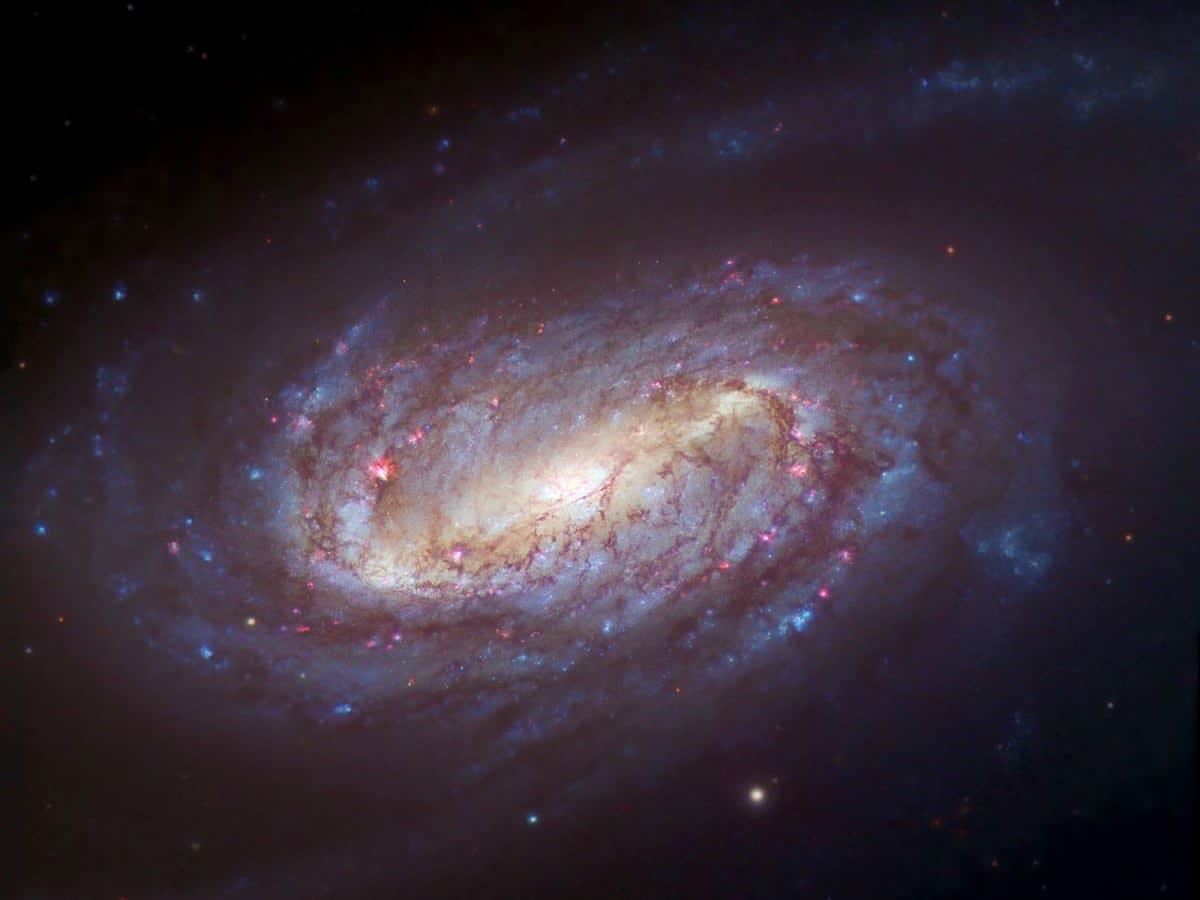
A barred spiral galaxy.
The findings were presented at the 247th meeting of the American Astronomical Society on January 8, and updates are awaited. The recently discovered spiral galaxy with a stellar bar has been named COSMOS-74706, and its formation dates back to about 11.5 billion years ago. "This galaxy was developing bars 2 billion years after the birth of the universe. Two billion years after the Big Bang," Ivanov said, as per Phys.org. The researcher explained a stellar bar as a "linear feature at the center of the galaxy." The bars are placed in such a way that they appear to be a line intersecting the galaxy's center. These bars play a major role in determining the evolution of galaxies and the universe. The stellar bars propel gases from the galaxy inwards, nourishing the supermassive black holes that rest at the center of every galaxy.
With the galactic black holes active, nearby stars are reduced in number, being pulled into the black hole due to its extremely high gravitational force. Although previous research has claimed to find the earliest barred galaxy, it couldn't be proven with certainty. That's probably because of the use of less-reliable methods of analysis. Ivanov and his team have opted for a method called spectroscopy, which provides definitive and precise results in comparison. In other cases, the galaxy's light appeared to be shifting because it passed by a distant massive object, a phenomenon known as gravitational lensing. It wasn't the redshifts that the researchers observed through spectroscopy. "It's the highest redshift, spectroscopically confirmed, unlensed barred spiral galaxy," Ivanov added.
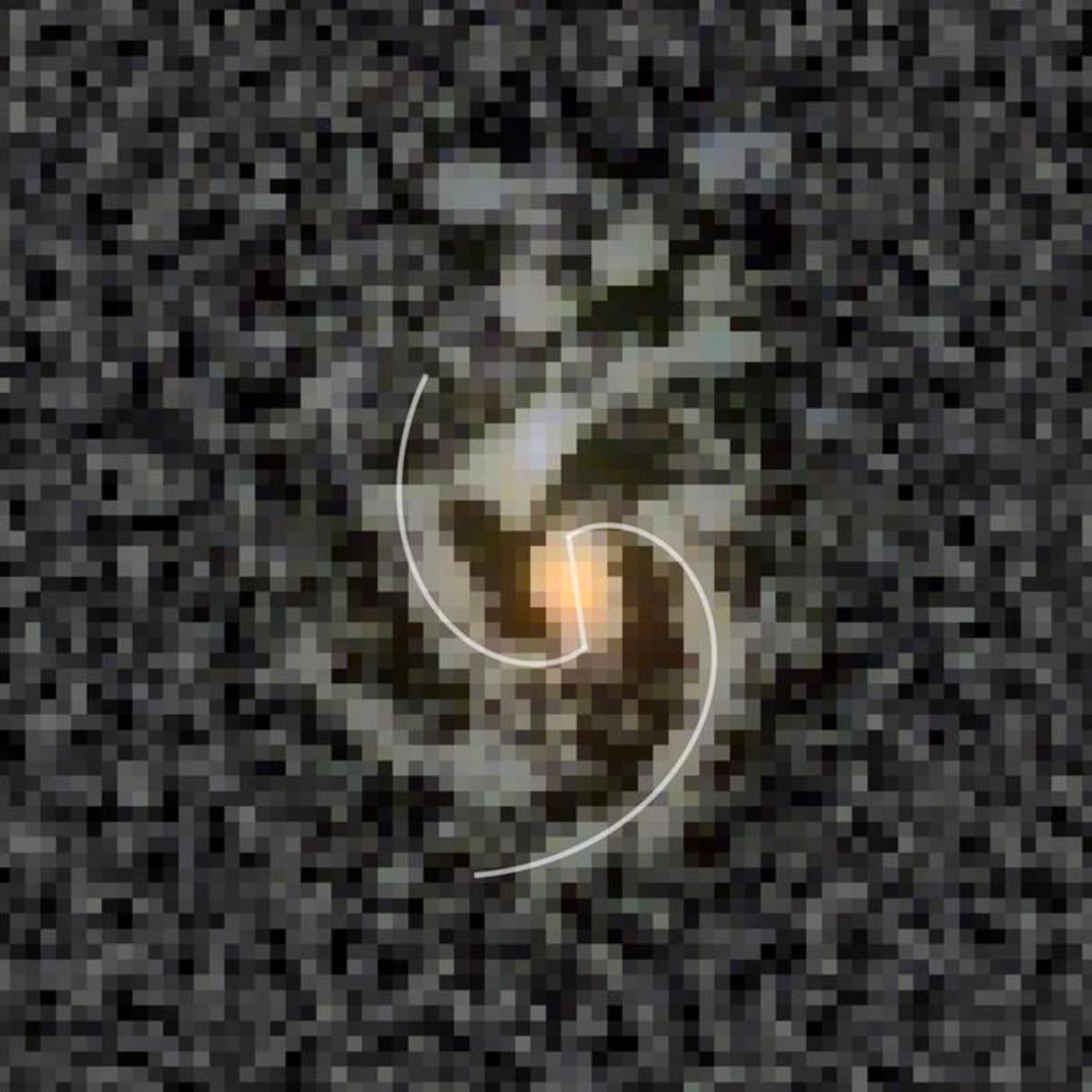
COSMOS-74706
Certain simulations also pointed to stellar bars forming at redshift 5, around 12.5 billion years ago, earlier than the one they uncovered. "In principle, I think that this is not an epoch in which you expect to find many of these objects. It helps to constrain the timescales of bar formation. And it's just really interesting," he added. According to NASA, barred spiral galaxies took their sweet time to form in the early universe. Despite thousands of them being discovered by the agency in today's time, their population was pretty minuscule about 7 billion years ago.
"The recently forming bars are not uniformly distributed across galaxy masses," says Kartik Sheth of the Spitzer Science Center at the California Institute of Technology in Pasadena. "They are forming mostly in the small, low-mass galaxies, whereas among the most massive galaxies, the fraction of bars was the same in the past as it is today," he added.