
Scientists Finally Know What the Strange Red Dots Marring James Webb Telescope’s Images Are
Published Jan. 19 2026, 8:57 a.m. ET

A mysterious red dot in the cosmos.
Scientists finally have an explanation for the mysterious red dots in space. In 2022, NASA’s James Webb Space Telescope captured a rare, similar sight of the cosmos where red lights glimmered like stars, but scientists could not figure out what it was. That’s how the adventure to uncover the mystery behind the “little red dots” or LDRs began. The unique bright red color intrigued researchers who wanted to know the secrets it might hold about the early universe. A recent study published in the journal Nature may have all the answers. Astronomers teamed up and compiled samples of LDRs, with most of them dating back to 1.5 billion years after the creation of the universe, aka the Big Bang. They found signs that these “little red dots” might contain supermassive black holes that are gradually expanding.
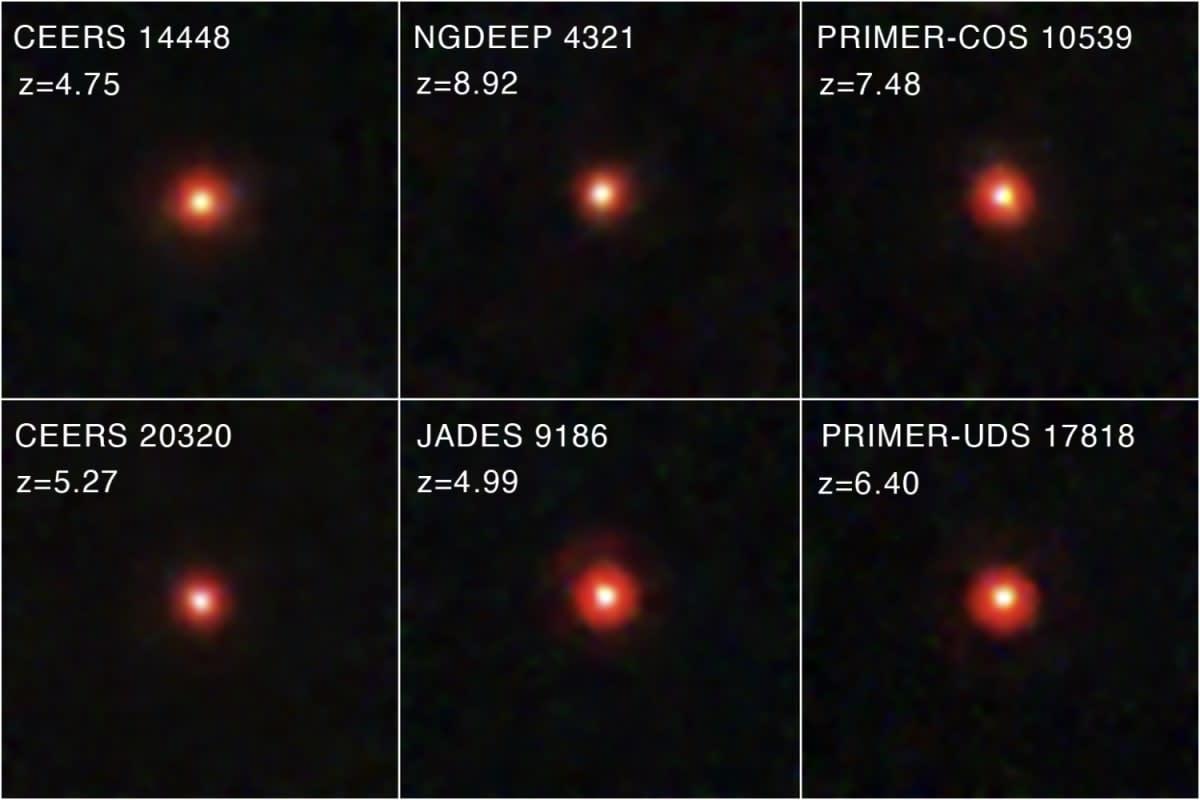
Largest compilation of “little red dots” (LRDs) created by astronomers using James Webb data. [Image Source: NASA, ESA, CSA, STScI, Dale Kocevski (Colby College)]
“We’re confounded by this new population of objects that Webb has found. We don’t see analogs of them at lower redshifts, which is why we haven’t seen them prior to Webb,” Dale Kocevski of Colby College in Waterville, Maine, and lead author of the study, said in a statement. “There’s a substantial amount of work being done to try to determine the nature of these little red dots and whether their light is dominated by accreting black holes,” he added. Researchers at the Niels Bohr Institute’s Cosmic Dawn Center also arrived at the same conclusion, highlighting that these LDRs are some of the most extreme objects in the universe. Since the supermassive black holes appeared to be still forming, they can provide powerful insights into how a fully developed black hole came to be.
“The little red dots are young black holes, a hundred times less massive than previously believed,” said Professor Darach Watson, one of the lead authors of the study, as per Science Daily. These cosmic features are entirely encapsulated within a cloud of gas. The black holes pull materials from these gases to grow, a process known as accretion. “This process generates enormous heat, which shines through the cocoon. This radiation through the cocoon is what gives little red dots their unique red color,” Watson added. Although these red glowing black-hole containers are an anomaly, they are not as big as previously assumed. Watson explained that, despite these cosmic features being remarkable, they are not groundbreaking enough to shake the foundation. “We do not need to invoke completely new types of events to explain them,” he added.
Supermassive black hole surrounded by stars
The fact that many of these “little red dots” have been observed by NASA’s telescope means there are many supermassive black holes in the process of formation. They are young and not too large for a black hole. However, they are significantly big in everyday standards, weighing more than 10 million times the mass of the Sun and about 6.2 million miles (10 million km) wide. The recent finding made researchers rethink the timeline of supermassive black hole formation. Even though there are fully-grown ones in existence, the young ones convey that the universe is capable of feeding a black hole even after 700 million years since the Big Bang. “We have captured the young black holes in the middle of their growth spurt at a stage that we have not observed before. The dense cocoon of gas around them provides the fuel they need to grow very quickly,” the professor added.