
Scientists Capture 'Eerie' Sound of Earth's Magnetic Field Flipping About 41,000 Years Ago
Published Jan. 19 2026, 4:25 a.m. ET

Earth's magnetic field flipping 41,000 years ago.
Earth's magnetic field flipped about 41,000 years ago, and an eerie recording has proof of it. The European Space Agency's (ESA) Swarm satellite created a soundtrack relying on the unusual upheaval that occurred centuries ago. As if the idea of Earth flipping its magnetic field was not terrifying enough, the spin-chilling sound shared by the agency is just as eerie. The event has been known as the Laschamp event, but ESA's satellite helped create a sound for it. Scientists used satellite data that recorded magnetic field line movements on the planet and represented them using natural noises. The recording is not real sound from the past but a representation of what it could have sounded like. The soundscape was created with natural noises similar to a wood creaking or rocks colliding.
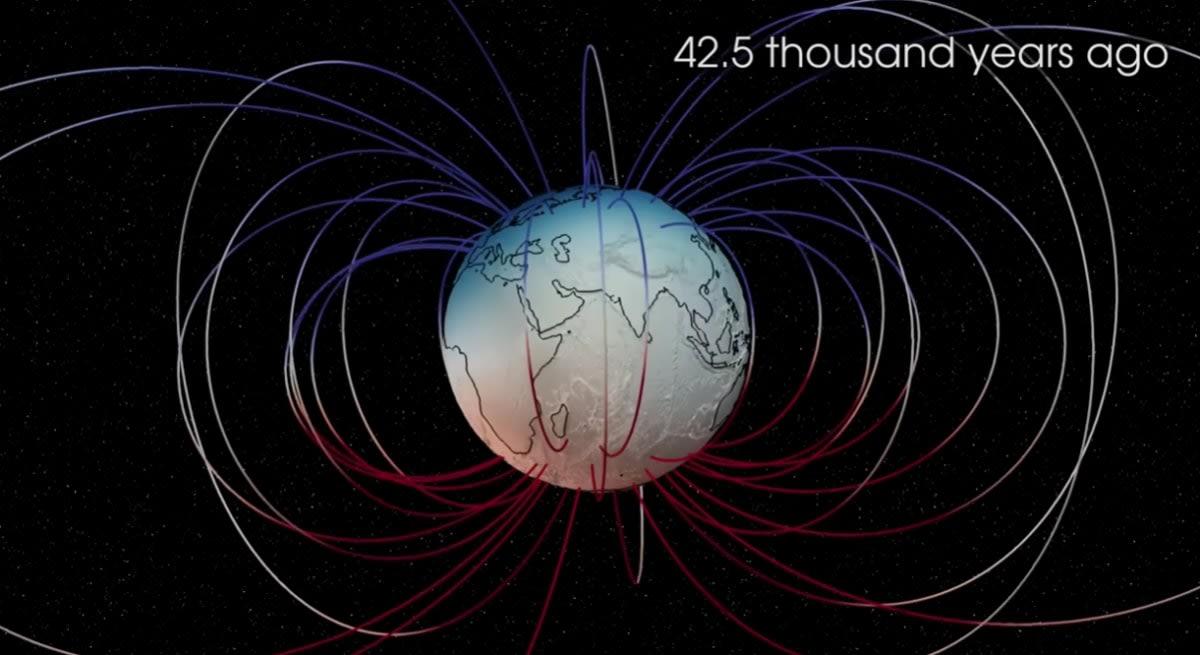
Earth's magnetic field.
The process of creating the soundscape was not too different from creating a score. The only difference is the use of natural sounds instead of musical instruments. So, when our planet endured the Laschamp event, this song could have been the background score. Earth's magnetic field is crucial to keep its inhabitants safe and protected from harmful solar radiation. However, the geomagnetic field does not remain steady, and the magnetic north does not coincide with true north, as per EurekAlert. Therefore, the magnetic field at the north pole constantly wobbles and sometimes flips.
For a brief period, the magnetic poles reverse. It means south becomes north and vice versa, a process known as magnetic field excursions. During this period, the magnetic intensity becomes low, as it did during the Laschamp event. Low magnetic intensity during these flips increases cosmic ray activity on Earth. In 2024, Sanja Panovska, a researcher at GFZ Potsdam, studied the relationship between ancient magnetic field intensity and cosmogenic radionuclides such as beryllium-10. She found beryllium-10 production doubled during the Laschamp event, indicating intensified cosmic ray exposure.
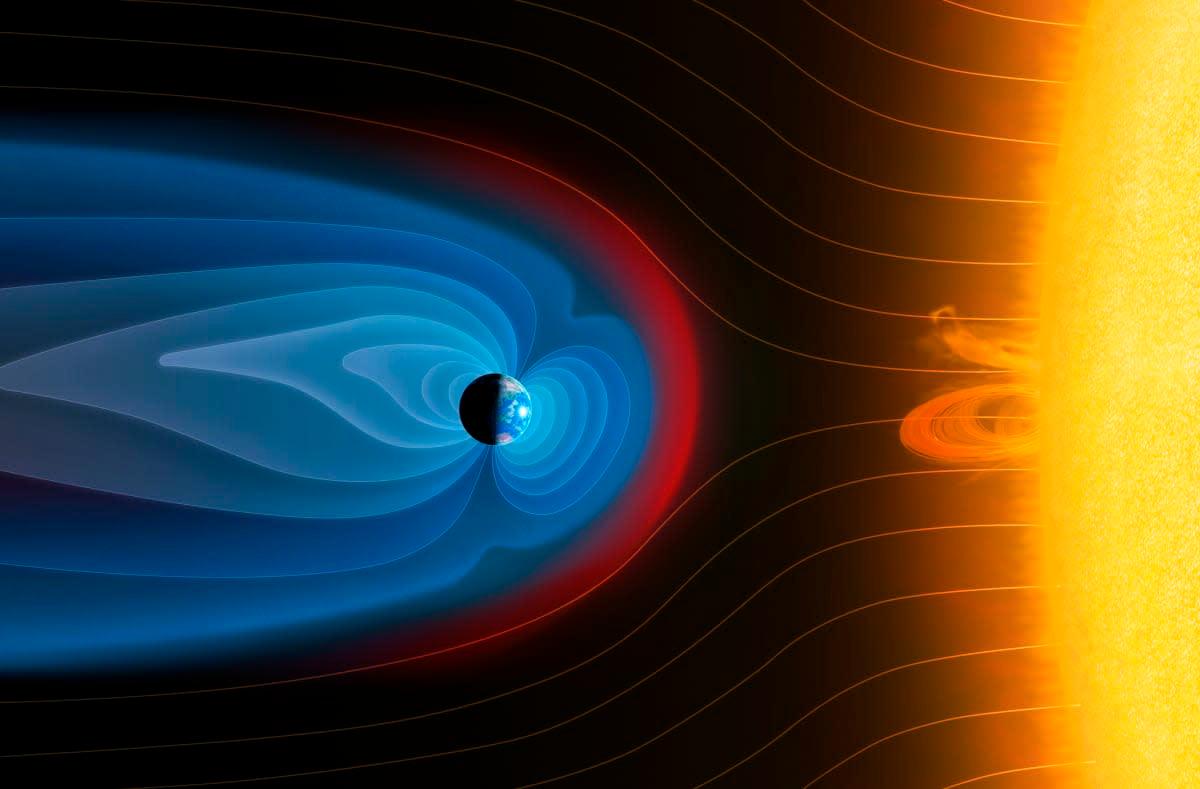
Illustration showing the interaction of the solar wind (red) with Earth's magnetic field (blue, not to scale).
In simple words, flipping of Earth's magnetic field entails low magnetic intensity and a high level of cosmic radiation reaching the planet. According to Panovska's findings, the magnetosphere contracted during the Laschamp event, reducing the "shielding" of our planet. "Understanding these extreme events is important for their occurrence in the future, space climate predictions, and assessing the effects on the environment and on the Earth system," she said at the time. Although it is rare, magnetic field excursions like the one that happened about 41,000 years ago can have a significant impact on Earth. But this is just one of the many magnetic field anomalies that have been recorded in previous studies.
Recently, a worrying development about the South Atlantic Anomaly was brought to light, with potential consequences of the widening "dent" in the magnetic field. The patch located somewhere near South America has the weakest magnetic field around the Earth, and the weak spot is concerning the stretching of its boundaries. The wider it spreads, the more vulnerable the area becomes to harmful solar rays and particles, slowly chipping away at Earth's atmosphere. "It's changing differently towards Africa than it is near South America. There’s something special happening in this region that is causing the field to weaken in a more intense way," a researcher said at the time.