
A New Celestial Visitor Just Entered Our Solar System — and It Could Be the 'Great Comet of 2026'
Published Jan. 13 2026, 3:02 a.m. ET

Comet C/2025 A6 (Lemmon), which passed us by in October 2025.
If 3I/ATLAS wasn’t enough of an excitement, our solar system has recently welcomed a new comet visitor. However, like 3I/ATLAS, it hasn’t arrived here from an interstellar home, but from a thick bubble of gas and icy pieces that envelops our solar system. Scientists have named it C/2025 R3 (PanSTARRS). Swinging around 215 million miles away from Earth, somewhere between the orbits of Mars and Jupiter, the icy visitor is being revered with the honorary title of the “Great Comet of the Year” for its potential to become the brightest comet of the year, per TheSkyLive. Scientists don’t yet know for how long the comet will spend wandering in our solar system, but it is here to stay at least until May.
C/2025 R3 (PanSTARRS)’s visit comes in the wake of the comets C/2025 A6 (Lemmon) and C/2025 R2 (SWAN) that kept comet watchers busy in 2025, not to mention the extremely curious 3I/ATLAS that is still the showstopper of the celestial comet show. Astronomer Yudish Ramanjooloo from the University of Hawaii and his fellow scientists first detected the comet in the Haleakala Observatory in Maui, using the Panoramic Survey Telescope and Rapid Response System (Pan-STARRS), per Harvard. Pan-STARRS is a pair of 5.9-foot reflector telescopes located at Haleakalā in Maui, Hawaii.
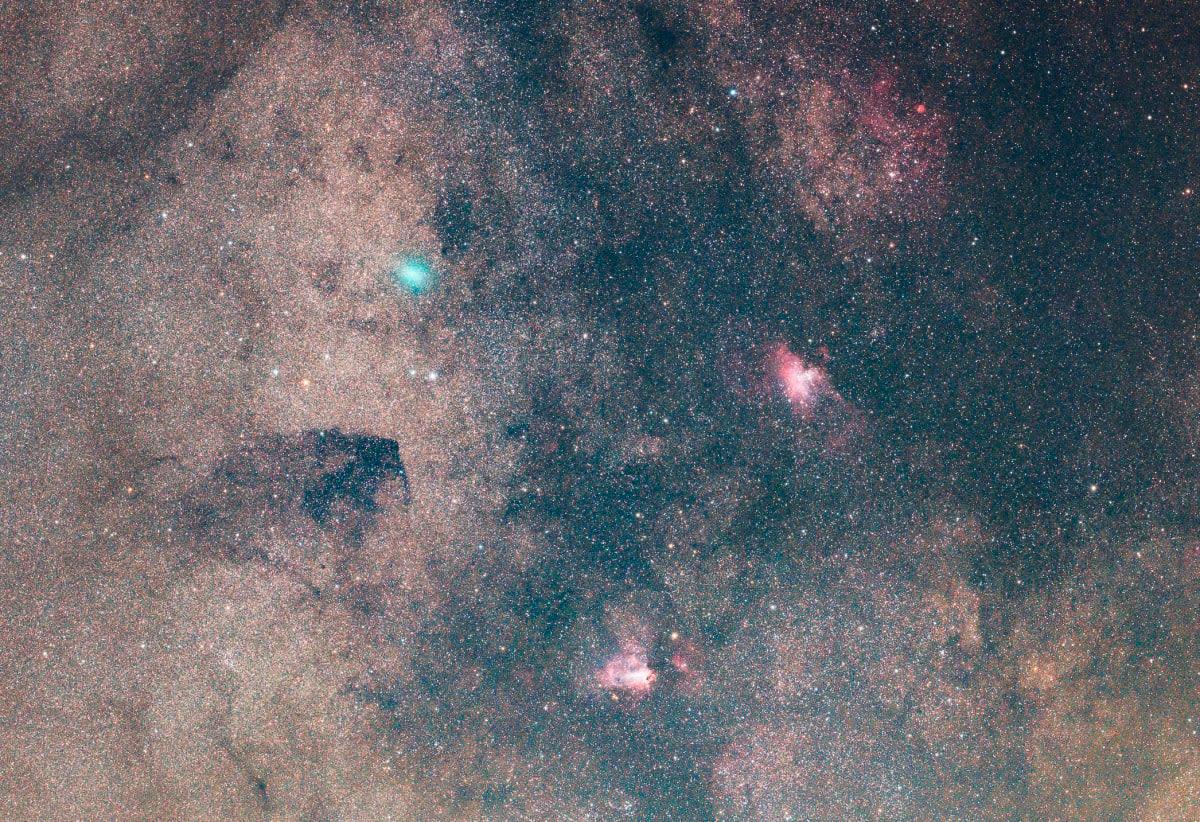
Comet SWAN C/2025 R2 Omega Nebulae in the Galactic Center in Espanya la Vella, Comunitat Valenciana, Spain.
On September 8, 2025, when it was first spotted, it appeared extremely faint. Over time, a sequence of processes has brought it to a point that it is now set to become one of the brightest comets of the year. Astronomers anticipate that it will reach its closest point to us less than four months from now. Currently speeding towards the Sun, the comet will reach its closest point or the perihelion on April 20 and will come within 47.4 million miles of the Sun’s boundary, somewhere between the orbits of Mercury and Venus.
Following its meeting with the Sun, it will make its closest encounter with the Earth on April 27, reaching its closest at 44 million miles, per Live Science. Since C/2025 R3 has been pigeonholed as a “long-period comet,” it is a fantastic trove of information for scientists interested in exploring materials from the early solar system, per USA Herald. Scientists are already planning to investigate its gas, dust, and overall chemistry via various observatories.
Two people are looking at the night sky.
The objective will be to identify if the comet has any peculiar water signatures, organic molecules, and isotopic ratios that can tell some stories of previous planetary formations. It's unusual trajectory and orbit may also recite the cosmic tales of ancient events that unfolded on the fringes of our solar system and about the gravitational disturbances the system experienced from passing stars and celestial objects. As for now, astronomers aren’t sure how brightly the comet will shine during its approach to the Sun or the Earth. There are various factors at play, as described by Space. First is solar radiation and how it will react with the Sun.
How much brightness it exhibits during its meet-up with the Sun will also determine whether or not it will be visible to the naked eye. Some researchers predict that it might reach the magnitude 8, which means it will only be visible via a pair of binoculars or a telescope. Whereas others predict that it might reach the magnitude of 2.5, which means it could be clearly visible to the naked eye. It boils down to what kind of chemistry it will experience as it gets in touch with the Sun.
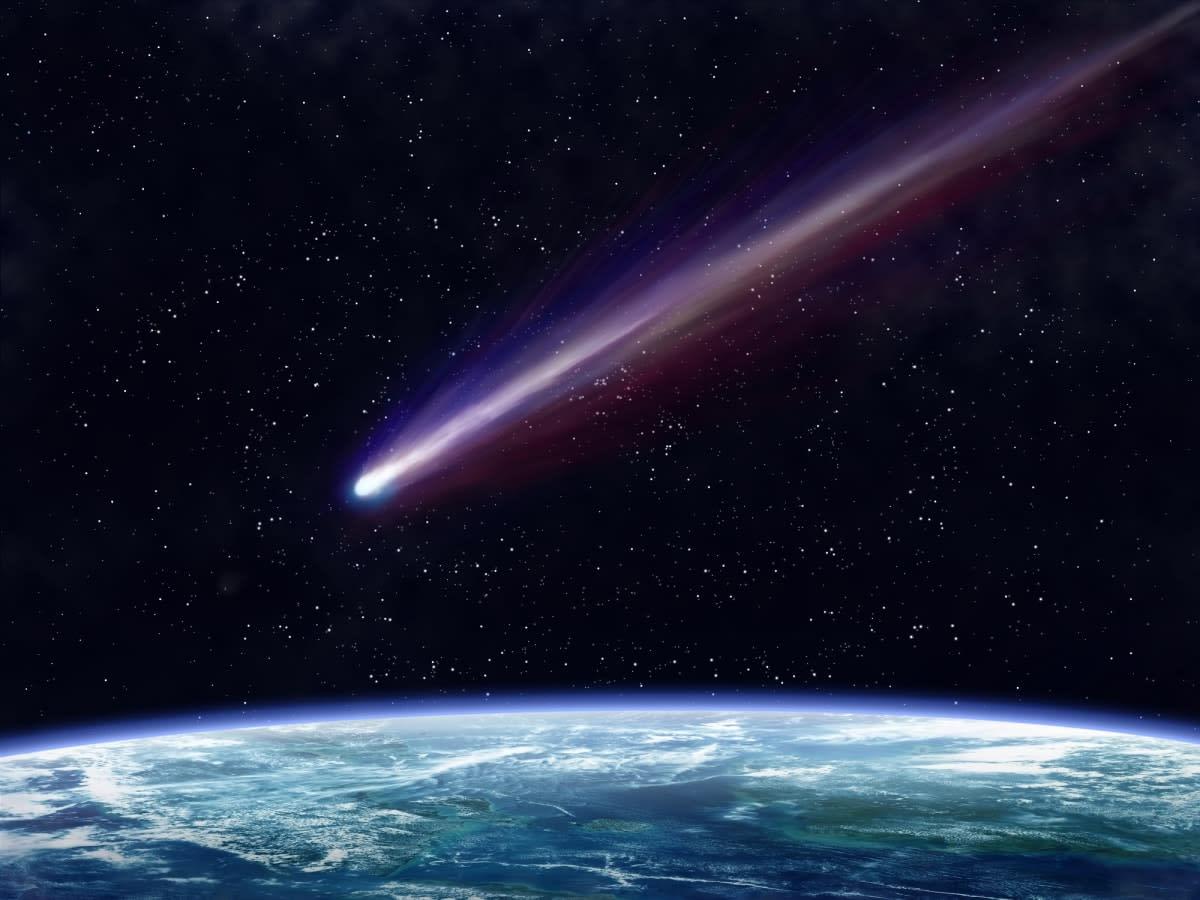
A glowing purple comet flits through the starry space.
Another factor that might influence its brightness is a phenomenon called forward scattering. Forward scattering is much like a sunbeam piercing a dusty room. The countless dust particles in the room collect sunlight and reflect it, making the room appear brighter. When the comet comes between the Earth and the Sun, its gassy-dusty coma concentrates the light of the Sun into itself and makes the comet appear babbling with glitter. Whether this brightness dims down by summertime, or whether it flares into a fierier glow, only time will tell.