
Scientist Identifies Technology to Help Extract Water from Beneath Mars' Surface
Published Jan. 27 2026, 6:46 a.m. ET

Portrait of a lake on the Martian surface.
A new breakthrough in research has increased hope for human survival and sustenance on Mars. Besides the right atmosphere, the Red Planet needs enough water to sustain life. A recent study examining alternative sources of water has reignited hope of making the planet habitable for humans in the future. Although water sources are scattered around Mars — underground ice, moisture-rich soil, and atmospheric vapor — extracting water is tricky for early explorers.
The study, published in the journal Advances in Space Research, focused on effective ways of collecting water from varied sources enough to support human habitation. “Reliable access to water would be essential for human survival on Mars, not only for drinking but also for producing oxygen and fuel, which would reduce dependence on Earth-based supplies," Dr Vassilis Inglezakis, from the University of Strathclyde’s Department of Chemical & Process Engineering, said in a statement.
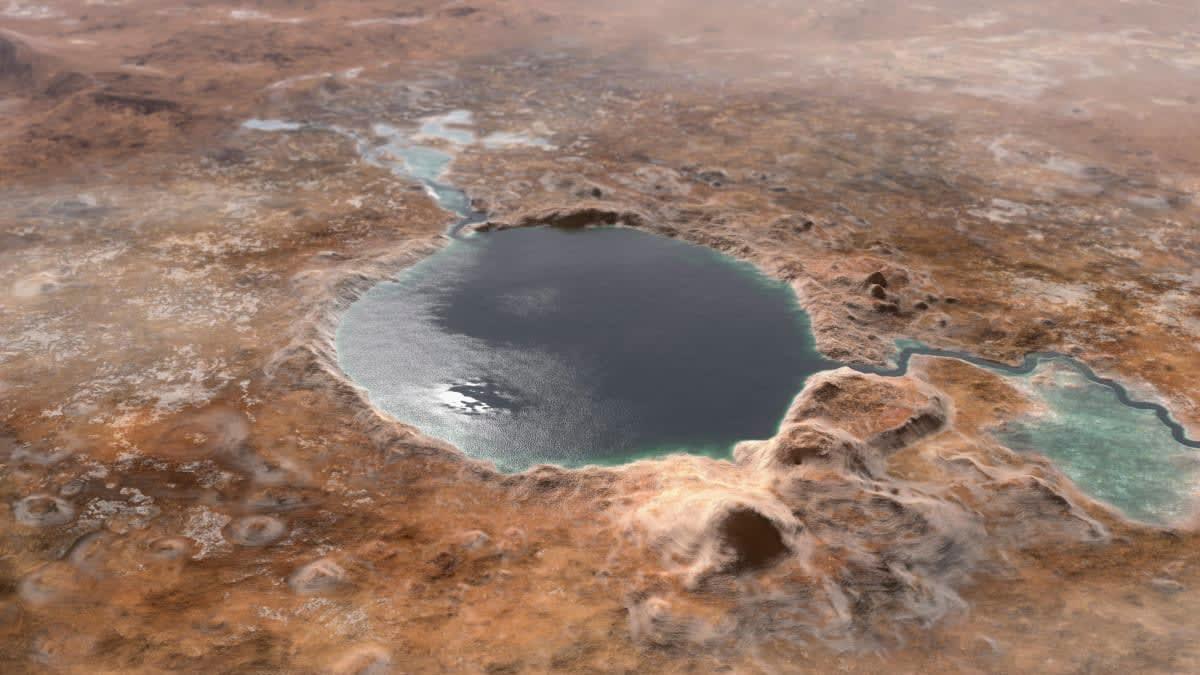
Illustration of a lake on the Jezero Crater on Mars.
Inglezakis revealed that it is the first study to compare different water extraction technologies that could be used on Mars. “It also puts forward new ideas for atmospheric water harvesting, offering potentially valuable alternatives where other sources are inaccessible,” he added. Colonizing the Martian land has been a dream of space agencies, and this research may be one of the first practical approaches to turning it into a reality. The research discussed modern technological methods while considering factors such as energy demands, scalability, and compatibility with the Martian environment. One natural water source that fits all these criteria the best is underwater ice, especially in terms of long-term scalability.
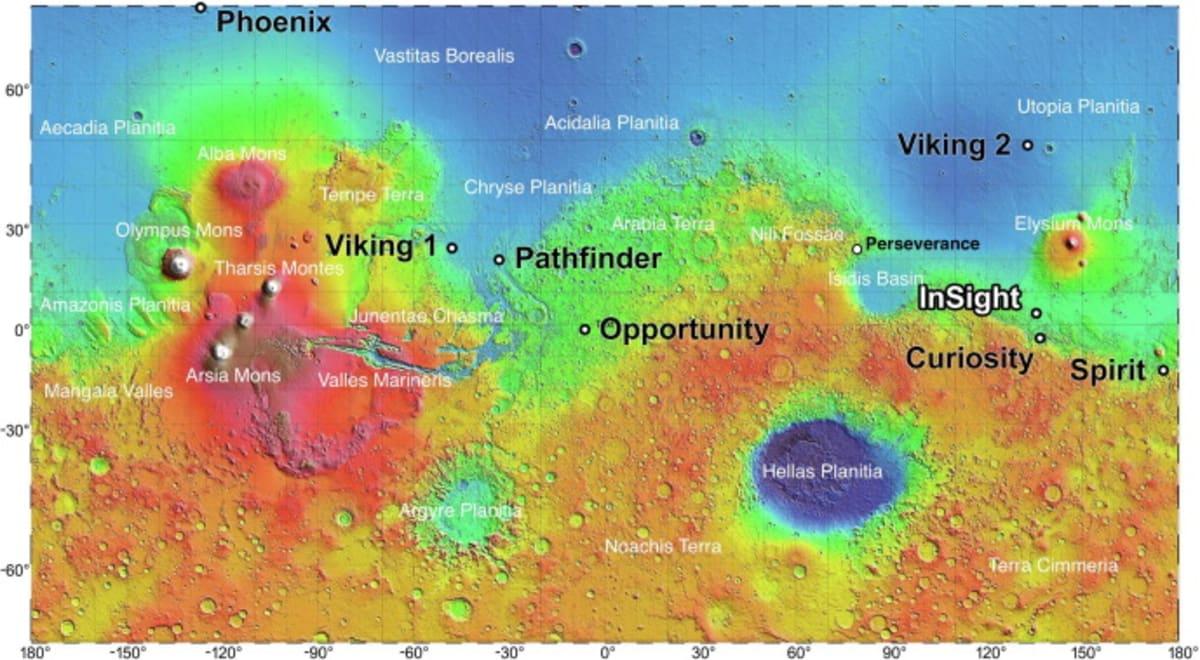
Mars topographic map based on Mars Orbiter Laser Altimeter (MOLA) showing location of landers (adapted from a NASA/JPL-Caltech image). Colors show the elevation, from dark blue (−8000 m) to brown (12,000 m).
That being said, atmospheric vapor and soil moisture can also act as reliable alternatives or secondary sources. Those potentially inhabiting remote areas of the planet can rely on these sources for water. According to the researchers, these alternatives will also come in handy during emergencies. Overall, extracting water from multiple sources makes sense for a long-term habitation goal on Mars. Moreover, this research focuses on the technologies that are already available, making the findings more practical and reliable. “While the search for water continues and much of Mars remains unexplored, a clear understanding of available technologies and their realistic applications will be key to supporting sustained missions and eventual settlement,” Inglezaki pointed out.
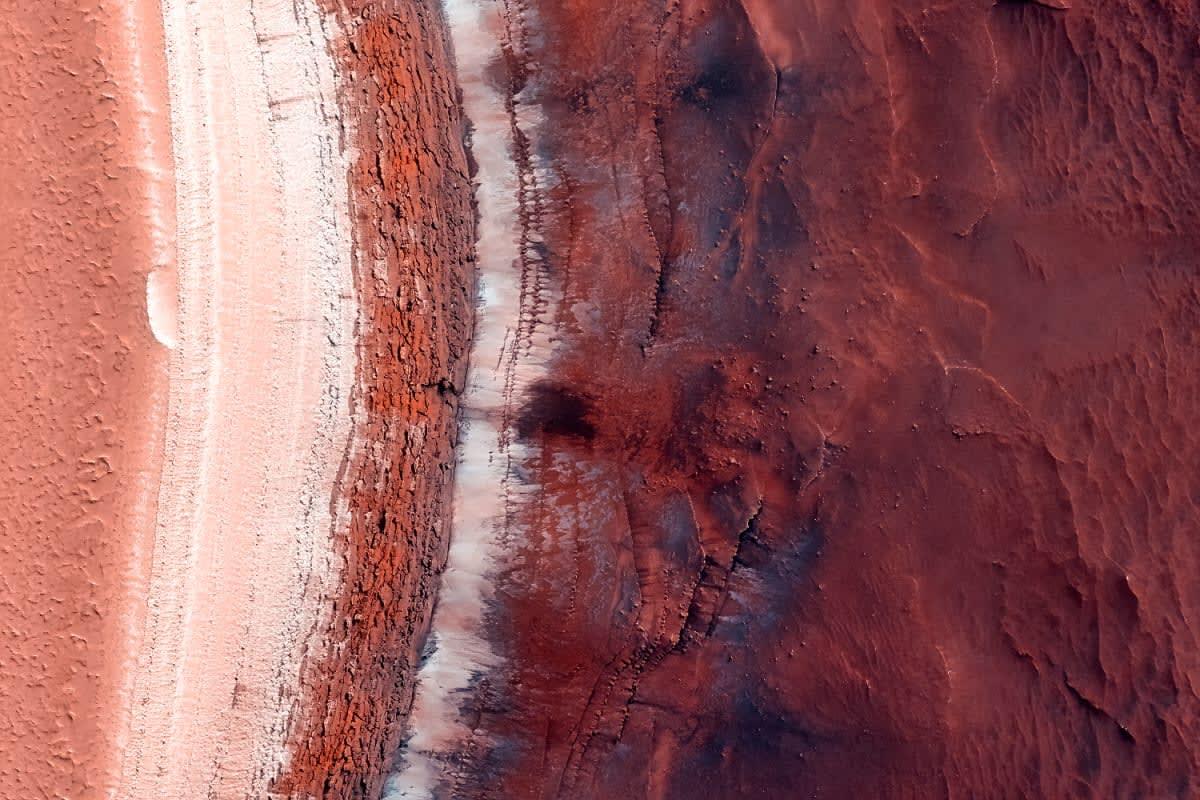
A close-up of an ice cap on Mars.
Even NASA has Mars on its radar for future explorations. The agency's Artemis IV aims to build a space station on the Moon to pave the way for future explorations. The mission aims to build humanity's first lunar space station, which will eventually carve out possibility of human missions to Mars. In an earlier study, researchers proposed using water decomposition to produce oxygen on Mars through electrochemical water oxidation (OER), enabling human habitation. The research team from the University of Science and Technology of China built a robotic artificial intelligence called AI-chemist to synthesize OER catalysts to enhance the production of oxygen in the Martian environment.
“This type of research is of wide interest and is under rapid development in organic/inorganic material synthesis and discovery,” said Prof. Jiang Jun, co-lead of the study. He believes that the technology will achieve a feat without human interference. “In the future, humans can establish an oxygen factory on Mars with the assistance of an AI chemist. This breakthrough technology brings us one step closer to achieving our dream of living on Mars,” he added.