
Dust Particles on Mars Are Changing the Planet's Chemistry in Surprising Ways, Experts Find
Published Jan. 13 2026, 8:52 a.m. ET

Illustration of a Martian dust storm.
Dust isn't that bad after all, at least on Mars. The Red planet has an abundance of dust, dirt, and soil across most of its surface, and they constantly interact or rub against one another. From this friction between the dust particles comes electricity that can light up the Martian sky. In a recent study published in Earth and Planetary Science Letters, researchers found that electricity created by dust also significantly influences the planet's chemistry. Researchers found that the dust storms across the Martian surface create enough frictional electricity to break down the planet's atmosphere. Electrostatic discharges (ESD) are common on the Red planet because of its low atmospheric pressure, and they appear with a slight glow, similar to auroras on Earth.
Cold reddish desert landscape of Mars
Alian Wang, a planetary scientist and a professor at Washington University in St. Louis, studies the chemical changes caused by the electrical discharge triggered by movements of dust storms or particles. Wang and her team developed two planetary simulation chambers, PEACh (Planetary Environment and Analysis Chamber) and SCHILGAR (Simulation Chamber with InLine Gas AnalyzeR). These chambers imitate Mars' climate conditions, including its low atmospheric pressure and dry surface. The scientists added fine dust particles to these simulated atmospheres to mimic the dust storms found on Martian land. They found that the movement of dust particles on the planet could generate carbonates, (per)chlorates, and volatile chlorine.
The researchers studied the chemical fingerprints of the reaction products produced by an ESD created in the simulated chambers by analyzing isotopic compositions of chlorine, oxygen, and carbon. The measurement was different from previous quantification, which prompted the researchers to realize the significance of electricity triggered by dust storms. "Because isotopes are minor constituents in materials, the isotopic ratios can only be affected by the MAJOR process in a system," Wang said. "Therefore, the substantial heavy isotope depletion of three mobile elements is a 'smoking-gun’ that nails down the importance of dust-induced electrochemistry in shaping the contemporary Mars surface-atmosphere system," she added.
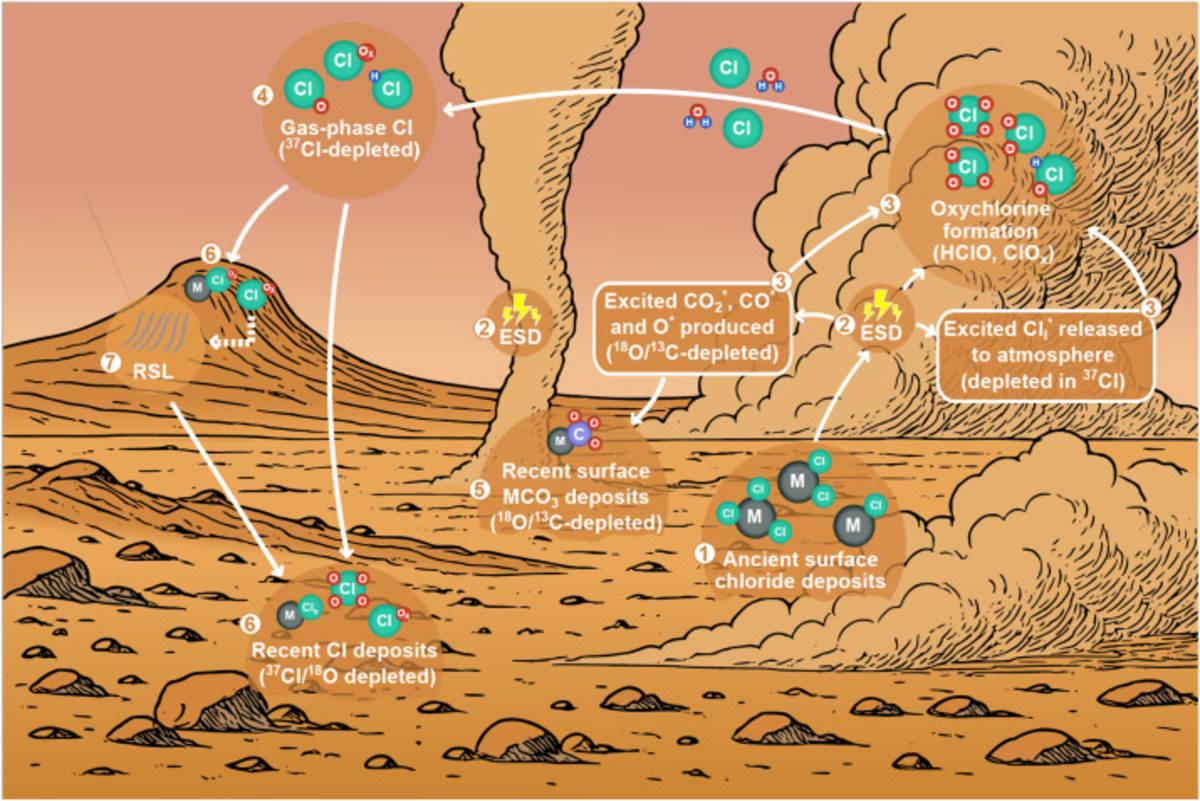
A conceptual model of the Mars global contemporary surface-atmosphere Cl cycle and air-borne carbonates that is consistent with the results of the present study (i.e., the transfer of isotopic signatures)
Wang and her team combined these measurements with previous findings and formed a new model of Mars’ modern chlorine cycle. This model helps explore the interplay between the dust-triggered ESD and the chemical composition of the planet's atmosphere. It's fascinating how the electrical discharge produces reactive chemicals in the atmosphere, which ultimately settles into the surface of Mars, changing the chemical composition of the planet. Since the isotope composition produced through ESD is reduced, scientists were able to connect the dots to some bizarre isotope composition found on the Martian land. This may have been the factor responsible for the extremely negative chlorine isotope values, as observed by NASA’s Curiosity rover.
"This is the first experimental study to look at how electrostatic discharges can affect isotopes in a Martian environment," said Kun Wang, an associate professor of Earth, environmental, and planetary sciences at Washington University. "Isotopic signatures are like fingerprints, and they can be used to trace the processes that have influenced the chlorine cycle on Mars, which makes this study especially valuable," he added. Although the experiment didn't produce the chlorine isotopic signatures that the NASA rovers detected, Kun believes that the recent finding is one step forward towards understanding their origins. "It also highlights just how different Mars is from Earth, with very different atmospheric and surface processes controlling chemical reactions,” he added.