
Mars May Have Been Far Wetter Than We Thought — With Lakes and Maybe Even Oceans
Published Jan. 13 2026, 5:25 a.m. ET

Illustration of Jezero Crater, the landing site of the Mars 2020 Perseverance rover, as it may have looked billions of years go on Mars, when it was a lake.
When thinking of Mars, a big, red, and dry landscape comes to mind. The image hardly ever consists of a water body, even though the planet is known to contain them. Recent findings may have found new leads hinting at the presence of an ancient ocean on the Red planet. Researchers at Rice University used a climate model redesigned for Mars, though a tool called Proxy System Modeling, to understand if lakes could thrive on the planet. The findings, published in AGU Advances, showed that areas near Mars' equator, like Gale Crater, could have contained lakes beneath a thin seasonal ice for decades until the climate conditions were stable. Researchers believe that the lakes that persisted over a long period might be the reason why Martian lake beds are well-preserved even today.
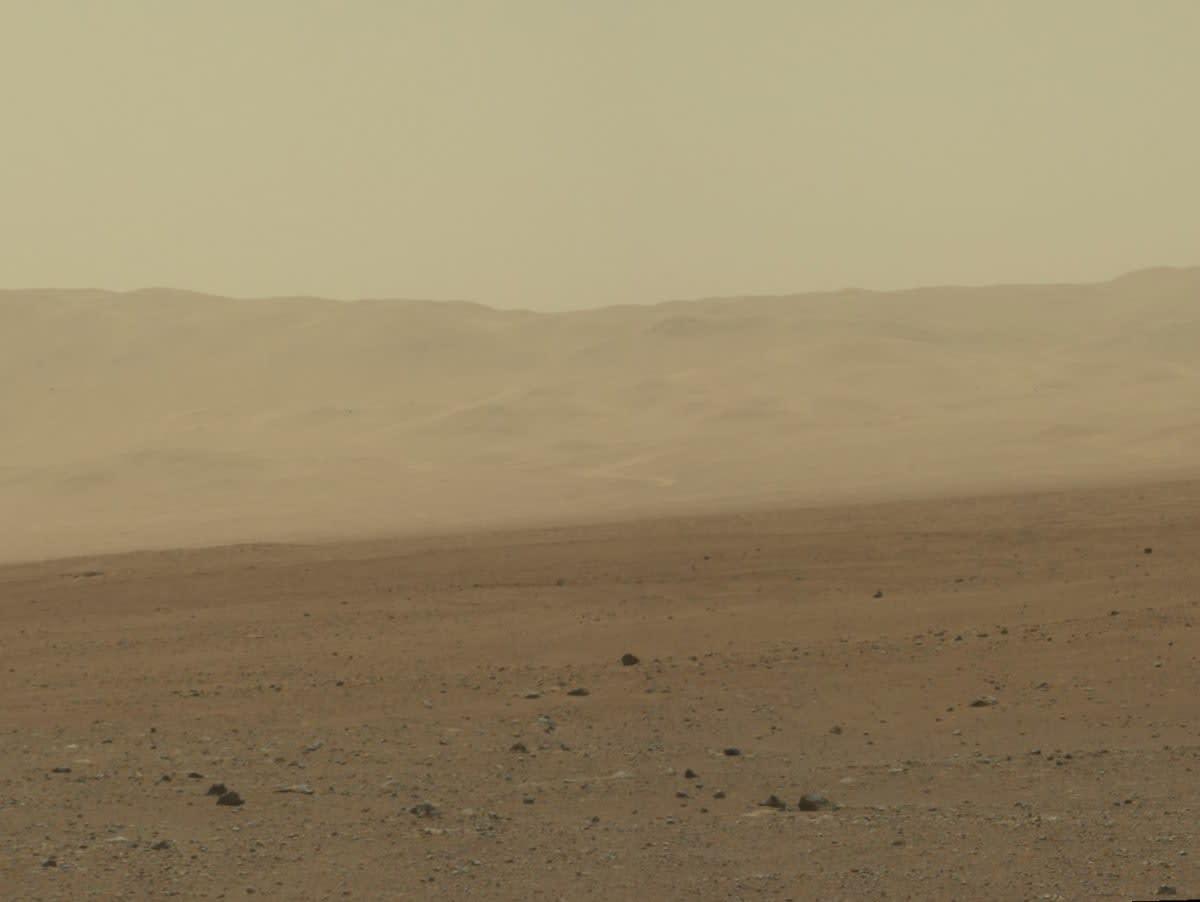
In this handout image provided by NASA/JPL-Caltech/MSSS, a color image from NASA's Curiosity rover's Mast Camera shows part of the wall of Gale Crater.
“Seeing ancient lake basins on Mars without clear evidence of thick, long-lasting ice made me question whether those lakes could have held water for more than a single season in a cold climate,” Eleanor Moreland, a Rice graduate student and lead author of the study. The fact that only a thin layer of ice was able to preserve lake bodies for so long is enough to provide scientists hope for future explorations of the Martian surface. "It was exciting that we might finally have a physical mechanism that fits what we see on Mars today," Moreland added. How could lakes have survived for so long? Different simulations showed varied results.
In some simulations, the lake froze over in the winter. Whereas in others, it remained liquid underneath the ice sheet. “This seasonal ice cover behaves like a natural blanket for the lake,” explained Kirsten Siebach, an associate professor of Earth, environmental, and planetary sciences and co-author of the study. The ice sheet melts in summer and insulates the lake beneath in winter. But because it reoccurs seasonally, they leave very faint evidence behind. “Because the ice is thin and temporary, it would leave little evidence behind, which could explain why rovers have not found clear signs of perennial ice or glaciers on Mars,” Siebach added.
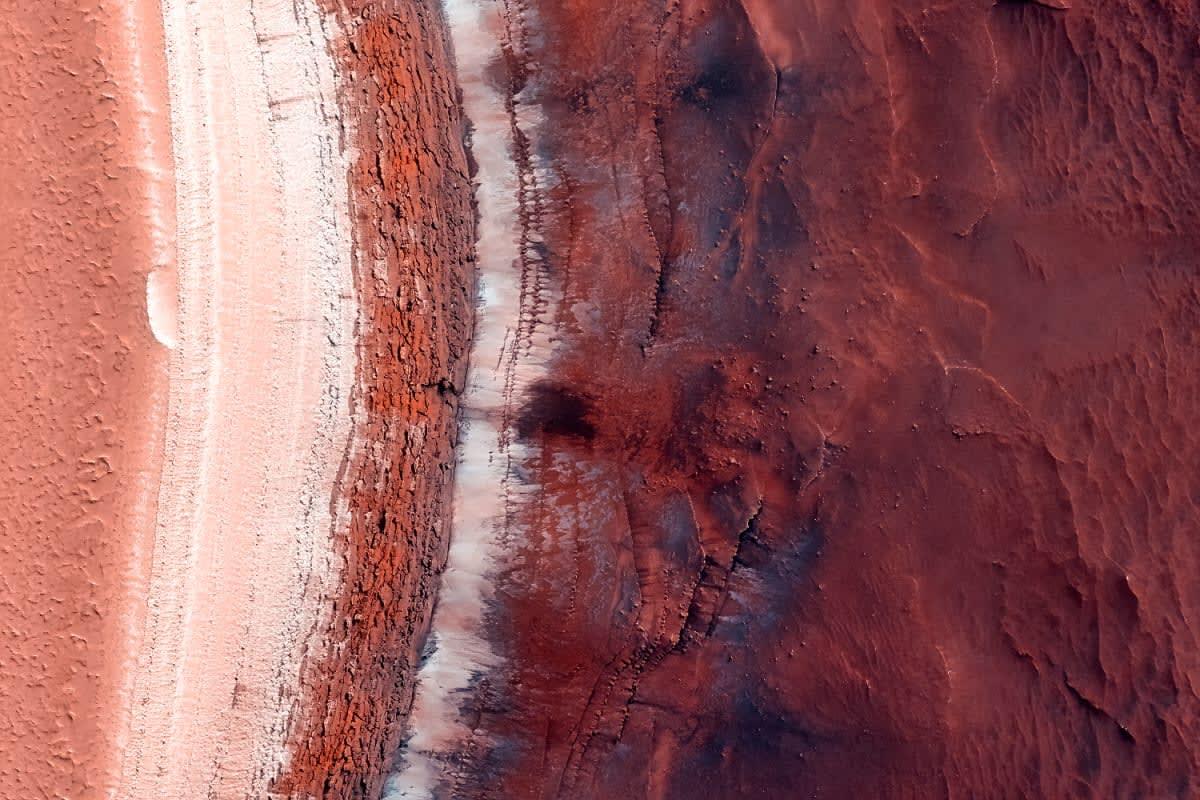
A close-up of an ice cap on Mars.
While this research found strong enough evidence of lakes persisting on Mars, another study, published in the journal npj Space Exploration, hints at a potential Martian ocean. Although the possibility of oceans existing on Valles Marineris, the largest canyon system along the equator of Mars, has been explored before, a recent study found new insights. Led by a team of researchers from the University of Bern, in collaboration with the INAF—Osservatorio Astronomico di Padova, the new study found a resemblance between the geomorphological structure of Mars' Valles Marineris and the Earth. Since the structure represents the mouth of an ocean, scientists take the finding as evidence of a Martian ocean.
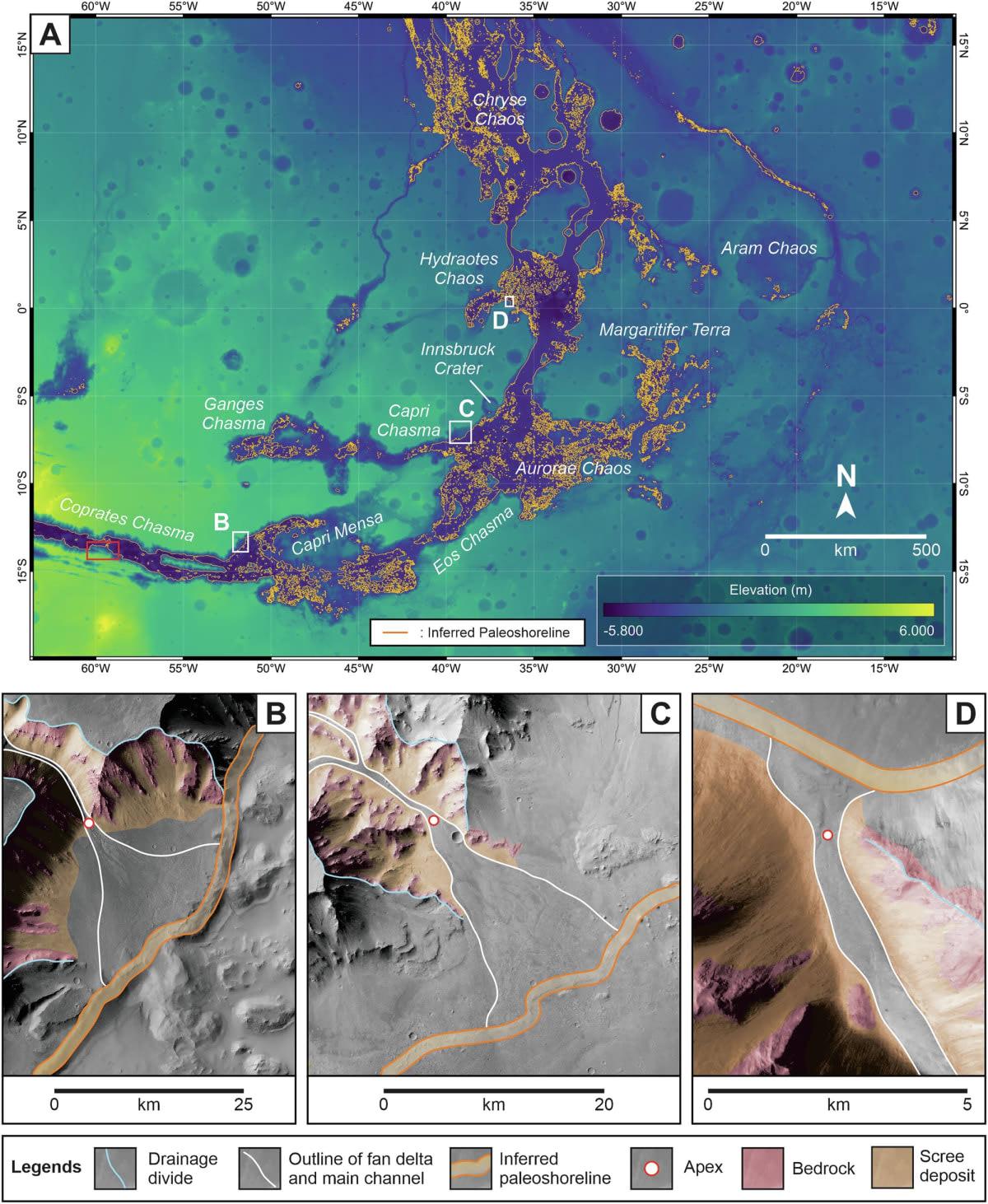
The extent of scarp-fronted deposits in Valles Marineris.
"When measuring and mapping the Martian images, I was able to recognize mountains and valleys that resemble a mountainous landscape on Earth. However, I was particularly impressed by the deltas that I discovered at the edge of one of the mountains," Ignatius Argadestya, PhD student at the Institute of Geological Sciences and the Physics Institute of the University of Bern, said in a statement. "Delta structures develop where rivers debouch into oceans, as we know from numerous examples on Earth," Fritz Schlunegger, Professor of Exogenous Geology at the Institute of Geological Sciences at the University of Bern, added. According to their findings, Argadestya says the red planet of today could have been a blue planet similar to Earth about 3 billion years ago. "This finding also shows that water is precious on a planet and could possibly disappear at some point," Argadestya added.