
Record-Breaking March ‘Heat Dome’ To Hit West Coast Soon — These Cities Will Face The Worst of It
Published March 13 2026, 7:25 a.m. ET

A person uses a piece of cardboard as a sunshade on Santa Monica Pier amid an intense heat wave in Southern California.
As winter takes its final lap, an 'extraordinary' forecast for March looms over the West Coast. The heat will turn unbearably high later this week with a record-breaking heat dome forming in the region. Experts reveal that the temperatures will soar to triple digits, making the transition from the final days of winter to summer pretty evident. So far, it's been the warmest March on record for the United States, with potential for more records in the remaining weeks of the month, as reported by The Washington Post. Los Angeles witnessed a record-breaking heat of 95 degrees Fahrenheit recently. In the next week, the city's temperature might soar to an even 100. In Phoenix, the heat could even exceed the 100-degree Fahrenheit mark, whereas Las Vegas is also predicted to reach 100 degrees.
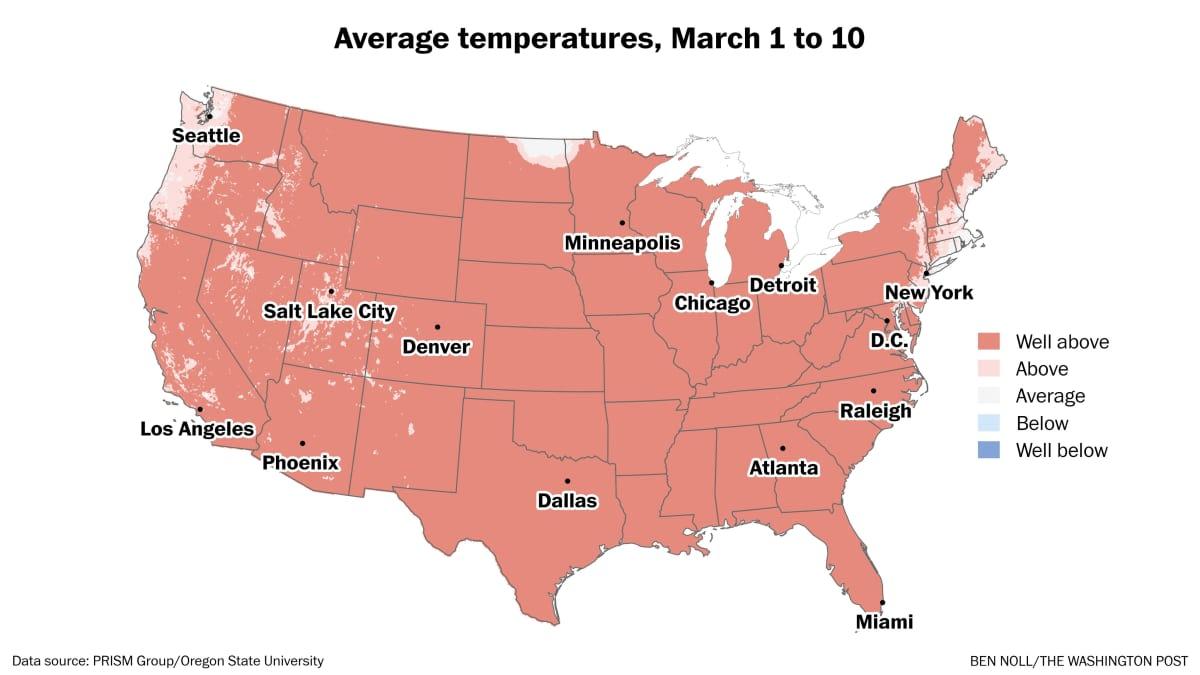
The map shows a period of remarkably high temperatures across the United States from March 1 to 10.
The sudden surge in temperature is no accident. A marine heat wave building and intensifying offshore is to blame for this pattern. Experts believe that the heat wave will further expand in the next week amid widespread record-breaking temperatures and snow drought on the West Coast. “I’d say the pattern next week would be the nail in the coffin of a very unforgettable winter season,” said assistant Utah state climatologist Jon Meyer. According to the National Oceanic and Atmospheric Administration (NOAA), extreme heat will arrive in the West in two waves. About 20 to 25 million people in the region are forecasted to be under moderate heat risk, which is level two. In this scenario, the extreme heat will impact "those who are sensitive to heat, especially those without cooling/hydration, and some health systems and industries."
In the first heat wave, arriving Thursday, Southwest regions like California, Nevada, Arizona, and New Mexico will face record temperatures. The second heat wave will arrive sometime next week and will expand to Utah, Colorado, Wyoming, Idaho, and Oregon. Over the next weekend, the forecast suggests high temperatures will be observed across the Southwest. The record temperatures in some areas will be a staggering 30 degrees higher than average. On the contrary, the monthly heat record in some regions, including Salt Lake City, Denver, and Reno, Nevada, may fall in the upcoming weeks. The temperature in these areas is predicted to reach the 80s.
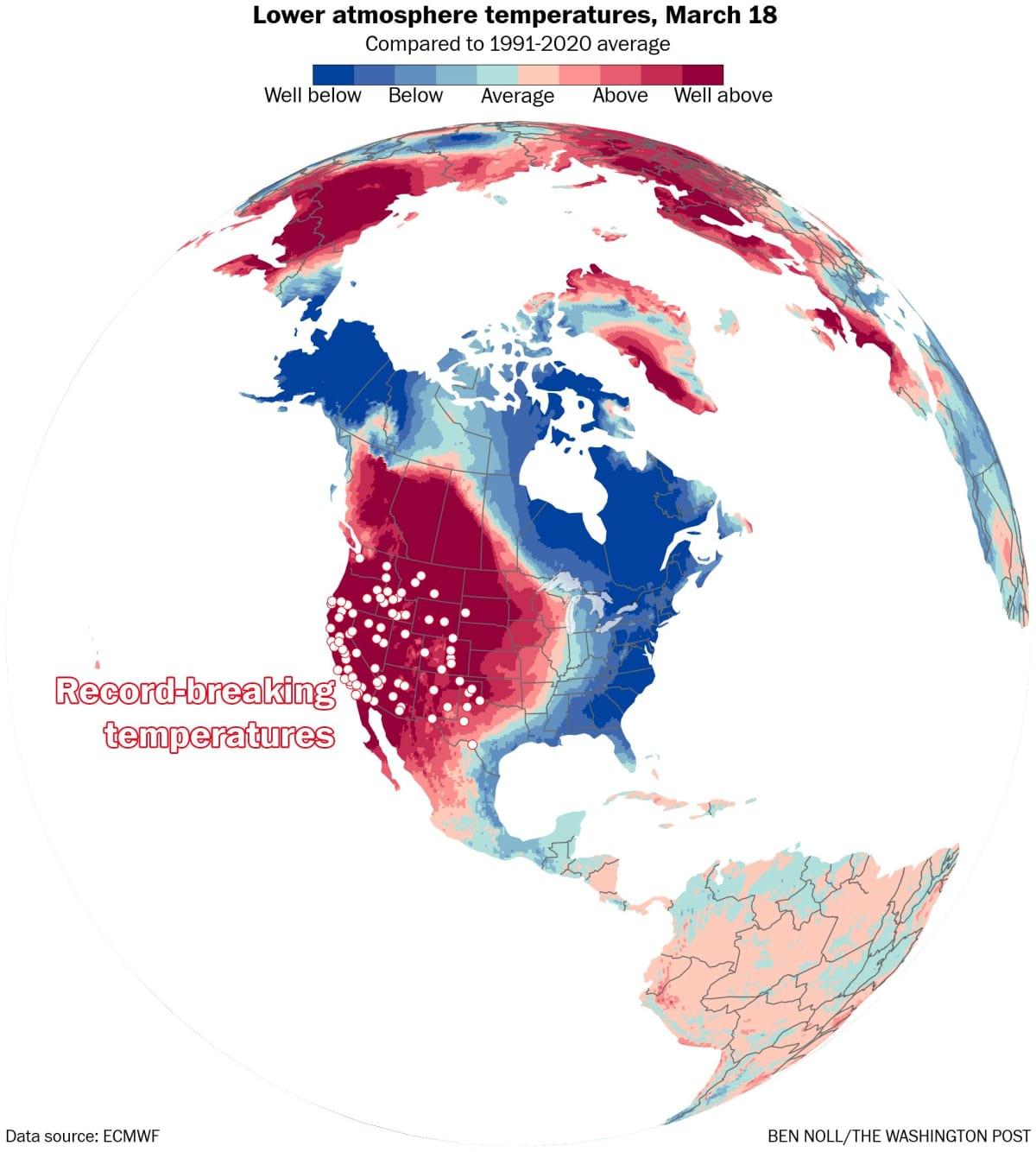
Map highlighting record-breaking heat in North America on March 18.
Climate scientist Daniel Swain says that even though the heat wave will last for a long time, the temperature won't peak for another week to 10 days. “This forecast is truly extraordinary for March,” he added. The expert also revealed that the extreme heat would rapidly melt away the remaining snowpack. This winter, the issue of snow drought was something experts struggled with. Now, with soaring temperatures, the snow drought would only worsen. Utah witnessed record-low levels of snowpack this year. “The knockout punch comes in the form of Utah’s reservoirs, which are only at 40 percent of capacity right now,” said Meyer. “All this means we are likely going to see some very tangible water supply cuts and conservation efforts by the state this year," he added.
The sea surface temperatures off the coast of Southern California have increased by about 5 degrees above average, which has aided in the development of a strong, Category 2 marine heat wave.