
NASA Scientists Create First-Ever Cosmic Mapmaker That Charts the Universe in 102 Colors
Published Dec. 23 2025, 5:38 a.m. ET

NASA's SPHEREx has mapped the entire sky in 102 infrared colors. This image features a selection of colors emitted primarily by stars and cosmic dust.
Typically, when an architect sets out to build a bungalow, a shopping mall, or maybe a monument, they draw out every corpus of details and dossiers of maps that determine the positioning of features. Since no one has met the cosmic architect, it remains beyond knowledge what happened in the first billionth of a trillionth of a trillionth of a second after the Big Bang. How this mysterious architect distributed the galaxies and what system they used to fill these up with stars, nobody has any idea. Currently, the fathomless cosmos in which Earth floats is a sprawling labyrinth of galaxies, punctuated with trails of star clusters, notorious black holes, and pulsing celestial streets littered with asteroids, comets, and assorted space rocks.
The primordial architect might have eloped into hiding and hid the secrets of their remarkable creation, but NASA scientists aren’t any less clever. They designed an instrument that breaks down light into hundreds of colors to peer into the densest trenches of the cosmos, unravel the mysteries, and curate a map of the “collective glow.” The instrument is currently hovering 400 miles above Earth, solving these ancient architectural mysteries. Meet SPHEREx, the $488 million device that NASA scientists call the “mantis shrimp of telescopes.”
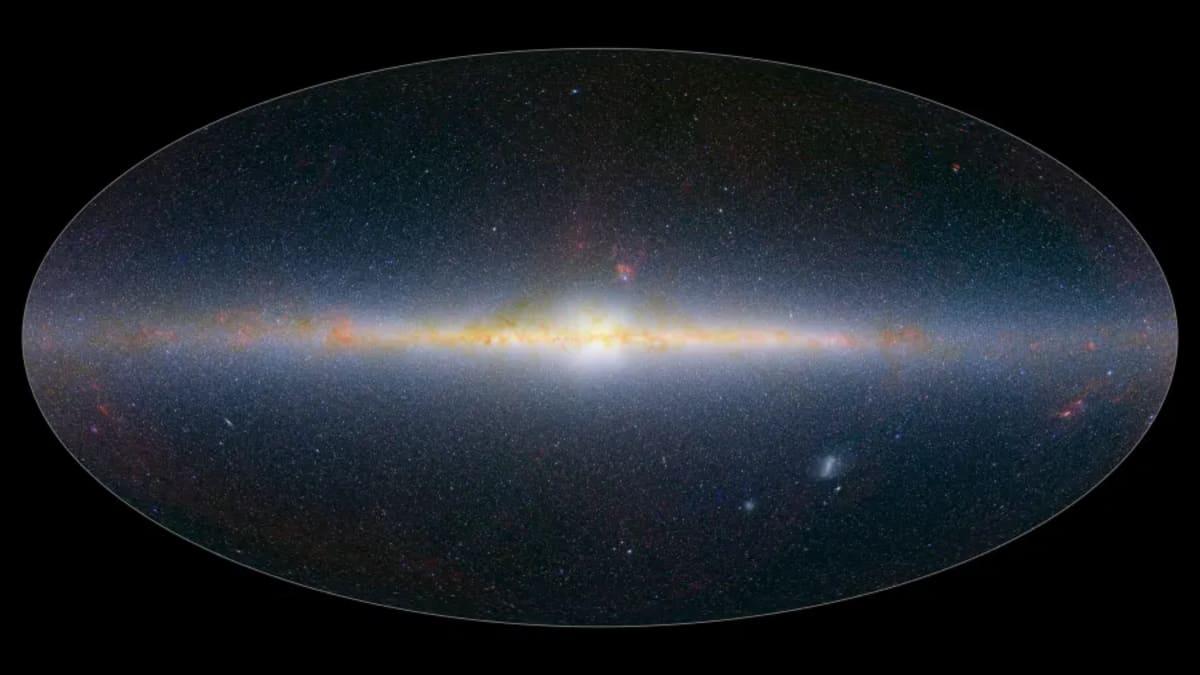
This SPHEREx image features a selection of colors emitted primarily by stars and galaxies.
Launched from Earth on March 11 this year, SPHEREx is one of the most handsome creations of NASA engineers, embellished with a multi-color visual detection system that enables them to view the universe like never before. Most telescopes work by mapping either a small patch of the universe with several different wavelengths or a vaster portion with a smaller number of wavelengths. SPHEREx does both. The x-factor of this mechanical detective is its ability to manipulate light to unfurl information and memories accumulated over billions of years of evolution.
The technology is simple. SPHEREx collects light from astronomical bodies like galaxies, and breaks it down into a rainbow, a process called spectroscopy. While the rainbow humans see has only seven colors, it breaks down light into hundreds of colors and creates 3D maps of the cosmos. It is studded with six detectors, each with a filter with a gradient of 17 colors, which means it can isolate light from 102 different wavelengths.
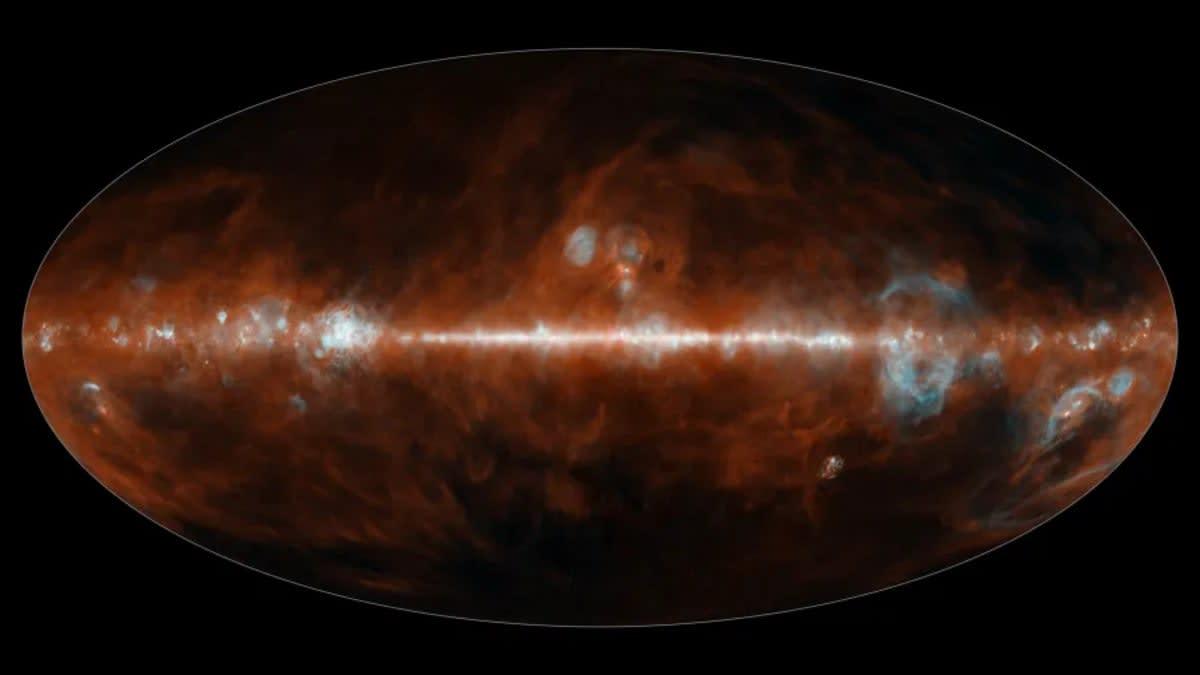
This SPHEREx image features a selection of colors emitted primarily by dust (red) and hot gas (blue).
SPHEREx, or Spectro-Photometer for the History of the Universe, Epoch of Reionization and Ices Explorer, has many striking features, but two of them are the most crucial: The photon shields that keep it cool from the radiation of the Sun and Earth, and the aluminium grooves with jewel-like mirrors that deflect extra heat into the universe. Funny thing, SPHEREx’s concentric cone-shaped mouth looks like a dog collar, NASA JPL joked on Instagram.
SPHEREx identifies the signatures of specific color molecules to create 360-degree maps of the cosmos. It circles the Earth about 14.5 times a day, journeying from north to south. In just one day, it snaps over 3,600 images that reveal colors like the electric blue of hot hydrogen, the tantalizing red of the cosmic dust, and the magenta of star clusters. The instrument is managed by NASA’s Jet Propulsion Laboratory in Southern California.

Stunning view of stars and blue-purple light in a galaxy
“It’s incredible how much information SPHEREx has collected in just six months, information that will be especially valuable when used alongside our other missions’ data to better understand our universe,” said Shawn Domagal-Goldman, director of the Astrophysics Division at NASA Headquarters in Washington. Currently, the cosmic mapmaker is looking forward to unfolding the mysteries like cosmic inflation, dark energy, different flavors of ice in the Milky Way, the tally of light generated across the universe, and the whole story of how the Big Bang shaped the cosmos. Recently, it also joined other telescopes to learn more about the interstellar comet 3I/ATLAS, per NASA.
You can watch the video here.