
NASA Says a Bus-Sized Asteroid Is Nearing Earth Today. Does It Pose a Threat?
Published March 11 2026, 7:09 a.m. ET

Star map showing the position of NEO Asteroid 2026 CC3 in the constellation of Hydra
Asteroid 2026 CC3 will be flying by Earth very closely today. The newly spotted celestial object is approximately 33 feet wide, around the size of a city bus. The asteroid will fly safely past Earth on March 11, 2026, at a distance of about 976,000 miles, according to NASA’s tracking data. Officially named 2026 CC3, it is currently in the direction of the constellation Hydra. The asteroid is being closely monitored by experts at the facility as part of ongoing efforts to track near-Earth objects (NEOs) to better understand their paths through space.
However, the space rock is pretty small as far as near-Earth asteroids go. Compared to the giant asteroids scientists actually worry about in terms of planetary defense, this one is tiny. That said, astronomers are still tracking asteroids like 2026 CC3. Even small ones can help scientists learn more about how these objects move through our corner of the solar system. And it’s not unusual, many small asteroids pass by Earth every year, usually at safe distances. Each flyby offers researchers another prospect to study them, improve their tracking methods, and fine-tune the systems used to spot near-Earth objects. This will help scientists detect larger asteroids, which will actually pose a threat in the future.
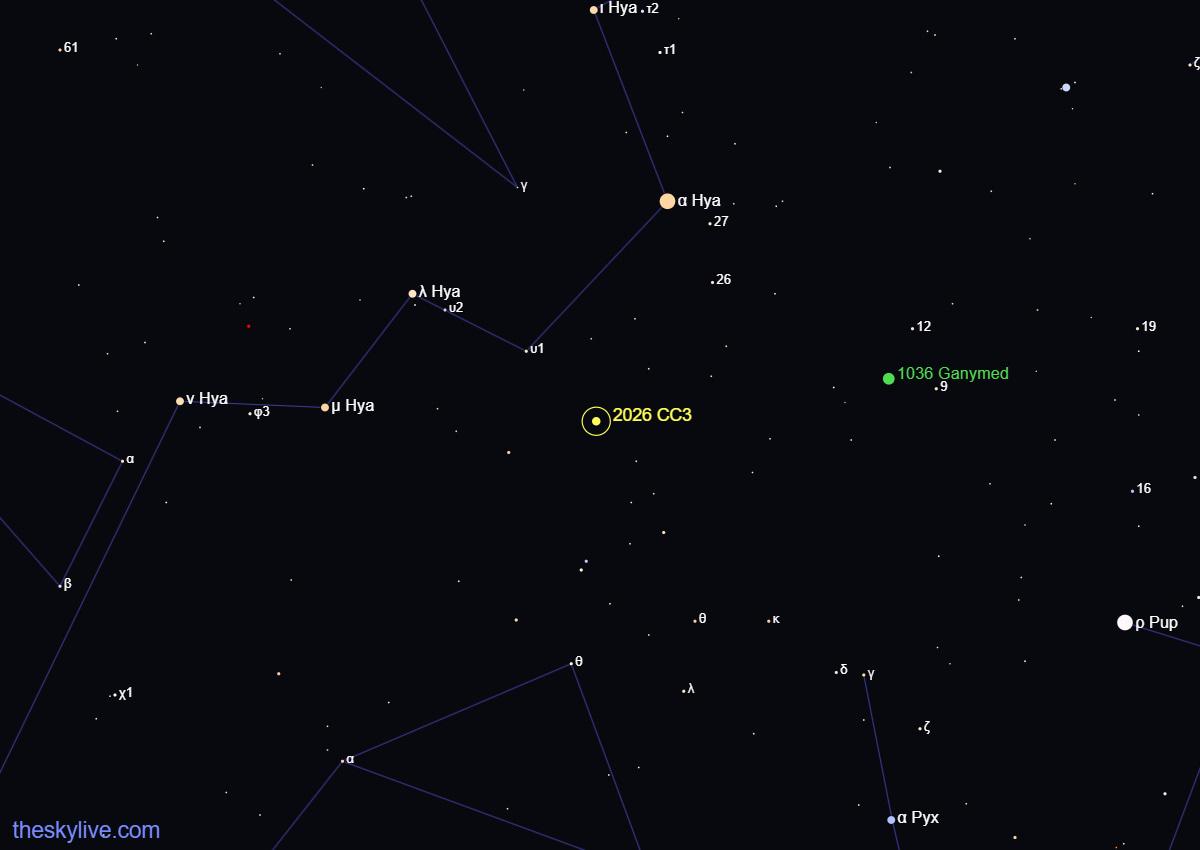
Star map showing the position of NEO Asteroid 2026 CC3 in the constellation of Hydra on March 11, 2026
2026 CC3 will pass by Earth at a distance of 976,000 miles. Although it may sound close, in space terms, it is still a safe distance. The asteroid is expected to make its closest approach at around 05:00 UTC. For U.S. viewers, that is roughly 1:00 AM Eastern Time, midnight Central Time, and 10:00 PM Pacific Time on March 10. The exact timing can shift a little as astronomers collect more observations and continue refining the asteroid’s orbit.
It is crucial to note that asteroids like 2026 CC3 are regularly tracked by observatories worldwide. It is especially monitored by NASA’s Center for Near-Earth Object Studies (CNEOS). When astronomers spot a new object like this, one of the first things they do is work out its orbit. They calculate the asteroid’s path around the Sun and check whether it will pass near Earth by using telescope observations. From there, they can estimate when the asteroid will come closest to our planet and how far away it will be. This helps scientists quickly figure out if the object poses any danger or if it will pass safely.
2026 CC3 is just one of many small asteroids expected to pass safely by Earth in the coming months. Several other asteroids have also made, or are expected to make, safe flybys of the planet. For instance, asteroid 2026 CU1 passed Earth on February 26, 2026, coming within about 764,000 miles. Another object, 2026 CR2, made a much closer approach on March 8, 2026, passing at roughly 84,800 miles from Earth. Meanwhile, asteroid 2026 DG7 flew past the planet on February 27, 2026, at a distance of about 2.24 million miles.