
An Airplane-Sized Asteroid Is Heading Close to Earth— NASA Details Its Trajectory
Published Dec. 19 2025, 3:16 a.m. ET

Asteroid making its closest approach to Earth
NASA's Jet Propulsion Laboratory is tracking a near-Earth asteroid roughly the size of an airplane. The asteroid named 2025 XQ3 is set to make a safe closest approach to our planet on December 19, 2025. The object, approximately 100 feet in diameter, will be located at a distance of 2.14 million miles from Earth, according to the space agency. Although it's extremely far in general standards, it's the closest the asteroid will ever come to our planet in its 2025 orbit. Another asteroid will reach its closest distance to Earth on the same day: An asteroid named 2025 XV3, measuring 170 feet. This would be yet another airplane-sized asteroid that will reach its closest approach at a distance of 3.5 million miles.
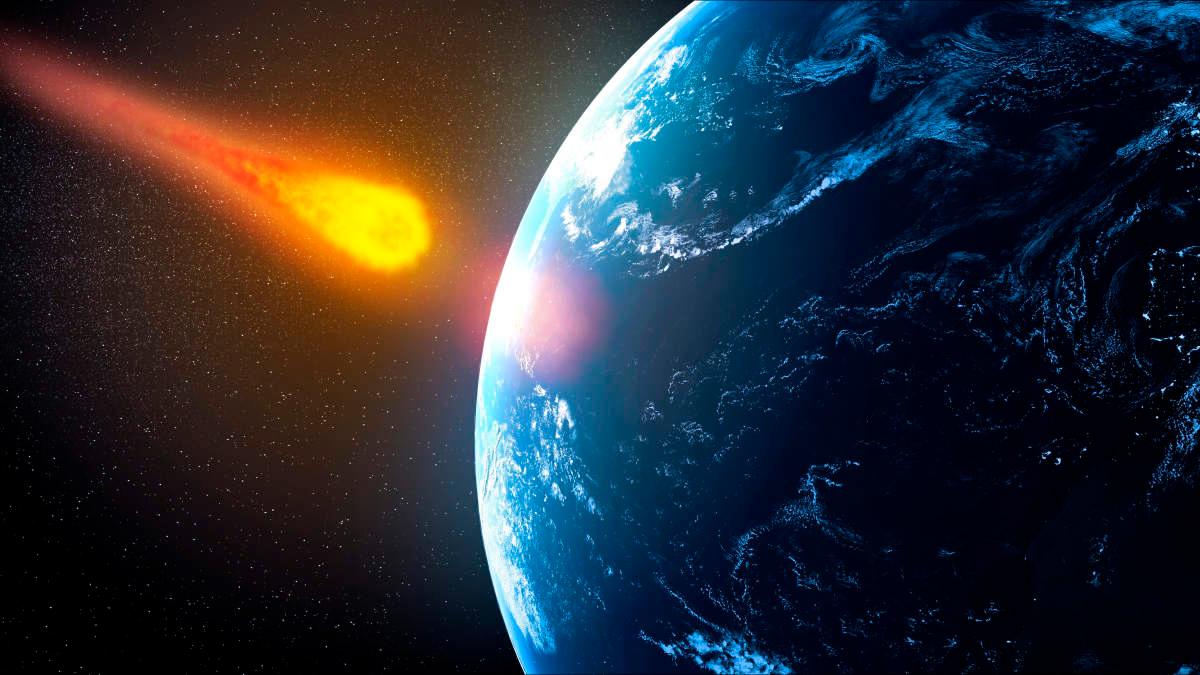
Near-Earth asteroid, artwork - stock illustration
According to NASA, an asteroid is labelled "potentially hazardous" based on a combination of factors: its size and how close its orbit comes to Earth. Asteroids measuring 492 feet or beyond approaching the planet within 4.6 million miles are considered potentially dangerous. In the case of asteroid 2025 XQ3, the distance is closer than what the agency considers a threshold, but its size is extremely small to pose any threat. The 2025 XV3 is quite large in comparison, yet outside the threshold to be considered dangerous. But for any asteroid that falls under the hazardous category, it doesn't mean that impact with Earth is inevitable. There are chances of a 492 feet asteroid reaching dangerously close to the Earth, but it could safely pass by without an impact, hence the term "potentially" is used in this context.

Enormous asteroid collision sends space rocks hurtling around
The Potentially Hazardous Asteroids (PHA) classification was likely made to help scientists prioritize their monitoring. "Being classified as a PHA does not mean that an asteroid will impact the Earth: None of these PHAs is a worrisome threat over the next hundred years," as per the agency. However, tracking the orbits of these massive asteroids will help perfect future predictions of their close approaches and impact possibilities. The asteroids 2025 XQ3 and 2025 XV3 are two of the five asteroids that are reaching their closest approach to our planet before the year ends. On Saturday, December 20, a Bus-sized asteroid is set to reach its closest point from a distance of 1.56 million miles. This asteroid, called 2025 XT4, will be the tiniest of the five upcoming asteroids, measuring only 29 feet.
Digital illustration of an asteroid hurtling towards Earth
Next up, we have another small but comparatively larger asteroid named 2025 XV1. The airplane-sized asteroid will approach the Earth from a distance of 4.2 million miles on December 20. On the same day, another airplane-sized asteroid measuring 220 feet will be at a distance of 4.61 million miles from the Earth. This asteroid, named 2010 WR7, is the largest among the upcoming asteroids approaching, but it doesn't qualify as a PHA. Since the average distance between Earth and the Moon is 239,000 miles, all the asteroids' closest approaches are quite far from the Moon. Nevertheless, NASA closely monitors these, exploring its approaches and potential impacts.