
The Red Giant Paradox: How One Anomalous Star Is Rewriting the Rules of Galactic Evolution
Published Dec. 30 2025, 6:24 a.m. ET

A crimson-red galaxy glowing with stars and bright celestial objects
Death is not the end; it is a change of form. This is what stars teach us. Stars usually take anywhere from millions to trillions of years to pass away. Their death is a fascinating process of mass shedding and ash scattering. As they die, they discard clusters of chemical materials from their bodies. The jettisoned ashes spread into space, enriching galaxies with raw material for what could potentially birth a new star, planet, or entire solar system. Ever since scientists began studying stars, they have known this intricate cosmic processing cycle. The detailed mechanism, however, remained poorly understood. In a recent study, published in Astronomy & Astrophysics, scientists documented this mechanism on the R Doradus star and how it challenged their long-held assumption about the winds generated by stars as they die.
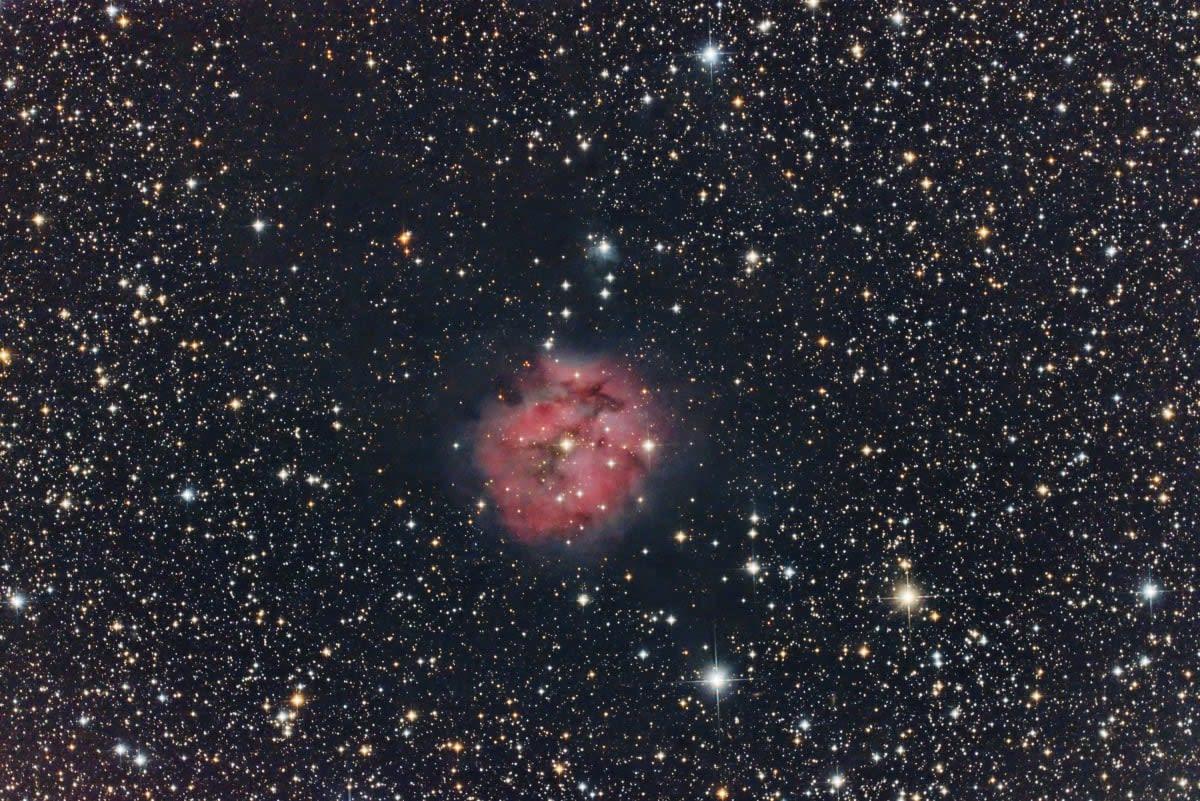
Red gassy nebulae surrounded by tiny stars
“We thought we had a good idea of how the process worked. It turns out we were wrong. For us as scientists, that’s the most exciting result,” lead scientist Theo Khouri stated in a press release. Apart from Khouri, the study was conducted by a team of researchers from Sweden’s Chalmers University of Technology. What they discovered challenged the long-held assumption about how stars spread and distribute life-supporting ingredients in space as they wither away to dust and ashes, and made scientists rethink the cosmic recycling process. They concluded that starlight and stardust are not enough to drive the winds so powerful that they would transport the building blocks of life through the galaxy.
Glowing purple-blue nebulae surrounded by gas and dust as a star dies
Red giant stars, like R Doradus, are older, cooler cousins of the Sun. They are the dying stars that are on fire. In this study, scientists investigated the oxygen-rich asymptotic giant branch (AGB), which is a luminous dying star in its final stage before it becomes a white dwarf. AGBs feature a carbon-rich outer core surrounded by shells undergoing hydrogen-helium fusion. The outer, convective envelope has oxygen-bearing molecules. As the envelope stretches, it provokes a tailspin of pulsations and shockwaves that generate conditions for dust condensation and mass loss. Propelled by the radiation pressure, the stars start shedding mass and generating winds.
As these winds swirl away from the star, they carry potent material that would form new celestial bodies in the future. While there are other red giant stars out there, R Doradus one is the most beloved target for scientists, given its sheer size. About 180 light-years away from Earth, swimming in the Southern Hemisphere constellation of Dorado, the Swordfish, R Doradus is a red giant star measuring about 370 times the Sun’s diameter.
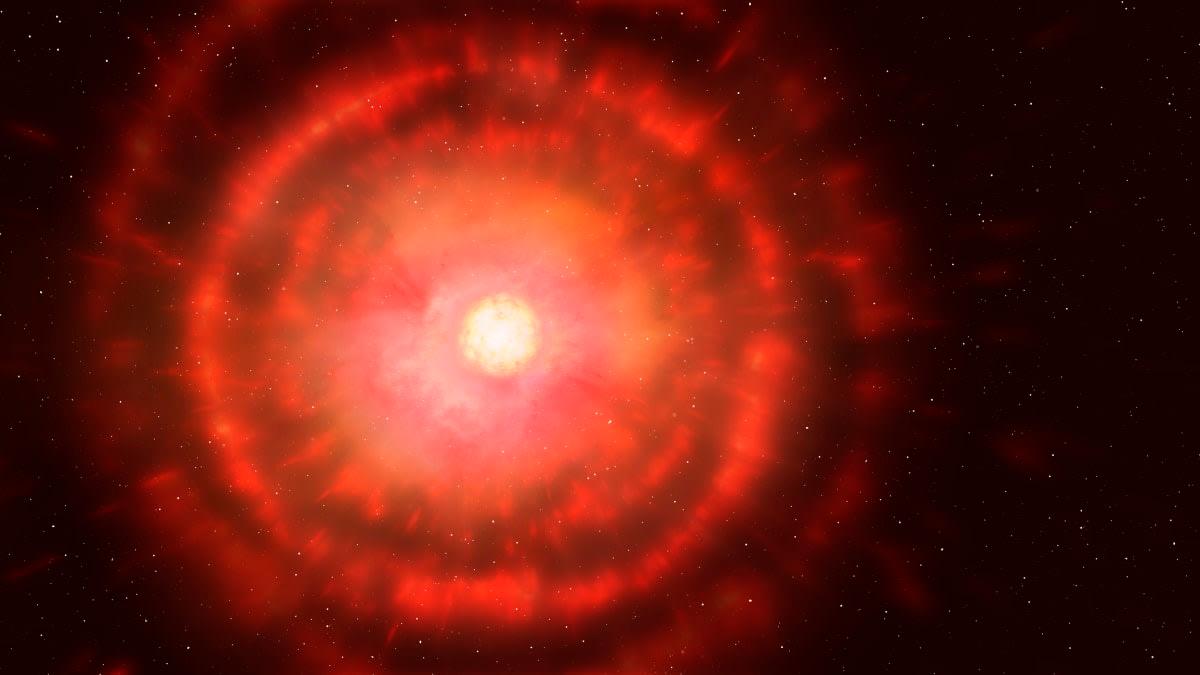
Red giant star with a carbon-rich core and an outer layer pulsing with oxygen-bearing molecules
As ancient sages have said, observing a grain of dust is like holding infinity in the palm. To understand the star’s dying mechanism, scientists targeted dust grains using the Very Large Telescope (VLT). They studied their shapes, sizes, and polarization signatures, as well as the effects these factors had on scattering of the material and wind-driving potential. Two types of dust grains came to attention - iron-free and iron-bearing. Observation of the iron-bearing grains unleashed a scientific crisis.
The grains are too small, too opaque, and are likely to sublimate under high temperatures, unless they grow to at least 0.3 micrometers in size. “It simply doesn’t provide enough force to explain what we see,” explained another study author, Thiébaut Schirmer. “Our analysis reveals that dust contributes weakly to the momentum budget in this particular case and cannot independently sustain the observed outflow,” researchers noted. They concluded the dust grains might play a supporting role, but they don’t play a dominant role in the star’s mass loss. This insight is exclusive to R Doradus or is valid for other AGBs; only further studies will tell.