
NASA Discovers Puzzling Solo Black Hole That Is 50 Million Times the Mass of the Sun
Published Jan. 5 2026, 7:53 a.m. ET

Supermassive black hole surrounded by a tapestry of glittering stars
When a giant star dies, it leaves behind an enormous cloud of dust and gas that collapses under its own gravity and turns into a massive black hole. These behemoth black holes are points of concentrated matter with gravity so intense that even light can’t escape. Little-big stars swirling in its neighborhood often get pulled into the black hole’s gravity and eaten up. Born from the corpses of stars, these leviathan cosmic disks float through the dark space, sending out invisible ripples that disrupt the signals pulsing out there.
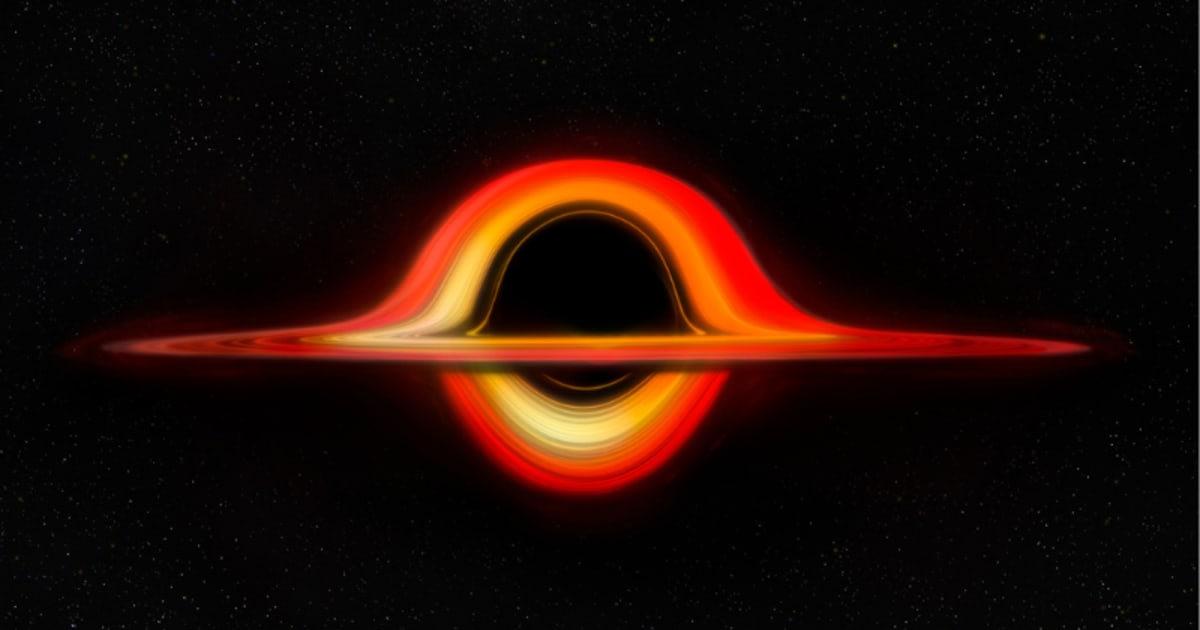
Striking depiction of a black hole
In 2022, NASA’s favorite James Webb telescope was investigating a star cluster when its sensors stopped on the peculiar three “Little Red Dots” in a galaxy. In the newest study published on the arXiv server, scientists documented a supermassive black hole that resides within this galaxy from the time of the Big Bang. Named Abell 2744-QSO1, the naked black hole exists all by itself, without any stars orbiting around it.
Priyamvada Natarajan led the study from Yale University. Apart from James Webb, observations are attributed to Chandra’s X-ray Observatory, with the black hole profile further enhanced by Pandora’s Cluster Abell 2744 via gravitational lensing. The discovery is unexpected, if not super-interesting, all the more. Data suggests that the black hole lived about 700 million years after the Big Bang and weighs as much as 50 million times the mass of the Sun, also equal to the mass of the galaxy that hosts it.
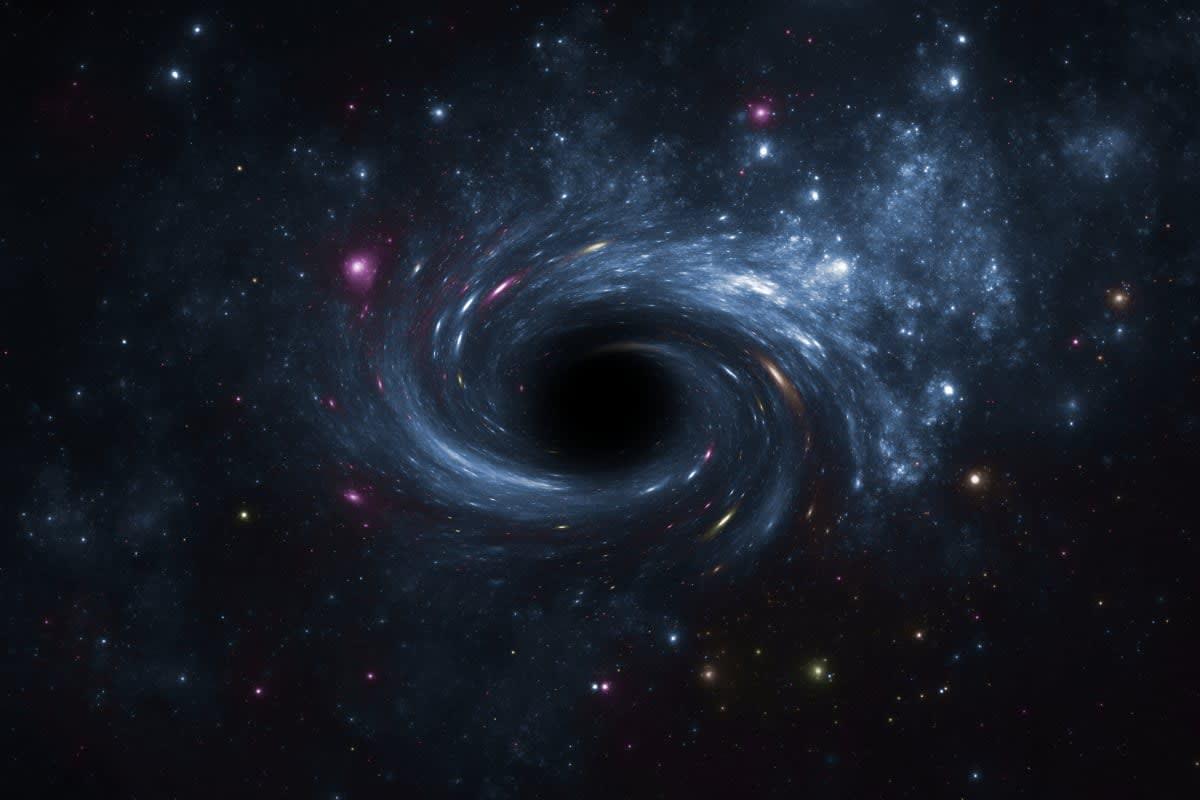
Supermassive black hole surrounded by stars
Boyuan Lio, one of the study’s authors, reflected that the black hole has come upon as a puzzle, because the traditional theory says that black holes form later, first come the stars, per New Scientist. This discovery, however, challenges this idea, likely suggesting that black holes could exist long before the formation of stars. This cosmic candidate breaks all the rules. One hypothesis is, it’s a remnant from the times of cosmic childhood, a.k.a. the Big Bang.
Called “primordial black holes,” these hypothetical objects were first coined in the 1970s by Stephen Hawking and Bernard Carr. Another possibility makes it look like the black hole was formed as a result of matter inconsistency rather than from a dying star. This black hole likely emerged from extreme variations and densities of matter, and then built new, more complex simulations of how gas behaves around a primordial black hole.
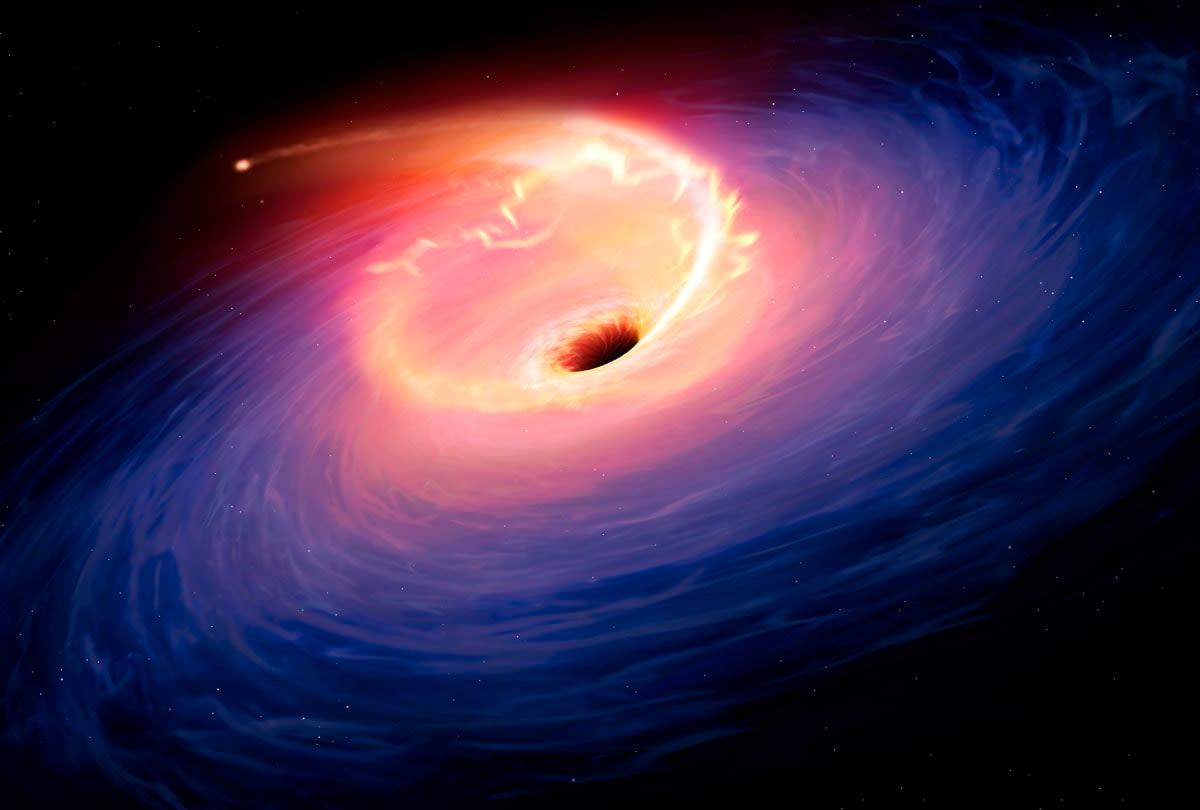
Supermassive black hole devouring a star
However, all these hypotheses come with certain discrepancies. The galaxy, QSO1, is known for ultra-low stellar mass. How it formed without sufficient stellar mass of the galaxy is a mystery. Another discrepancy lies in the mass of a typical primordial black hole. Typical simulations of these black holes rarely produce objects larger than one million solar masses. In contrast, this one is 50 million Sun masses. Many black holes may have merged to form this; this is just one possibility. Yet another discrepancy comes from the very formation process. A usual formation process of a primordial black hole requires intense bursts of high-energy radiation. For this one, no such source has yet been identified near QSO1.
This black hole is unlike anything scientists have ever observed before. Astronomer Dale Kocevski, not involved in the study, told Quanta Magazine that the black hole is pushing the boundaries on “what we think might be true, what we think might happen.”