
Millions Helped Search for Aliens — Now, Scientists Are Down to 100 Signals Worth a Second Look
Published Jan. 14 2026, 6:17 a.m. ET

David Anderson, co-founder of SETI@home, discusses the distributed computing project in 2003.
For over two decades (between 1999 and 2020), a crowdsourced computing effort involving personal computers aimed to find extraterrestrial intelligence (ET). For this project, millions of volunteers worldwide lent their computer processing power to UC Berkeley researchers searching for extraterrestrial intelligence. The SETI@home project (short for the Search for Extraterrestrial Intelligence) was one of the early internet's most well-known crowdsourced scientific endeavors, garnering a large following eager to use their personal computers to help search for alien life. Participants downloaded a program that used their computer's processing power to analyze radio telescope data, effectively creating a massive distributed supercomputer.
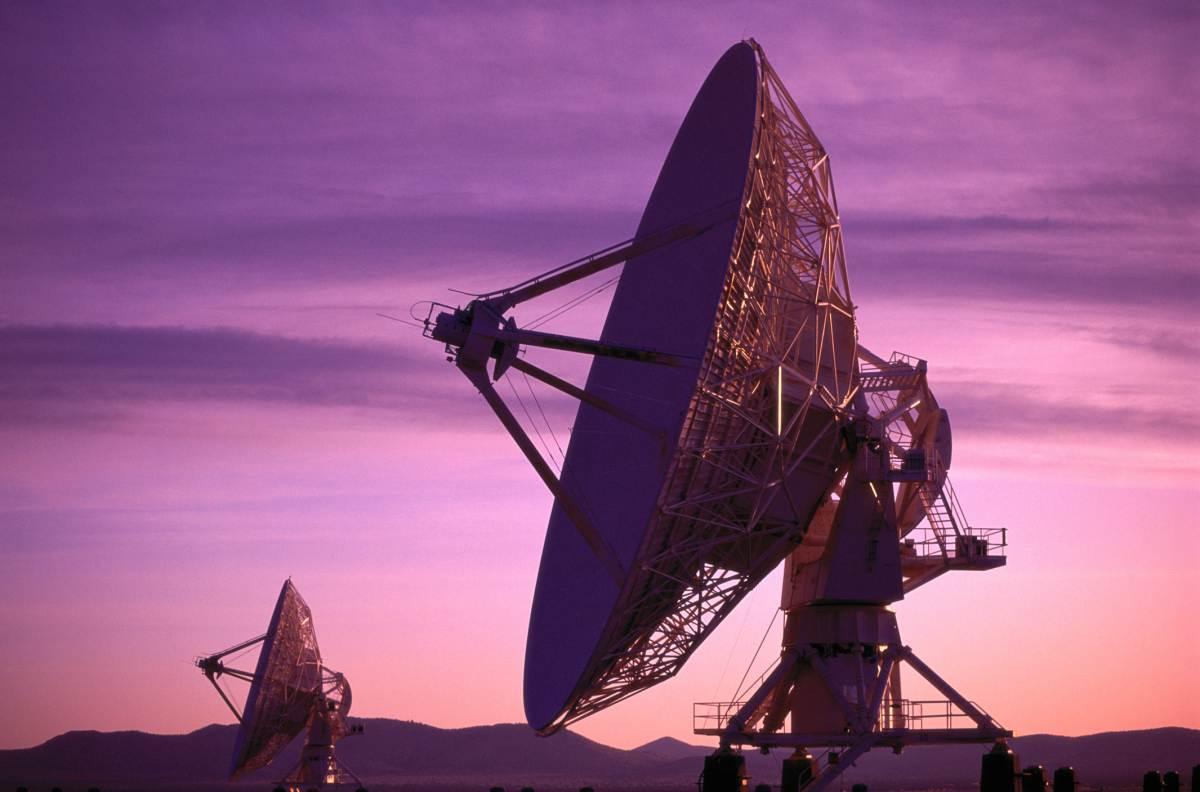
A radio telescope.
Computations from the SETI@home project generated 12 billion potential alien signals, described by co-founder David Anderson as "momentary blips of energy at a particular frequency coming from a particular point in the sky." After a decade of analysis, SETI@home has narrowed down potential alien signals to 100 promising candidates, which scientists are now re-examining with China's massive FAST radio telescope since July, hoping to confirm these intriguing signs of extraterrestrial intelligence. Even with future FAST telescope data, Anderson does not anticipate finding alien signals. However, SETI@home results published in The Astronomical Journal offer valuable insights, highlighting potential shortcomings in current extraterrestrial intelligence searches and guiding future efforts.
Anderson said, "If we don't find ET, what we can say is that we established a new sensitivity level. If there were a signal above a certain power, we would have found it. Some of our conclusions are that the project didn't completely work the way we thought it was going to. And we have a long list of things that we would have done differently and that future sky survey projects should do differently," according to UC Berkeley News.

A researcher looks through a telescope.
SETI@home director Eric Korpela mentioned that while searches will find countless signals, the real challenge is creating algorithms to filter out terrestrial noise (such as satellites, TV, microwaves) from genuine alien messages. Researchers must develop algorithms to distinguish true alien beacons from Earthly noise without discarding discoveries. "There's no way that you can do a full investigation of every possible signal that you detect, because doing that still requires a person and eyeballs. We have to do a better job of measuring what we're excluding. Are we throwing out the baby with the bathwater? I don't think we know for most SETI searches, and that is really a lesson for SETI searches everywhere," Korpela said.
Anderson and Korpela solved the problem by adding approximately 3,000 artificial signals, known as "birdies," to their data flow before filtering out radio frequency interference (RFI) and general noise. They performed this elimination process without knowing the specific characteristics of these fake signals, then determined their detection sensitivity based on the signal strength of the birdies they successfully recovered.
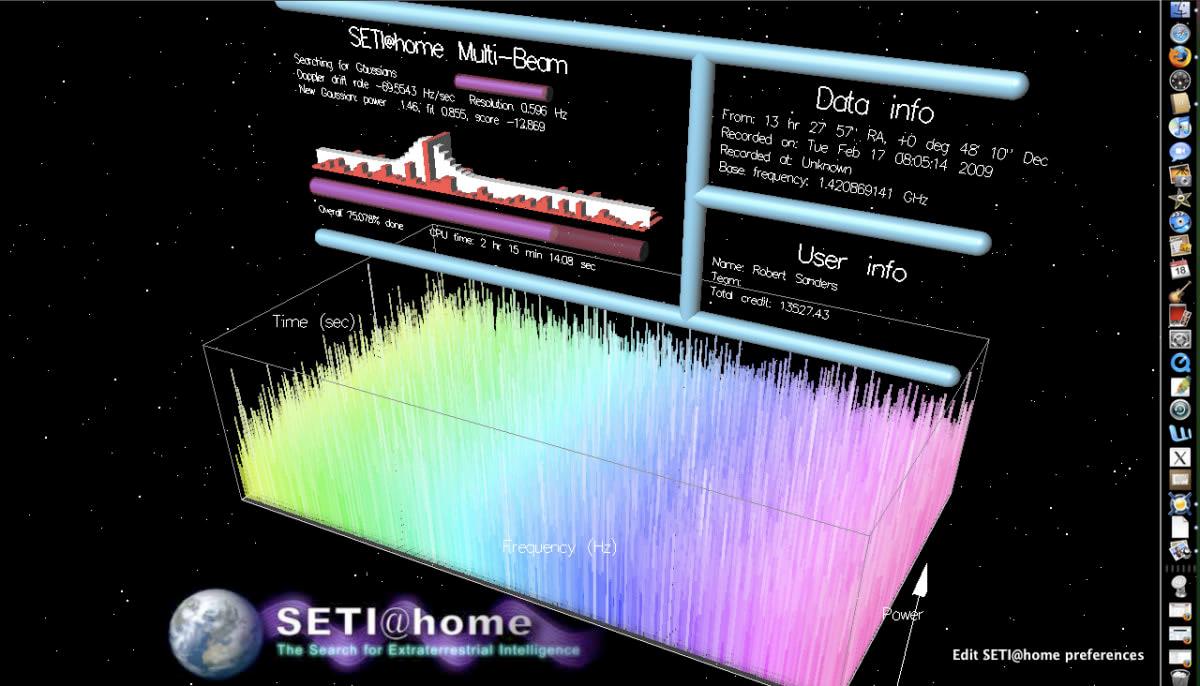
A screenshot of the SETI@home user interface on a desktop computer in 2009.
Korpela further explained that SETI strategies focus on detecting powerful, narrowband signals (like a lighthouse beam) to attract attention, followed by adjacent, lower-power broadband signals that carry data. For better detection, these beacons should use frequencies astronomers already monitor, especially the 21cm hydrogen line, making them easier to spot amidst cosmic noise. This approach uses a "loud" alert followed by a detailed message, increasing the odds of discovering alien civilizations. Korpela shared, "If we saw an extraterrestrial narrowband signal somewhere, we would probably have every telescope, radio telescope, and optical telescope available pointing at that point on the sky, searching in all frequencies for anything else. So far, we haven't had that. If we had, I think we would all know about it."
When Anderson was asked to comment on the success of SETI@home, despite its failure to find ET, Anderson said, "I'd say it went way, way, way beyond our initial expectations. When we were designing SETI@home, we tried to decide whether it was worth doing, whether we'd get enough computing power to actually do new science. Our calculations were based on getting 50,000 volunteers. Pretty quickly, we had a million volunteers. It was kind of cool, and I would like to let that community and the world know that we actually did some science."