
Scientists Create New Design to Generate Electricity from Earth's Magnetic Field
Published Dec. 22 2025, 3:25 a.m. ET

Electrical engineers working
Imagine not having to pay your electricity bills because a gigantic magnet surrounding the Earth produced power. Well, Earth indeed has a magnet like this, which is its magnetic field. When the fiery forces of heat blast into the Earth’s outer core, they cause the liquid iron to churn violently. As the liquid metals churn and pulse through the already existing magnetic field, they provoke streaks of electric currents.
Nearly 200 years ago, a scientist named Michael Faraday tried experimenting to see whether Earth's magnetic field could help humans generate electricity for practical purposes. He concluded that generating electricity this way wasn’t just challenging, but impossible under those circumstances. In a study published earlier this year in Physical Review Research, scientists challenged this long-standing “impossibility argument” and documented the design for a small experimental device that possibly could enable electricity generation just through Earth’s rotation.
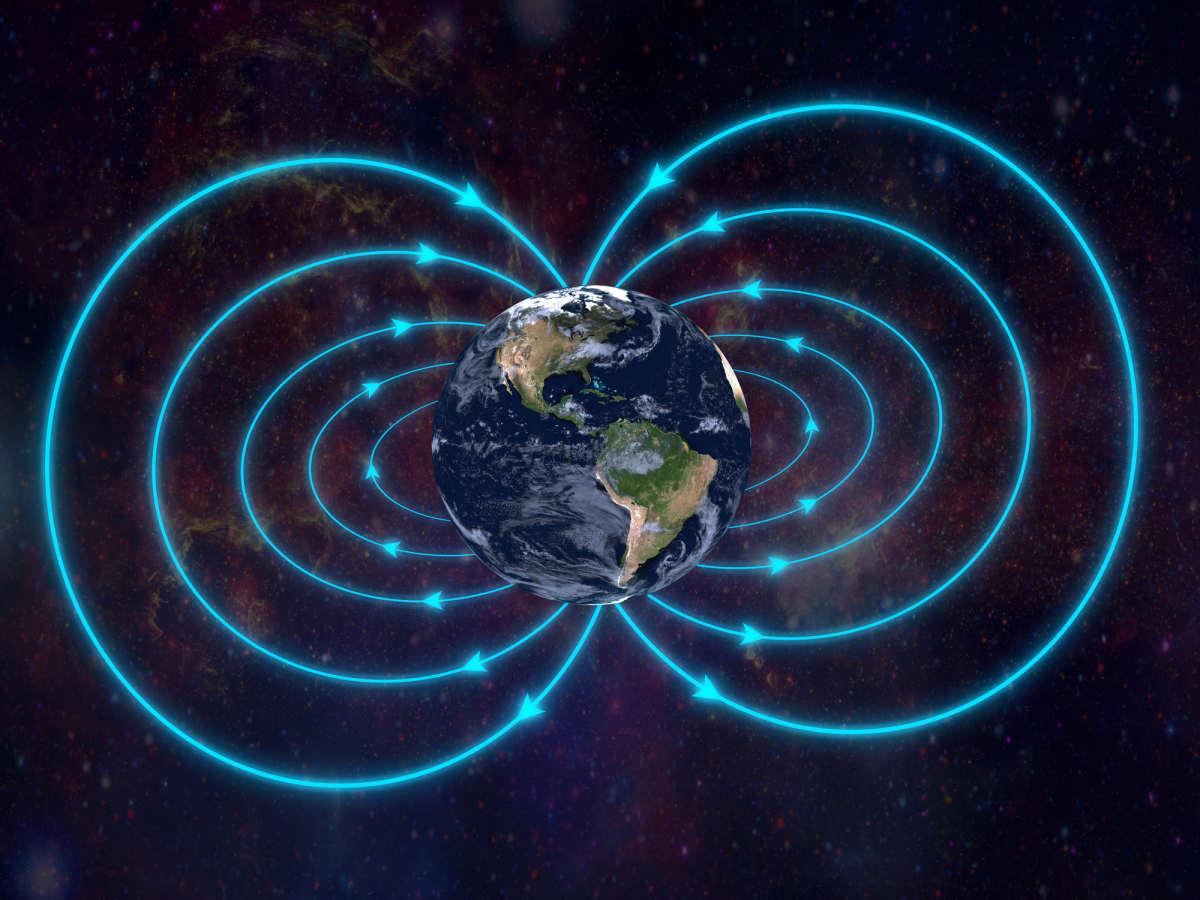
Depiction of Earth's magnetic field
Faraday argued that since Earth rotates through the axisymmetric part of its own magnetic field, it was impossible to generate electricity this way. Even if the agitated electrons succeeded in triggering electric currents, the currents would soon be cancelled out by the magnetic field, much like a tug-of-war. And even though Earth’s magnetic field acts like a gigantic, self-powered geodynamo, it is ineffective in producing usable electricity for humans. As the planet spins, one part of the electric field remains static, explains Scientific American. This static field is soon overpowered by the magnetic forces pulsing vigorously. In the latest study, scientists claimed a provocative theory that revealed to them a major loophole in this entire magnetic-electric struggle.
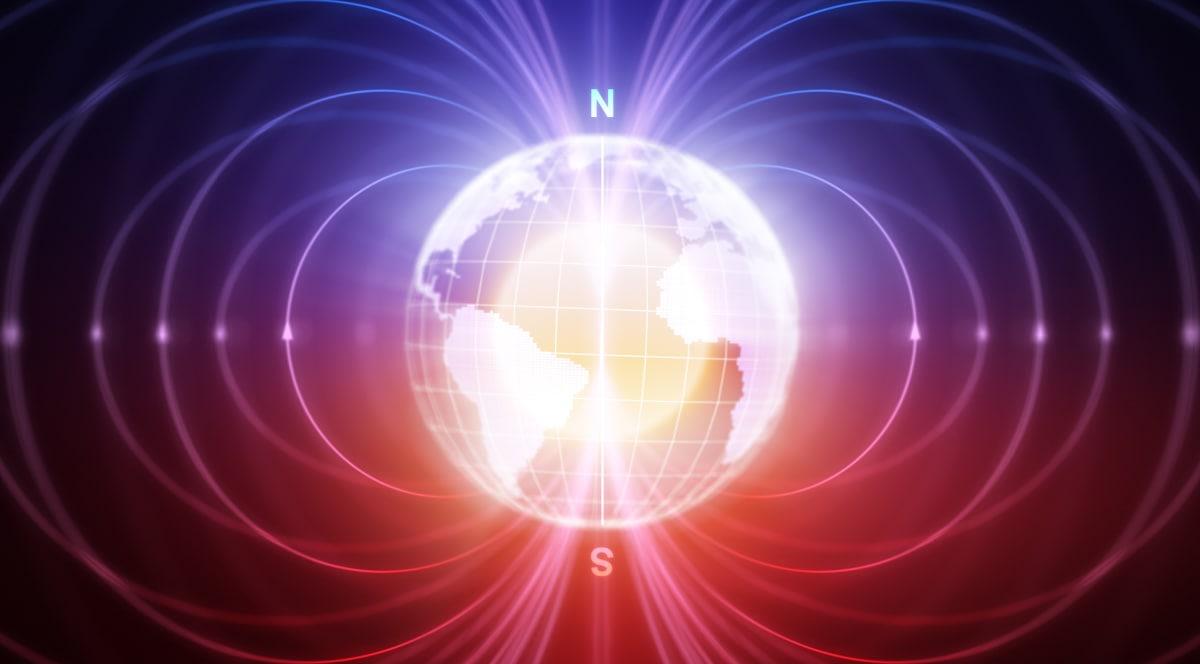
Earth's magnetic field Earth's magnetic field
From the previous studies, scientists believed that the magnetic bubble around Earth might be efficient in protecting us from the flares and hot winds of the Sun, but it can’t generate usable electricity, at least not in any practical sense. Now, experts have revisited those assumptions. They have designed a small device that, in principle, is capable of pulling out electricity from just the rotational motion of the Earth.
The objective of this tabletop experiment was to see if Earth’s spin and magnetic field could someday act as a constant, fuel-free energy source. With this device, scientists succeeded in producing electricity, but only tens of microvolts, a fraction of the voltage released when a single neuron fires. If this process could be iterated and scaled up, scientists could even generate emission-free power while remaining static, which could be useful in remote locations or for medical applications. The team says that the tiny device works just like an electrical power station, which is both unusual and intriguing.

Patches of Earth illuminated with golden city lights
The team involved in the study was led by physicist Christopher F. Chyba and included other researchers from NASA’s Jet Propulsion Laboratory. To conduct it, they crafted a hollow cylinder made of a soft, magnetic material known as manganese zinc ferrite. The requirement for this material was that it should satisfy a particular mathematical condition and a composition and scale favoring magnetic diffusion. Whilst controlling a series of effects, they monitored if there was any voltage or current running through the device. There was.
They observed a 17-microvolt current rushing through the device, depending on the setup’s orientation with respect to Earth’s magnetic field. When they used a solid chunk as the conductor in place of the hollow tube, the current came down to zero. Looking ahead, this is just a proof-of-concept device for now, and not suitable to be used as a practical energy source for humans. Perhaps, in the near future, scientists can refine this design so as to simulate the planetary magnetic field better, and therefore, help you out with your electricity bills.