
Man Built a Tennis Ball-Sized 'Artificial Sun' and Switched It on in a Dark Forest
Published March 3 2026, 3:59 a.m. ET

YouTuber Matthew Perks created a small 'artificial sun.'
Ever wondered what it would be like to have your own piece of the Sun? Thanks to this "LED Supernova," you could own an artificial sun for about $1300. The creator of the YouTube channel DIY Perks has invented a tennis-ball-sized LED array that generates a staggering 120,000 lumens as output. To put that in perspective, a household lightbulb produces roughly 1,000 lumens. However, creating equipment that generates such a large output isn't a piece of cake. Producing that much light requires a lot of power. For this LED array, 1.5 kW of power is required to function. "This is an incredible amount of light, but 1.5 kW of power generates a ton of heat as well. And without extreme cooling, it just will literally burn itself up," said YouTuber Mathew Perks.
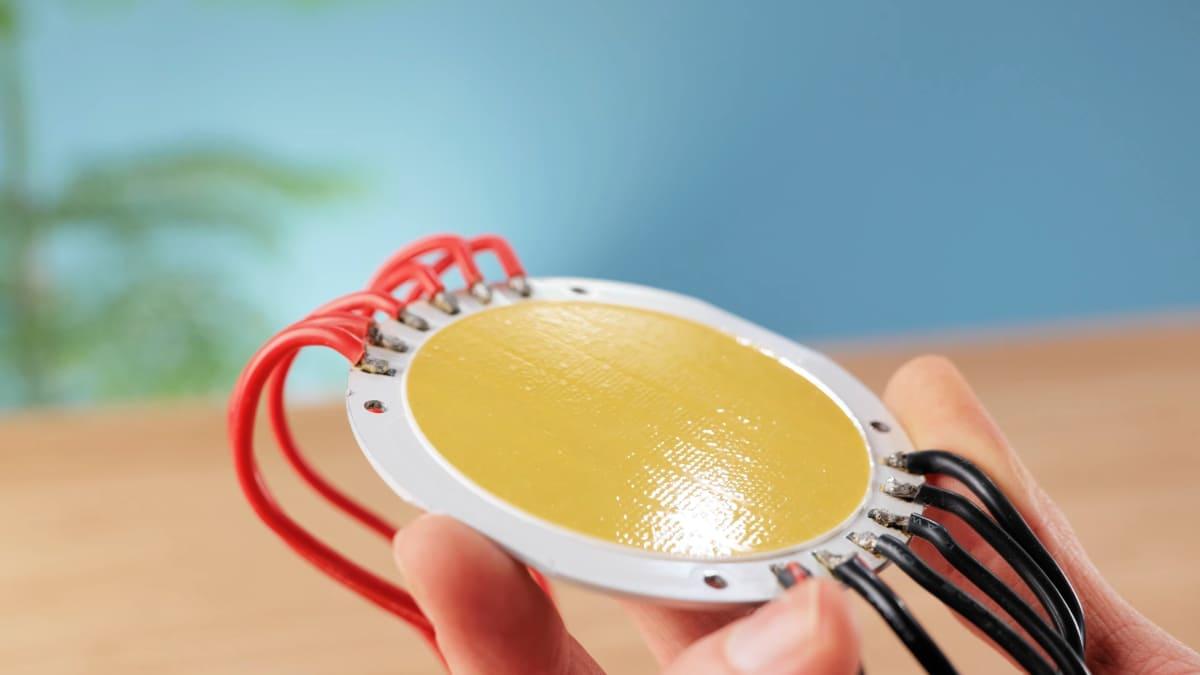
The pocket-sized LED array designed by Mathew Perks.
In his latest video, he attempted to find a solution to this issue by building a cooling system for the LED array, but it wasn't without its trials and errors. In his initial attempt, Perks constructed a custom-built water cooling loop to pull heat away from the LED array. "Despite promising results, it drew so much power that it literally blew up my power supply, putting a stop to further testing," he revealed. "It's clearly a specialist component, unique and extremely rare," he said of the portable light source. Now that he knew about the challenges his next attempt had to overcome, he attempted to create a better-engineered rig. The technology had to be efficient enough to support the illumination while being lightweight.

The hexagonal cooling system installed with fans.
Perks was sure the cooling system shouldn't hamper the LED array's portability. Keeping these criteria in mind, he built a hexagonal water-cooling system around a coolant reservoir. Perks had six copper radiators, each of which is cooled by three PC fans. Forming a hexagonal structure allowed him to fit 18 fans, making the cooling more efficient. As for the LED array, the YouTuber placed it on a custom-built water block. The water from the cooling reservoir flows through this block and then enters the 6 copper radiators, each of which is cooled by the fans placed within the system. Perks used a portable lithium battery to power the LED array. The same battery also powers the onboard electronics, like sensors that monitor coolant flow rate and temperature, and an Arduino to monitor them.

Mathew Perks testing the power of his 'artificial sun.'
Perks also installed a data screen that displays various battery parameters and has a power button. "Pressing this power button activates the battery, and we can see its charge state on the screen as well as the active current draw, which is presently 1 amp," he added. "This current draw is mostly the fans and water pump with a little for the Arduino," he explained. After the first lens successfully illuminated, Perks attached the second lens, which was a glass Fresnel lens, and took the finished product out into a forest for real-time testing. Much to his delight, the technology worked and produced a massive amount of lumens that lit up a large portion of the dark forest. "I've never seen a light like this before. That is wild," Perks gushed.
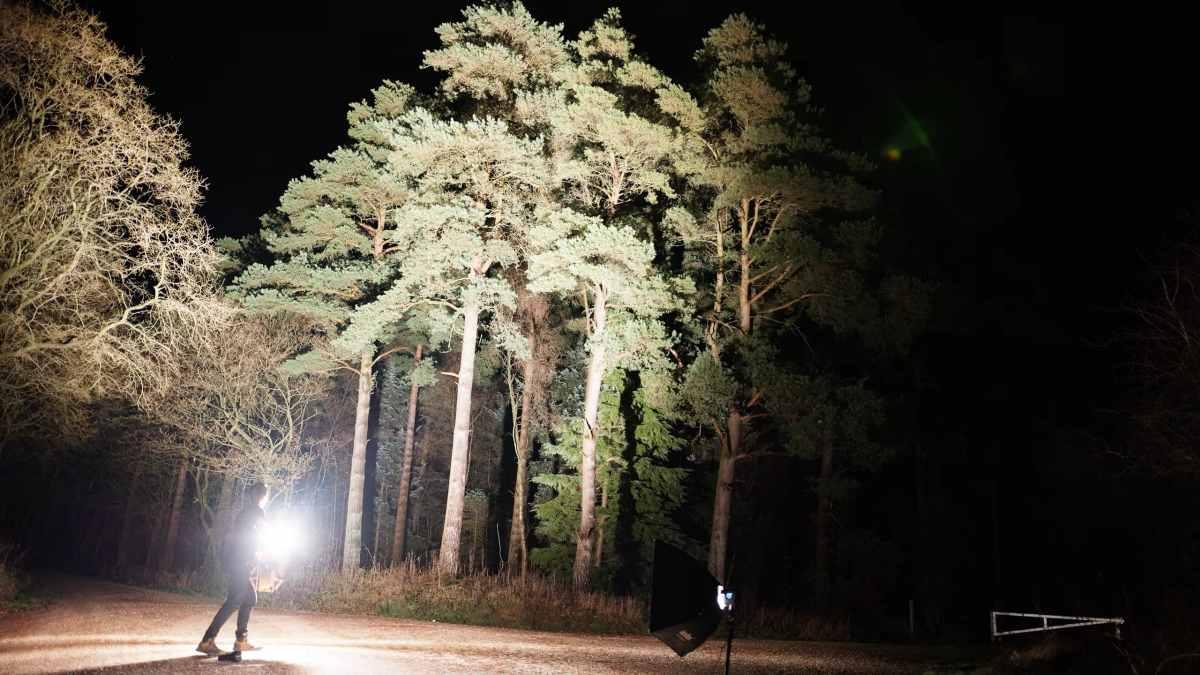
Mathew Perks tested the LED array in a forest.
"The amount of light bursting forth from the LED is truly spectacular," he added. Perks once dreamt of using a one-of-a-kind LED, and it finally came true. He also gushed over the incredibly efficient performance of the cooling system, keeping the LED array cool as long as it operated.