
California Scientists Create 'Rechargeable Solar Battery' That Surpasses Lithium-Ion Ones
Published Feb. 26 2026, 4:41 a.m. ET

(L) Sun emitting solar flares; (R) Lithium ion battery (Cover Image Source: Getty Images | (L) Javier Zayas Photography; (R) Kypros)
Scientists have taken a significant step forward in advancing solar energy, as they developed a material that can gather sunlight, store it in chemical bonds, and finally release it as heat on demand. This material is called “pyrimidone” and is essentially a modified organic molecule. It is the latest offering in Molecular Solar Thermal (MOST) energy storage. It addresses a huge drawback of solar energy usage. Solar panels cannot harness solar energy once the sun goes down, and this method may enhance the current systems to utilize solar energy even in the absence of sunlight. If the potential turns out to be reality, it will enhance the scope of renewable energy. The study has been published in the journal Science.
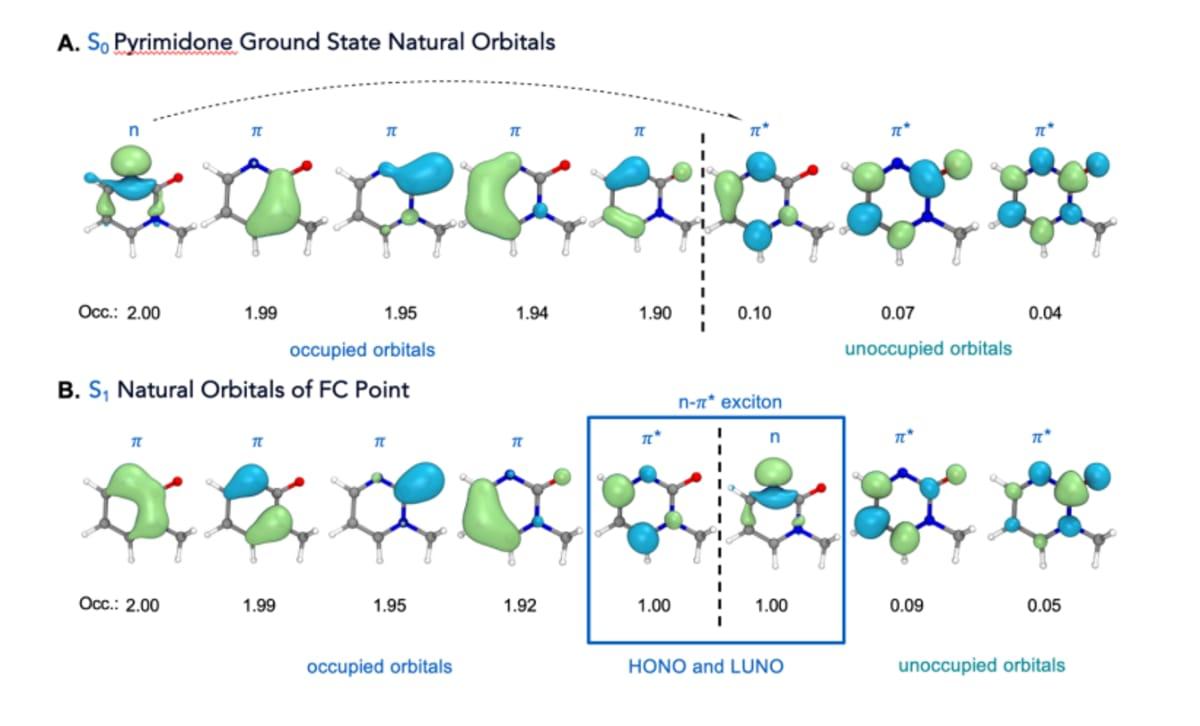
Natural Orbitals of (A) 2-Me-pyrimidone ground state and (B) Franck-Condon point. (Image Source: Science (Supporting Online Materials)) .
Pyrimidone is a bio-inspired molecule, according to UCSB. Researchers investigated a DNA component, which, after exposure to UV light, undergoes reversible changes. They engineered a synthetic version of the DNA component, which led them to a molecule capable of storing energy and releasing it reversibly. The team took the aid of Ken Houk, a distinguished research professor at UCLA, to shed light on why this molecule can perform such unprecedented actions using computational modeling. Through computational modeling, they discovered that the pyrimidone molecule functioned like a mechanical spring, which allowed it to store and release solar energy.
After the molecule interacted with sunlight, its shape became strained and agitated, or a high-energy state. The molecule continues to hold this shape until a trigger, such as a small amount of heat or a catalyst, makes it return to a relaxed state. This transformation enables the release of solar energy as heat. The molecule is being recharged with some energy to release the earlier stored solar energy. The team describes the system as a rechargeable solar battery.
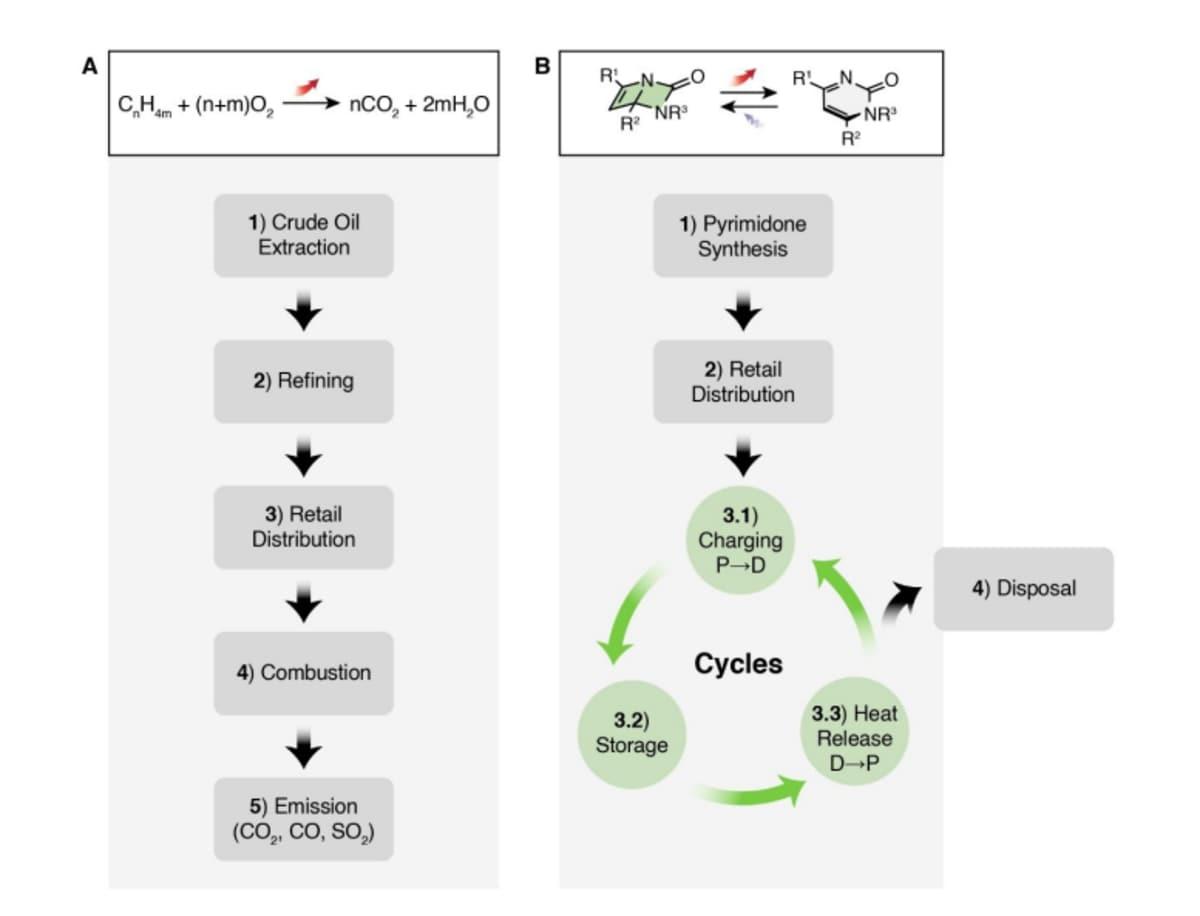
Illustration of life cycles of (A) heating oil (79, 80) and (B) pyrimidone.
The material has the potential to forever change the way solar energy is supplied worldwide. It is soluble in water and can be pumped through roof-mounted solar collectors, where it is charged in the day. Later, it is placed in the tanks, where it can supply heat even during the night. “With solar panels, you need an additional battery system to store the energy,” said co-author Benjamin Baker, a doctoral student in the Han Lab. “With molecular solar thermal energy storage, the material itself is able to store that energy from sunlight.”
The team was minimalistic throughout the design and creation process. “We prioritized a lightweight, compact molecule design,” explained Han Nguyen, a doctoral student in the Han Group and the paper’s lead author. “For this project, we cut everything we didn’t need. Anything that was unnecessary, we removed to make the molecule as compact as possible.”

High Angle Shot of Solar Panels
The team claims the system will be efficient for users. “The concept is reusable and recyclable,” stated Nguyen. “Think of photochromic sunglasses. When you’re inside, they’re just clear lenses. You walk out into the sun, and they darken on their own. Come back inside, and the lenses become clear again,” Nguyen continued. “That kind of reversible change is what we’re interested in. Only instead of changing color, we want to use the same idea to store energy, release it when we need it, and then reuse the material over and over.”
Researchers are ecstatic, as their research is outperforming lithium-ion batteries. According to recent testing, the molecule’s energy density was proven to be almost double that of lithium-ion batteries. It is also leaps and bounds ahead of previous generations of optical switches. They added that the material does not need bulky batteries or electrical grids to function, significantly decreasing investment costs and complexity.
The team established that the material has the scope of being used in practical applications by utilizing its high-energy density to produce observable outcomes. In this case, the heat produced from the molecule was used to boil water. “Boiling water is an energy-intensive process,” Nguyen said. “The fact that we can boil water under ambient conditions is a big achievement.” Researchers believe that the molecule can be applied in applications like residential water heating and off-grid heating.