
Sun Unleashes Biggest X-Class Flare in 2026 — and It Sets Stage for Stunning Auroras This Week
Updated Feb. 3 2026, 6:51 a.m. ET

A man standing beside a car, looking at auroras in the sky.
Even the Sun, Earth’s brightest star, has a dark side. Sitting 93 million miles away, it rises every day to bathe our beloved Earth in a soft golden glow that sustains all life. But from time to time, its magnetic field develops concentrated, cool regions of electrically charged gas called plasma. Scientists call these concentrated patches sunspots, per NASA. Like stretched rubber bands, the magnetic field lines in these sunspots start twisting and snapping, eventually jolting the magnetic field into surreal restlessness.
Over time, the restless magnetic field starts scooping photons from the sunspots and blasts them towards the Earth in generous flurries. As these charged particles hurtle towards our planet and succeed in breaching its magnetic boundary, they arrive in our atmosphere and crash right into the molecules of gases hanging there. When this happens, the skies on Earth erupt into bizarre optical phenomena, mostly dazzling displays of lights people know as auroras.
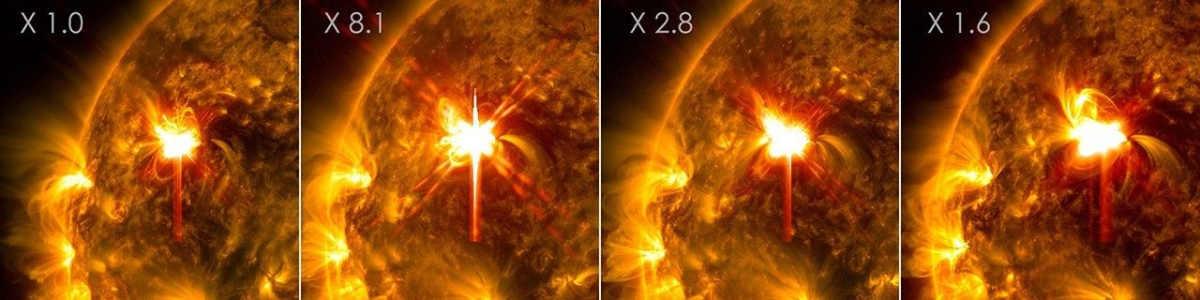
NASA’s Solar Dynamics Observatory captured these images of the solar flares—seen as the bright flashes in the center of the images—on Feb. 1 and Feb. 2, 2026.
This is the time when the Sun is reaching the peak of its 11-year solar cycle. In its southern hemisphere, the magnetic field is unusually active, especially in a sunspot named AR 4366. The sunspot is so intense, Spaceweather.com has dubbed this patch a “solar flare factory.” In just the past 24 hours, it has initiated dozens of solar flares towards the Earth as well as vortices of electrically charged photons. An X8.3-class flare is the most intense solar event recorded so far this year. The event is so powerful that scientists are anticipating the possibility of witnessing striking auroras on Thursday, February 5.
It started with an extraordinary burst of energy from AR 4366, which quickly transformed into a vigorous solar flare. Earth had just been struck by an X1.0 solar flare a few hours ago when X8.3 erupted. The X8.3 flare peaked at 6:57 pm EST on February 1, according to the US National Oceanic and Atmospheric Administration (NOAA)’s Space Weather Prediction Center. Tempestuous squalls of ultraviolet and X-ray radiation pounded on the Earth’s upper atmosphere. Not long after this flare, more flares, including an X2.8 and an X1.6, banged into the Earth on February 2.
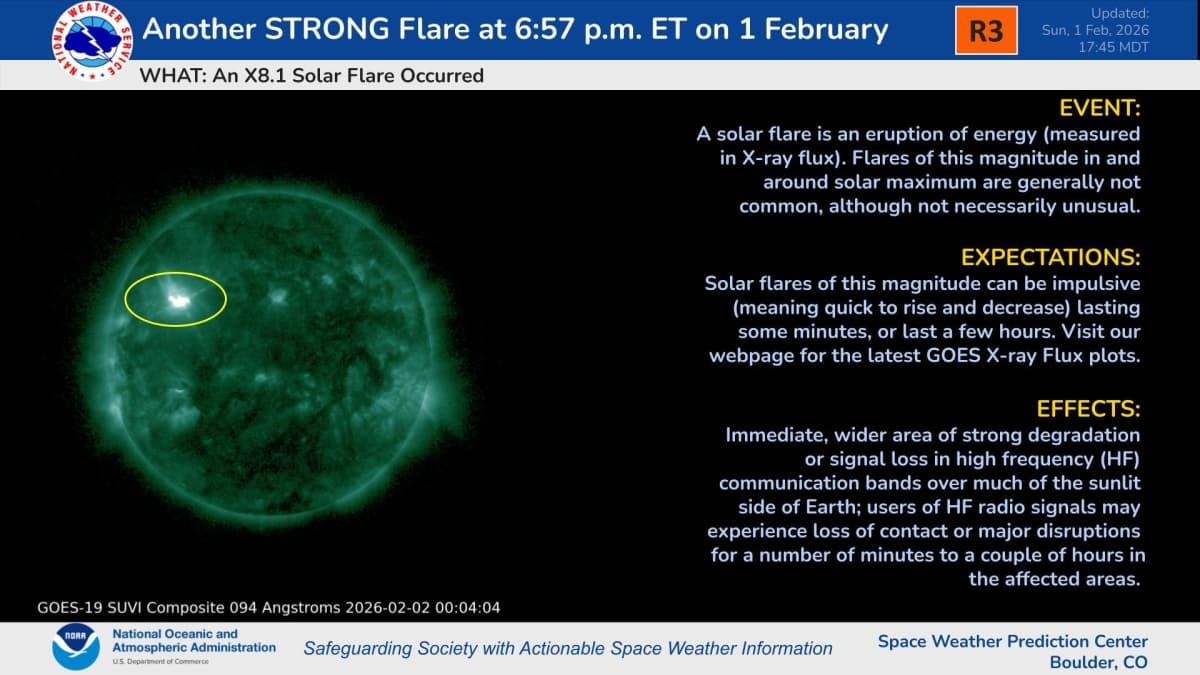
An X8.1 solar flare occurred from region 4366.
NOAA’s scientists generated models and studied them along with the images captured by NASA’s Solar and Heliospheric Observatory (SOHO). Analysis revealed that at least one coronal mass ejection (CME) may trundle past Earth on February 5. “A complex eruption resulting in possibly three CMEs was associated with the X8.1 and X2.8 event,” NOAA said. All this might sound like a warning preceding a storm, but there’s actually a packet of happy news. Regions across the north and even south may notice their skies brightening up in dances of glaring colors.
The intensity of an aurora typically depends on how solar winds behave and how they leave the Sun's corona. In a recent study published in Geophysical Research Letters, scientists from the University of Arizona detailed a new perspective on how the Sun's internal solar wind dynamics and wave propagation patterns work. By studying data from NASA's Parker Solar Probe, they discovered that the mechanism behind solar winds and coronal waves is more complex than previously thought. The waves of plasma, or the hot charged gas, aren't smooth. Rather, they follow non-Maxwellian speed patterns as depicted through beams of fast particles and hammerhead structures. These unevenly distributed streams of particles determine how energy will be dissipated. The speedier the solar wind is, the more intense the geomagnetic storm is, and the brighter the aurora is.