
Experts Say the Northern Lights Will Be More Intense in 2026— Here’s What to Expect
Published Jan. 6 2026, 6:41 a.m. ET

Silhouette of a man standing on a mountain beholding luminous green curtains of glowing lights decorating the night skies of Norway's Lofoten Islands during an aurora display
Picture a gigantic ball of fire wrapped in a tangle of electrically charged wires. That’s our Sun. The Sun follows a peculiar 11-year clockwork, beginning with a quiet phase that proceeds into a stormy rhythm. At the end of this cycle, the Sun gets freaked out. It starts discharging violent tempests of solar winds towards the Earth. As the wind crashes and spills on the oval-shaped magnetic field of our planet, some of it succeeds in entering the Earth’s atmosphere, where it excites the gas molecules, so they start emitting glowing colors. Since 2026 is the peak of the Sun’s 25th 11-year cycle, the year brings a generous platter of dazzling performances for sky watchers and aurora chasers. Northern Lights, a.k.a. auroras, will paint the skies across the Northern hemisphere, NOAA reports.
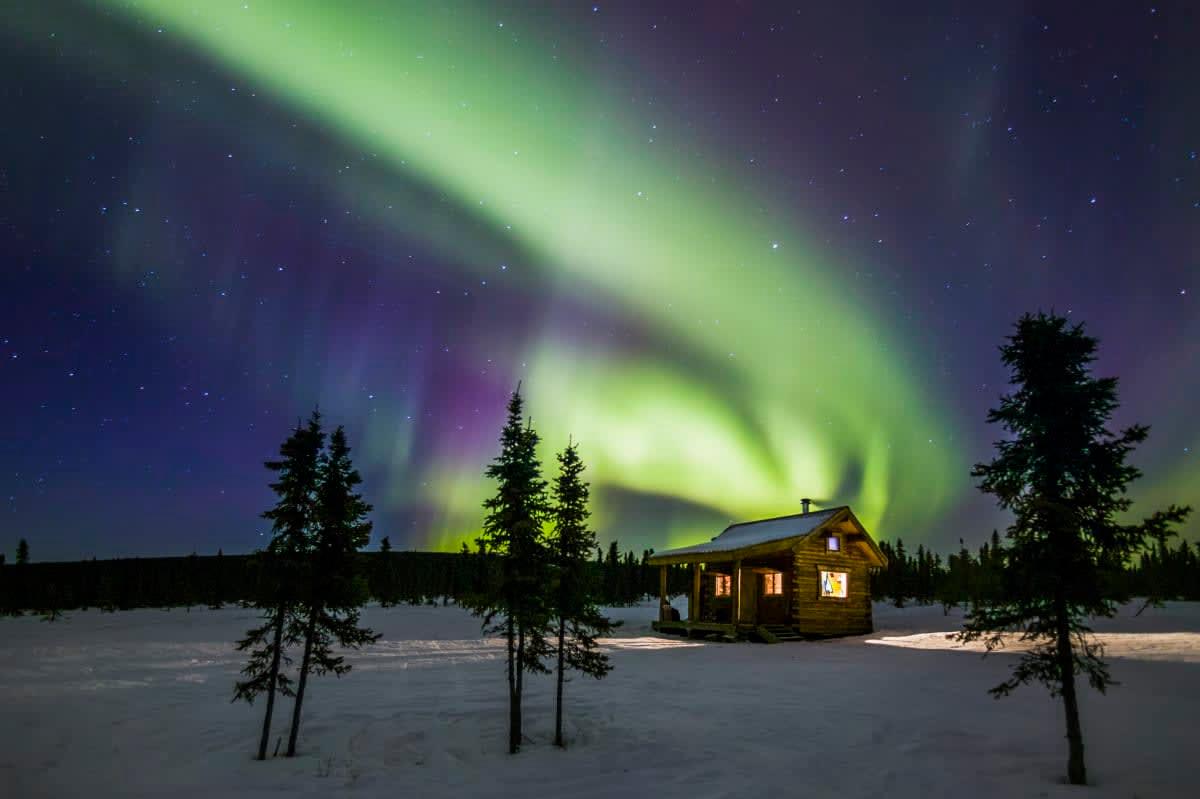
Gorgeous curtains of glowing lights decorating the night skies of Alaska's wilderness during an aurora display
An aurora is born out of a subtle yet sophisticated process governed by the Sun’s freaky mood as it reaches the peak of its 11-year cycle. It is the same process that guides neon boards, fluorescent lights, televisions, and lamps. The poles start to flip. The tangle of magnetic field lines starts stirring. At the peak, the lines snap, and the entire magnetic field is jolted in disorientation. Symptoms reveal as coronal holes, sunspots, solar flares, and coronal mass ejections. Billows of fiery solar winds charge from the Sun with billions of electrons rushing at millions of miles per hour.
This blazing hot flurry of electrons reaches the Earth and intrudes through the gaps in the magnetic field to arrive in the upper atmosphere. Here, the fervid electrons encounter gas molecules, transferring their packets of solar energy, which makes the molecules excited into higher energy states. As the molecules wander around and collide with other atmospheric molecules, their higher energy states start to deactivate. Their excitement calms down, and they start relaxing. Out of this relaxed state arises the “Goddess of Dawn,” a.k.a. aurora.
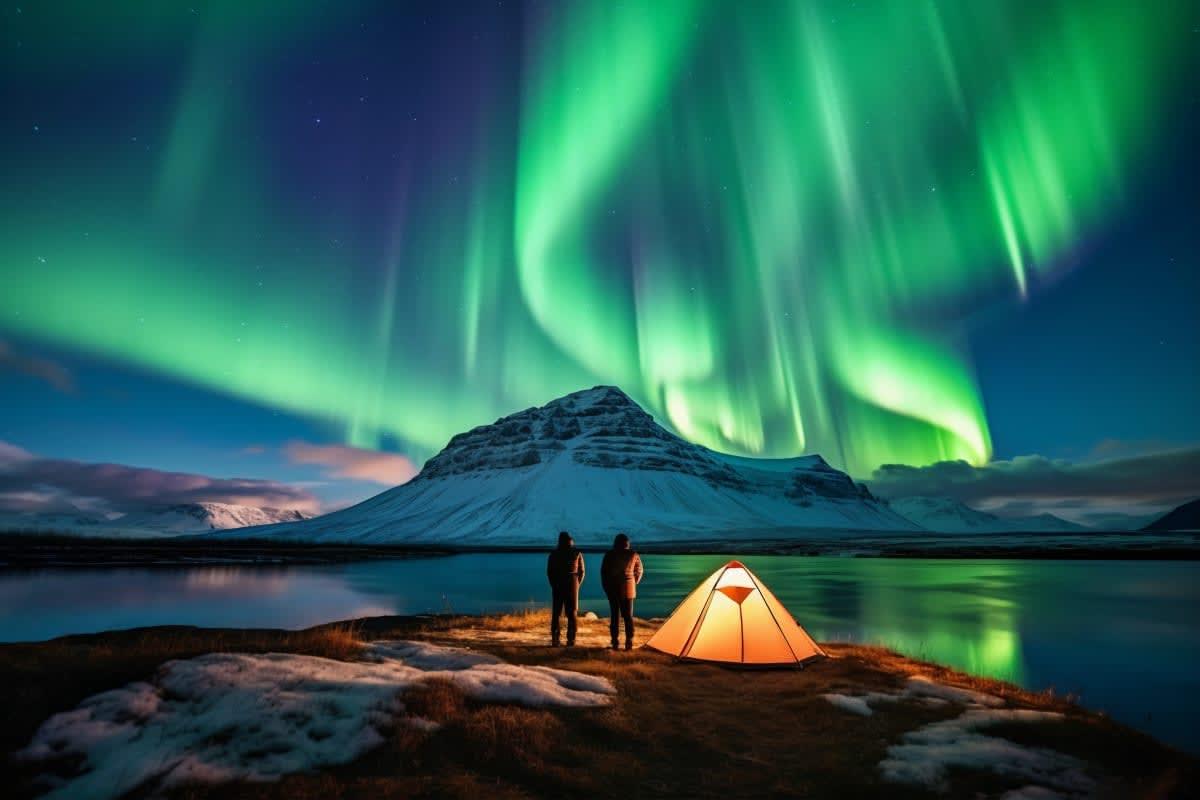
Dimly lit camping tent and two people behold the gorgeous curtains of glowing lights decorating the night skies during an aurora display
Curtains of glowing colors flutter in the air like cosmic draperies wrung and pintucked to the sky. Arcs of glistening, radiant light materialize over the mountains. Dark fjords turn into mirrors displaying the fluttery dance of these curtains and the geometrical ballet of these arcs. Columns of gradients emerge in the night skies, bathing the silhouettes of forest trees in shimmery rainbows. Even with the interference of the Full Moon, the auroral goddess decorates the sky in a way that is both unmatchable and unfathomable. That’s why meteorologists are calling out to all the sky watchers, stargazers, and aurora hunters to mark their calendars.
While the Sun is already preparing to enter its quiet phase, the storms will last at least until March. Parades of monstrous storms are barreling towards the Earth, hauling truckloads of the Sun’s fire energy packets. As these packets are delivered into the atmosphere, earthlings will have access to exciting visual treats throughout the year, spanning mostly the Northern hemisphere, but sometimes as far south as Devon and Cornwall.
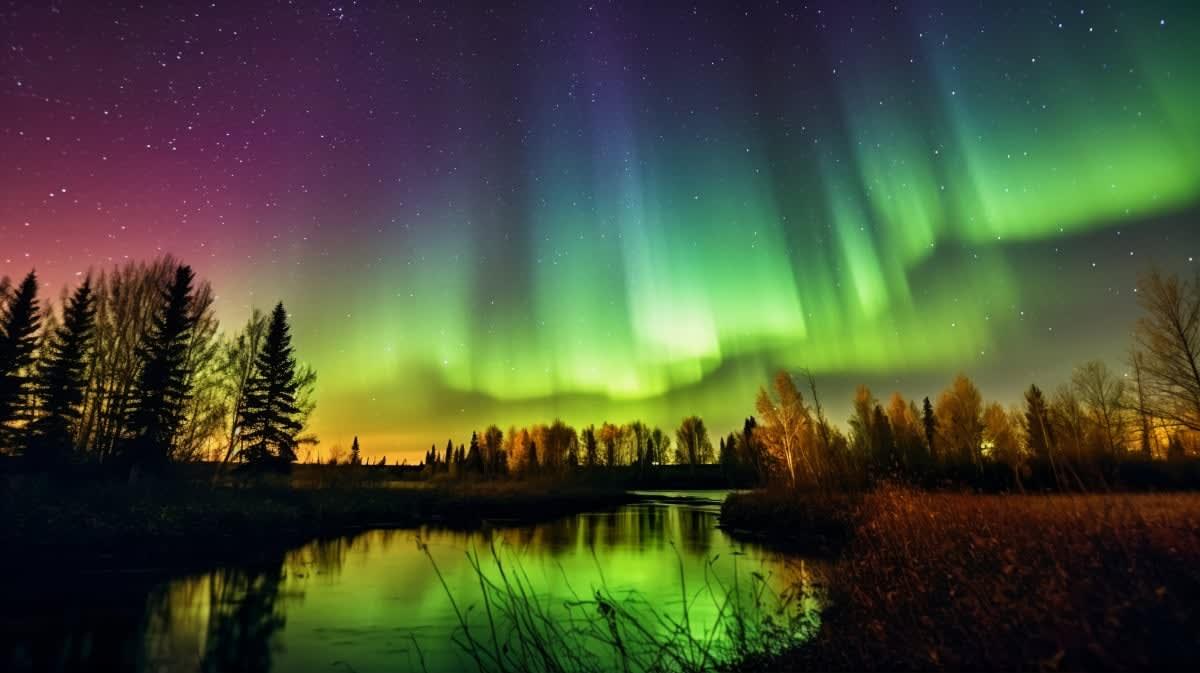
Gorgeous curtains of glowing lights decorating the night skies emerging from behind the silhouettes of trees during an aurora display
In conversation with Firstpost, Pal Brekke, Head of Space Research at the Norwegian Space Agency, explained that the activity of the Sun controls the intensity of these auroras. While aurora in itself is not a rare appearance, this is the time when it’s not just one solar flare or a single CME that will trigger an aurora. It’s an entire cluster of solar storms, which scientists also call “cannibal solar storm.” Due to the peak state, multiple solar storms will merge to form powerful gas clouds charged that will produce dramatic auroral displays, also provoking rare colors like pinks, reds, and purples to show up. This also means you are roughly twice as likely to see the aurora at these times of year, especially during spring and autumn, NOAA said.