
Astronaut Captures Strange ‘Underwater Auroras’ Around Bahamas Islands — Here’s What They Are
Updated Jan. 7 2026, 3:07 a.m. ET

The Great Bahama Bank and Little Bahama Bank are a brilliant blue in contrast to the black of the surrounding ocean.
A natural swirling pattern forms around a pair of islands in the Bahamas, a treat for the eyes. A 2016 satellite photo captured by an unnamed astronaut on the International Space Station shows sandbanks surrounding the island appearing as a stunning light blue streak. An array of coral reefs lines the edge of the Little Bahama Bank in the northern Bahamas. Beyond the coral-lined edge, the seafloor suddenly deepens, as denoted by the dark blue color of the ocean in the bottom right of the image. The two islands, Carter's Cays and Strangers Cay, are loosely surrounded by sandbanks like ribbons. They sit near the edge of an underwater drop-off where the shallow Bahama Bank suddenly plunges into deeper waters.
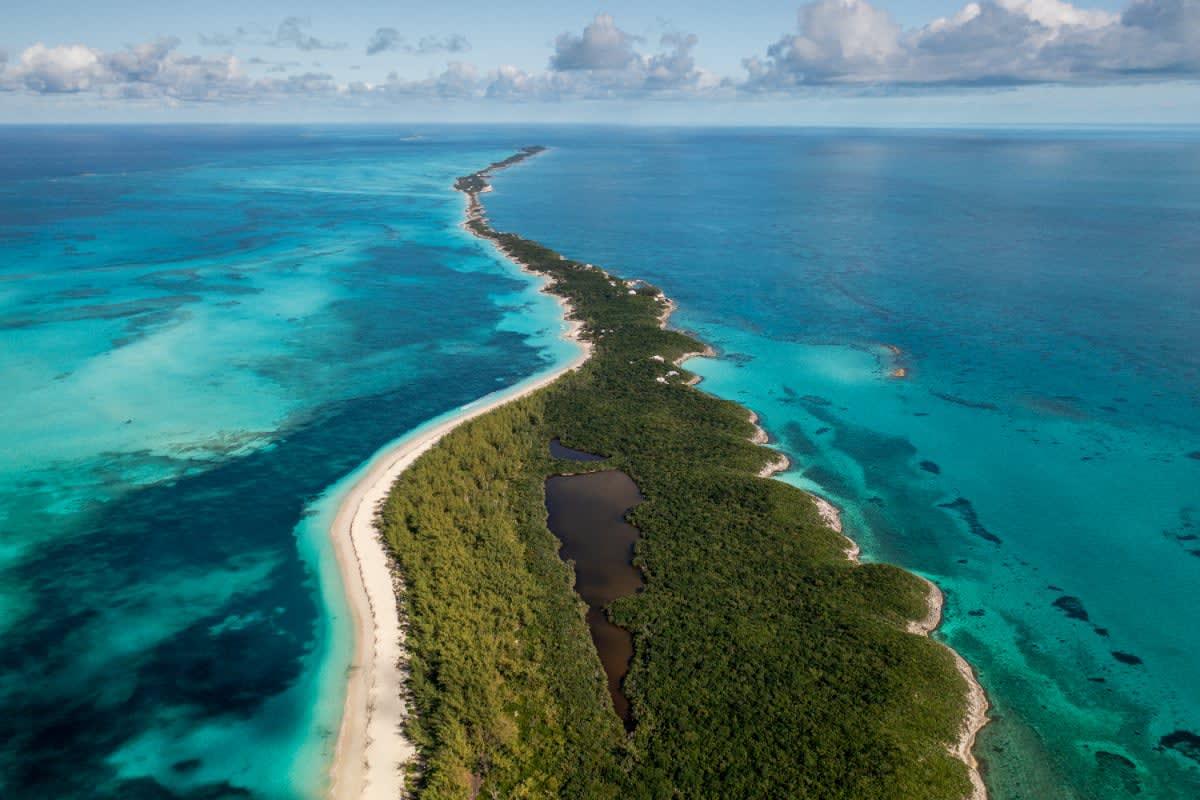
An island photographed from an aerial perspective in the Bahamas.
As water moves across the coral reef-lined edge, the turbulence caused is believed to be the reason behind the carved out submerged sand swirls. "The brightest swirls are shelly sands molded into sweeping shapes; they give a strong sense of the flow of water moved repeatedly onto and off the bank," according to NASA. The gap between the two islands is occupied by the largest submerged sandbank, forming a U-shaped structure. Right in front of the gap lies the biggest break in the coral reef, indicating a strong tidal flow in the region and movement of sand into the shallow waters. How did the sand accumulate in the regions around the two islands? According to researchers, it's been decades in the making. The ocean current in the deeper waters remained unchanged over the past decades, and as a result, it pushed the sand in the same direction, forming the pile-ups.
The shallower water surrounding the islands is protected from the deeper waters because of the coral reefs bordering the edge. But when the image was captured by NASA, "a brisk northeast wind" had streaked the shallow waters. That perhaps is what highlighted the prominent appearance of the swirling sandbanks. These sandbanks surrounding the island are quite small compared to the Great Bahama Bank, the biggest bank in the region that stretches across 80,000 square miles in the central Bahamas. Although the swirling sandbanks captured in the image aren't as large, they are quite eye-catching. The light-blue streaks appear nothing less than a paintbrush stroke, giving a mystical and magical appeal. Its luminescent appearance can be drawn parallel to that of auroras.
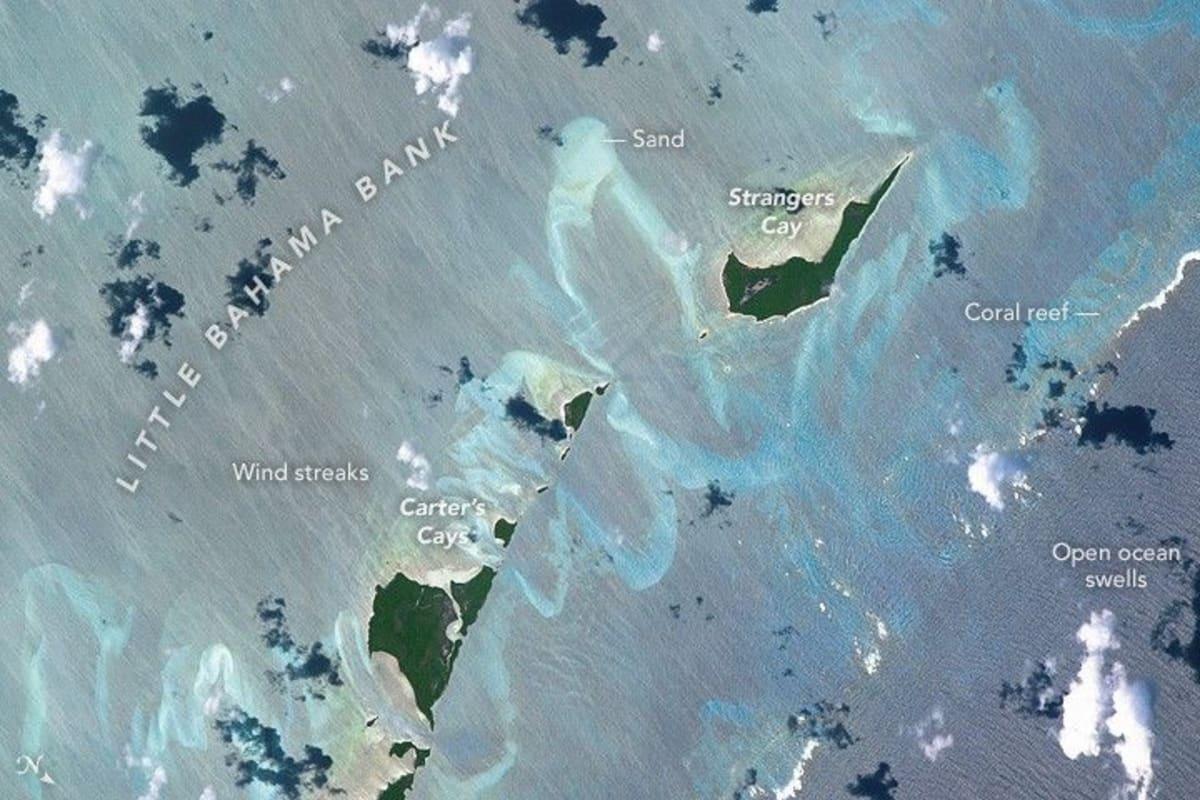
The Little Bahama Bank captured by an astronaut.
However, there's a major differentiator. While the Northern Lights or auroras are a real phenomenon, the luminous glow of the sandbanks is just an optical illusion. Since these features are close to the ocean, where sunlight can easily bounce off them, giving a luminous effect in the aftermath. In the image, the slight change in the water's color—lighter around the island and darker beyond the reef barrier—indicates the steep drop-off and the stark difference in depth between the two water bodies separated by the coral reefs. On the deep side of the reef, strong currents and winds have space to build large rolling swells that people often see from airplanes. But on the other side, the reef blocks big waves, so the wind can only carve out gentle ripples or faint streaks. The stark drop-off, the reef barrier, and submerged sandbanks make up the Bahama Islands, which are considered "one of the most recognizable places on Earth for astronauts."