
Can Solar Panels Create Electricity From Rain? Scientists Turn Breakthrough Tech Into Reality
Published March 9 2026, 9:41 a.m. ET

Schematic of the layering of their film-covered solar cell (Cover Image Source: Institute of Materials Science of Seville (ICMS))
A group of researchers in Spain have developed a clever device that can make electricity from both sunlight and rain at the same time. The team from the Institute of Materials Science of Seville (ICMS) designed a special hybrid setup that combines solar technology with tiny generators that react to falling raindrops. Researchers created a super-thin protective film placed on top of perovskite solar cells. This layer helps shield the panels from moisture and harsh weather, making them more durable and reliable. Moreover, it also allows tiny nanogenerators built into the system to produce electricity when raindrops hit the surface. Researchers say a single raindrop can produce over 100 volts, which could be enough to power small electronic devices or sensors.
A newer type of solar technology has been developed called “halide perovskite.” It is made from synthetic materials with a crystal-like structure that is really good at absorbing sunlight. As of now, most solar panels still rely on silicon, but perovskite cells are getting a lot of attention, as they can be highly efficient and much cheaper. The problem is that they tend to break down more easily when exposed to moisture, heat, or other harsh environmental conditions.
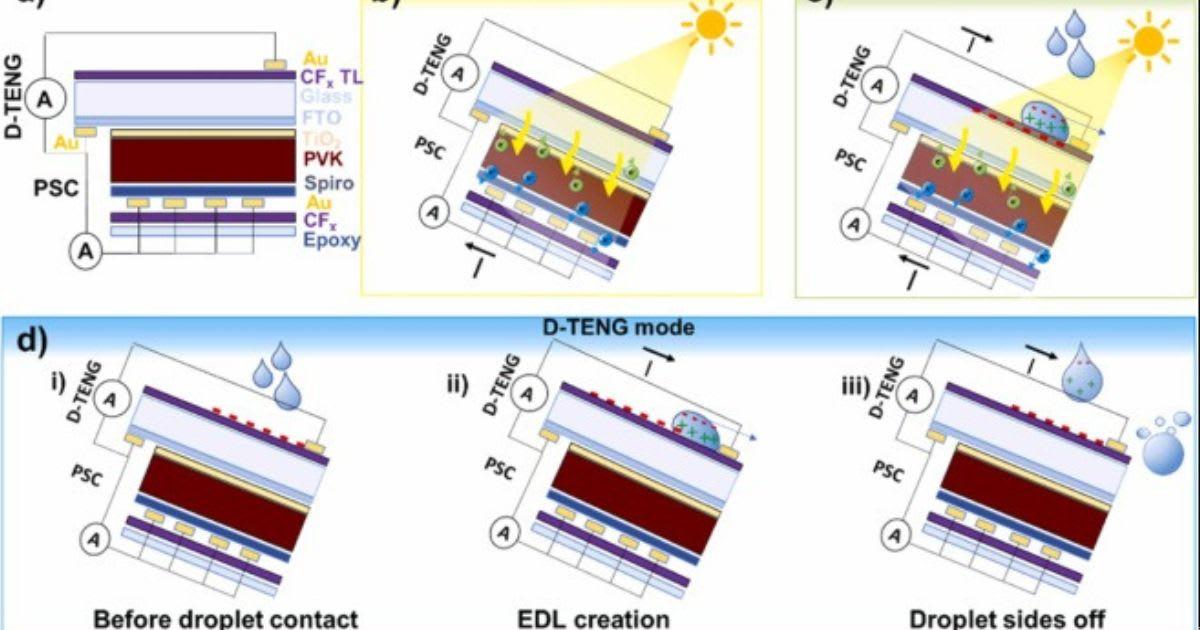
A figure showcasing the coat's functions
The research team at ICMS tackled this issue by using plasma technology to add an extremely thin protective layer on top of the solar cells. The coating protects the solar cells and helps them absorb sunlight. At the same time, the surface can generate an electrical charge when raindrops hit it, allowing the panel to turn energy from falling drops into electricity. During tests, it was revealed that the new material can generate up to about 110 volts from the impact of a single raindrop.
Furthermore, researchers say that the coating can be produced using sustainable methods. Another big advantage is its durability. The protective layer remained stable even in tough conditions, including when submerged in water. “Our work proposes an advanced solution that combines perovskite solar cell photovoltaic technology with triboelectric nanogenerators in a thin-film configuration, thus demonstrating the feasibility of implementing both energy harvesting systems,” Carmen López, a researcher at ICMS, said, per ZME Science.

A close-up of solar panels reflecting sun rays
Because regular batteries have limits and solar panels do not work on cloudy or rainy days, researchers say this new technology could be a smarter alternative. Their idea is that, instead of relying only on sunlight, the system uses both the sun and rain to generate power. The goal is to help small portable and wireless devices keep running without needing frequent battery changes or constant charging. Since it can produce electricity in sunny weather and during rain, the device could provide a steadier and cleaner source of energy.
The team says this could be especially useful for the growing Internet of Things (IoT) world. Things like environmental sensors that track rain, humidity, or pollution could benefit from it. “Its implementation in so-called smart cities is feasible, such as in signage, autonomous auxiliary lighting or monitoring, as it can withstand adverse weather conditions and the presence of rain, humidity and thermal cycles. It would also be applicable for distributed energy structures in remote, inaccessible or isolated areas, such as marine stations,” researcher Fernando Núñez said.