
Chinese Scientists Build Powerful New Solid-State EV Battery. One Charge Could Last 620 Miles
Published March 6 2026, 3:08 a.m. ET

Chinese scientists build a solid-state EV battery.
Chinese scientists have come up with an exceptional solution for a next-gen problem. Electric vehicles have been all the rage in recent times, but limitations in their long-term efficiency have held them back from reaching full potential. If such drawbacks are overcome, EVs could be the future. A recent study has come close to solving one such major issue. Scientists at Nankai University in Tianjin, China, claimed to have built a solid-state battery that can power electric vehicles for 620 miles on a single charge. They claim to have already installed the new EV battery in a vehicle to test long-distance driving.
According to a statement released by the university, author of the study Chen Jun claimed that he and his team had created a solid-state battery with an energy density of 400 Wh/kg, or 181 Wh/lb, in 2024. Jun spoke about the innovation at the second Deputies' Passage interview session of the Second Session of the 14th National People's Congress in March 2024. He revealed that the energy density of the solid-state battery exceeds that of the EV batteries currently on the market by 30%. While the team was ecstatic about the innovation, they had announced their plan to develop solid-state batteries with an energy density of 600 Wh/kg, or 272 Wh/lb, in the future that could power vehicles for about 620 miles on one charge.
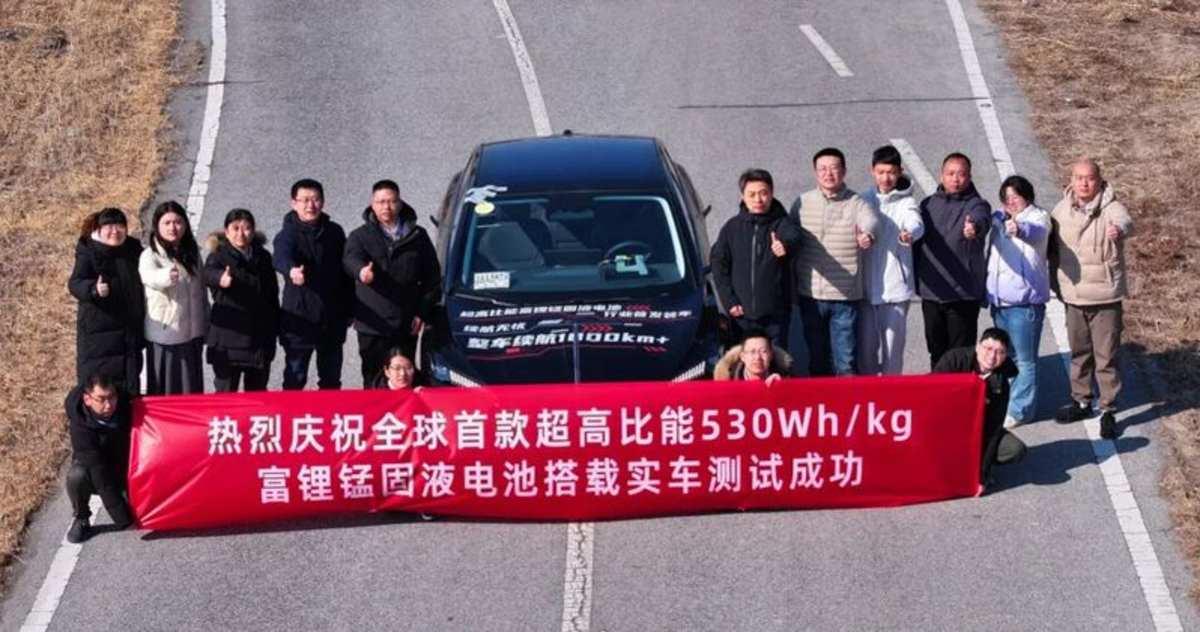
The new battery could allow electric vehicles to travel 620 miles on a single charge.
On February 6, 2026, the first meeting of the Technical Committee of the National Engineering Research Centre for Lithium-ion Power Batteries was attended by Jun and several other industry experts. There, he co-released an ultra-high specific energy lithium-rich manganese solid-liquid battery system product. It was developed by Jun's team and the R&D and Technology Center of China Auto New Energy. The battery cells unveiled at the meeting have more than 500 Wh/kg, or 227 Wh/lb, energy density. As promised, the battery would power EVs to more than 620 miles on a single charge.
Yan Zhenhua, a professor at the College of Chemistry at Nankai University and an important member of the team, also stated that they had already developed a more advanced version of a solid-state battery in the laboratory, which had more than 600 Wh/kg, or 272 Wh/lb energy density. They only unveiled the less advanced version because that is currently mass-producible. The solid-state batteries are improved versions of the lithium iron phosphate batteries in terms of high performance. According to the scientists, liquid electrolytes in lithium-ion batteries are flammable, whereas the solid electrolytes are not. Therefore, the latter is less prone to failures. Moreover, the solid electrolytes offer a longer lifespan.
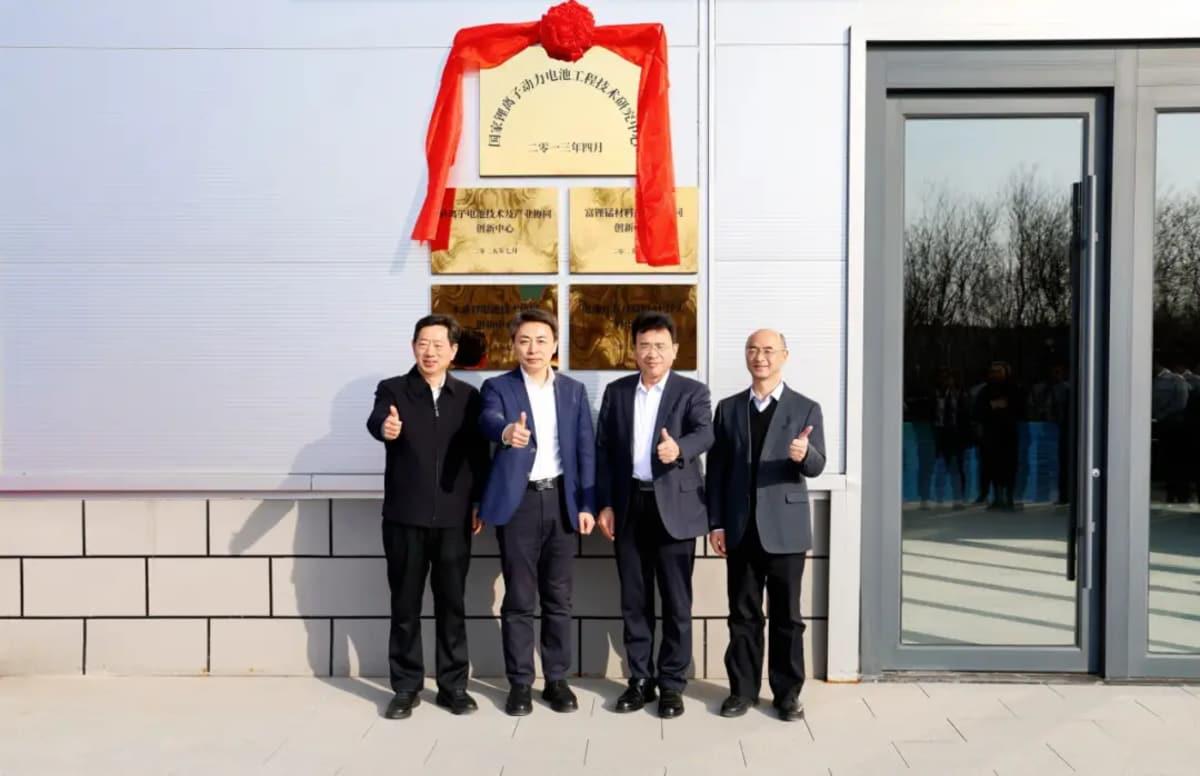
The researchers at the event.
The new battery depends on a lithium-rich manganese cathode and a hybrid solid-liquid electrolyte system. The combination of solid-state architecture and composite electrolyte helps improve ionic conductivity, making the design efficient compared to the pre-existing EV batteries. "The product utilizes super-wetting in-situ solidified composite electrolyte technology ... offering advantages such as high ionic conductivity, super-wetting properties, a wide electrochemical window, strong interfacial affinity, flame retardancy, and low cost," the statement read.
Li Xue, a researcher at China Auto New Energy, and another member of the team, revealed that the battery product system unveiled at the conference has an energy density of 288 Wh/kg, or 131 Wh/lb, with a total pack capacity of 142 kWh. This would enable a driving range of more than 620 miles after installation. He claimed that upgrades on the current product are ongoing while revealing the team's plan to attain higher capacity. They hope to build an EV battery with a pack energy density of 340 Wh/kg, or 154 Wh/lb, a total pack capacity of over 200 kWh, and a driving range exceeding 994 miles.