
A Huge ‘Gravity Hole’ Lies Beneath Antarctica. Scientists Say It’s Getting Stronger
Published Feb. 18 2026, 4:21 a.m. ET

Map detailing Antarctica
We might have assumed that gravity always remains steady and unchanging. But that might not be true after all. The strength of gravity actually changes from place to place across Earth. Scientists have found that one of the weakest spots is beneath Antarctica. In a new study published in Scientific Reports, researchers state that the “gravity hole” formed due to the rock’s extremely slow movements deep inside the planet over tens of millions of years. As these underground changes reshaped Earth’s interior, they also affected how gravity behaves at the surface. Researchers suggest that these gravitational changes occurred around the same time Antarctica underwent significant climate shifts.
A ship sailing on Antarctic waters
However, according to the study, Antarctica’s “gravity hole” was much weaker before. It became stronger between 50 and 30 million years ago, which is the same time when the continent began to freeze over and large ice sheets formed. “If we can better understand how Earth’s interior shapes gravity and sea levels, we gain insight into factors that may matter for the growth and stability of large ice sheets,” co-author of the study and a professor of geophysics at the University of Florida, Alessandro Forte, said, according to UF News. The team has not confirmed whether it affects Antarctica in any major way, especially with climate change.
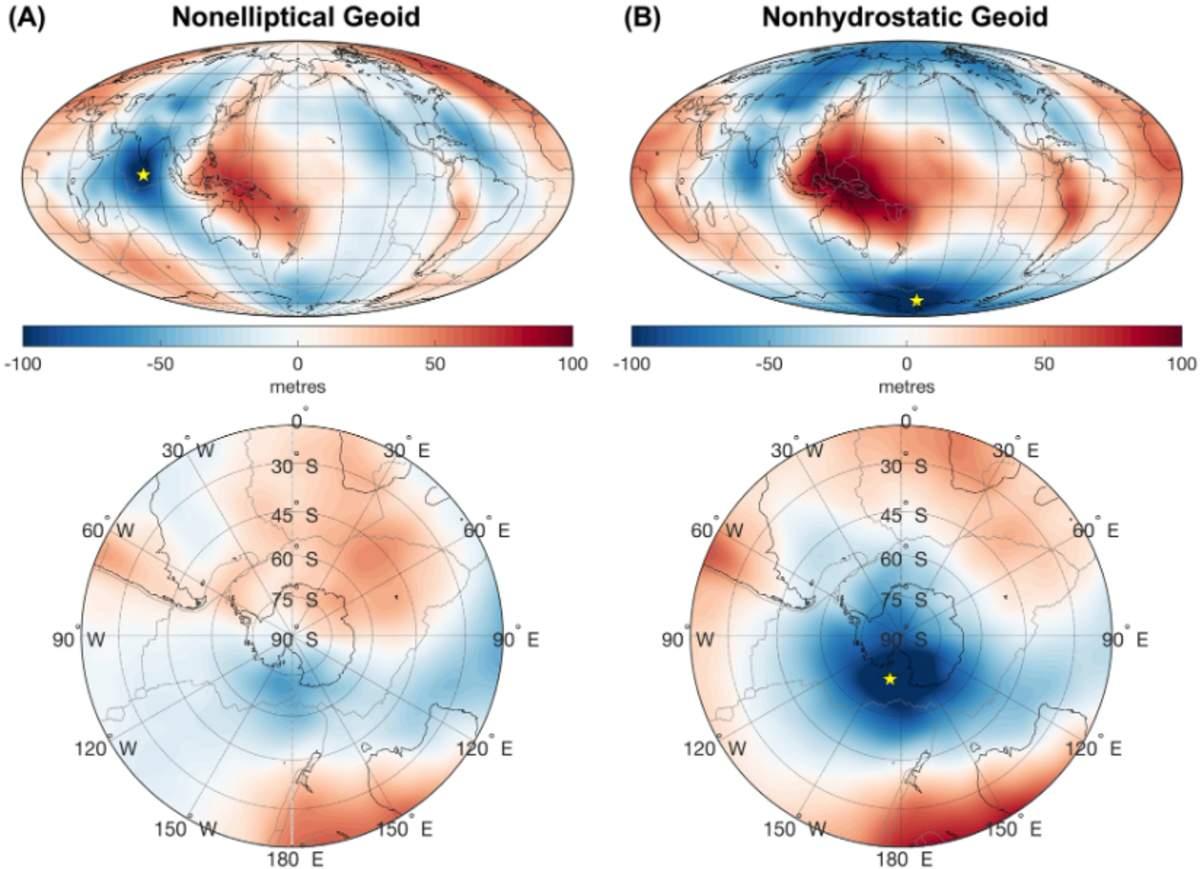
Present-day geoid anomalies. (A) Nonelliptical geoid undulations, derived from the GRACE geopotential, but represented relative to the WGS84 reference ellipsoid3. (B) Nonhydrostatic geoid undulations derived from the GRACE geopotential solution2 relative to Earth’s hydrostatic ellipsoidal figure, arising from the diurnal rotation6.
Earth’s uneven ocean surface is described by the geoid, which is neither smooth nor perfectly round. Instead, it is slightly bumpy, as gravity changes a little from place to place across the planet. These differences are minute, so humans never feel them in everyday life. We will not see people floating or being pulled down harder in certain areas. However, oceans do respond to these small differences, and water naturally moves toward areas where gravity is stronger. It means sea levels can be slightly lower in places where gravity is weaker, such as Antarctica.
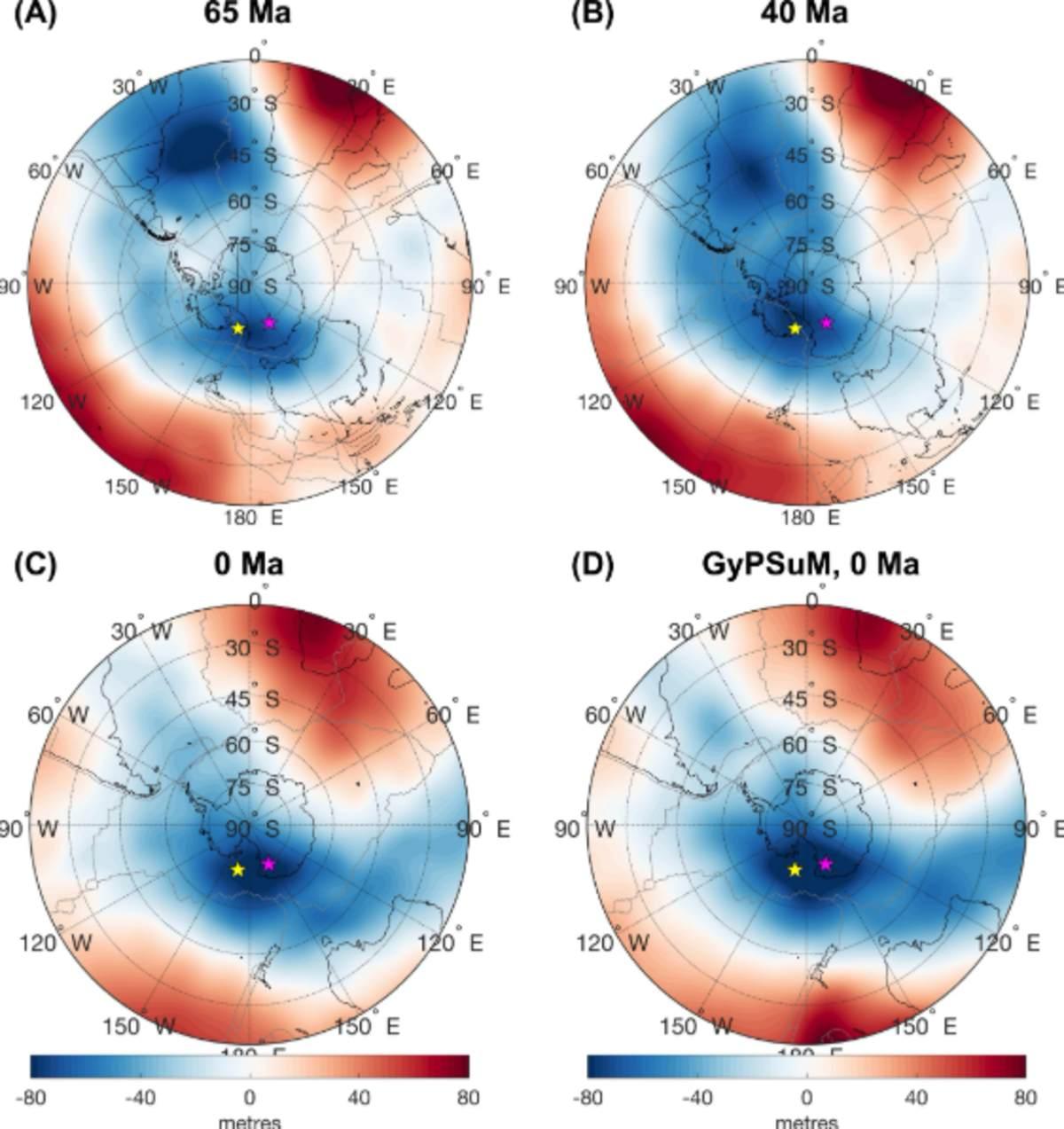
Time-dependent geoid predictions. Geoid anomalies are shown at: (A) 65 Ma, (B) 40 Ma, and (C) 0 Ma, predicted from the time-dependent reconstruction of 3D mantle structure at 70 Ma. (D) The geoid anomalies based on the present-day GyPSuM tomography model23.
The team rebuilt a 3D picture of Earth’s interior for the study, using global earthquake recordings. After building this model, the team used computer simulations to basically rewind Earth’s internal processes and track how rocks deep inside the planet moved over the last 70 million years. “Imagine doing a CT scan of the whole Earth, but we don’t have X-rays like we do in a medical office. We have earthquakes. Earthquake waves provide the ‘light’ that illuminates the interior of the planet,” Forte said.
The results were enlightening. It showed that in the beginning, cold and dense material sinking deep into the mantle helped create the gravity low near Antarctica. As time went by, between 50 and 30 million years ago, hotter and lighter mantle material began to rise. This shift redistributed mass beneath the continent. The mix of sinking cold material and rising hot material strengthened the mass deficit under Antarctica. This process made the gravity low more pronounced over time. Understanding the “gravity hole” of Antarctica could be the key to finding new details about the continent’s geological past. Ever since climate change has been heavily affecting the region, studying these deep-Earth processes is important. It may provide a better understanding of how Antarctica has evolved and how it may change in the future.