
Earth’s Core May Be Hiding 45 ‘Oceans’ Worth of Hydrogen, New Study Finds
Published Feb. 11 2026, 8:16 a.m. ET

Representative Cover Image Source: Getty Images | Tumeggy – Science Photo Library
Where did Earth’s water come from? This has been a topic of debate among scientists for a very long time, and we might finally be close to an actual answer. In a new study published in Nature Communications, researchers have revealed that Earth’s core may be holding enormous amounts of hydrogen. Earth has 5 oceans, which covers 70% of the planet’s surface, and if we multiply it by 9, that’s roughly how much hydrogen scientists think could be hidden deep inside. It could be as high as 45 oceans’ worth of hydrogen trapped in the core. “Earth’s core would store most of the water in the first million years of Earth’s history. The surface — where life resides — contains the least,” said lead author Dongyang Huang, per CNN.
A team of researchers added that the weight of the hydrogen inside the core could be 0.36% to 0.7%. These results suggest that most of Earth’s water may have appeared on Earth’s surface during the planet’s formation, rather than arriving later through comet impacts, as some theories have proposed. This means that water has been part of Earth’s makeup from the very beginning.
The formation of the core has been an intricate process. Earth began to take its shape more than 4.6 billion years ago. Rocks, gas, and dust orbited the young Sun and gradually clumped together through countless collisions, forming a growing planet. These impacts helped to separate the layers of the planet with the crust on top, the mantle beneath it, and a deep core at the center. The Earth’s core became a dense, churning mass of mostly iron and nickel under immense pressure and heat. This moving metal generates the planet’s magnetic field, which shields us from harmful solar radiation.
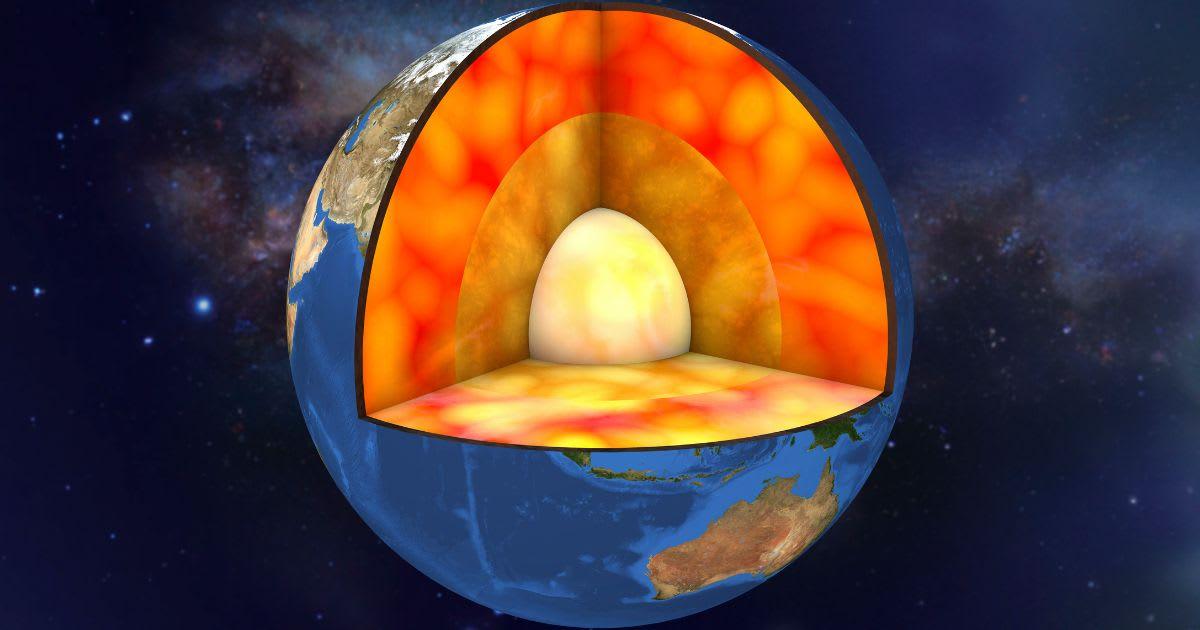
Earth's internal structure
However, it is crucial to understand how hydrogen is formed and stored to find out how planets form and life develops. Scientists have long tried to figure out how much hydrogen might be hidden inside Earth’s molten core. The team studied how hydrogen interacts with iron when placed under intense conditions, but there are limitations to this. The core lies thousands of miles deep inside the Earth, making it impossible to observe directly. On the other hand, recreating the same conditions in a laboratory is also difficult.
The team conducted another experiment. “The technique is fundamentally different from earlier methods,” Huang explained. They recreated extreme heat and pressure of Earth’s core in the lab and used iron to represent the planet’s molten metal interior. Afterward, they placed tiny iron samples inside a high-pressure device known as a diamond anvil cell and heated them with lasers until they melted. Researchers analyzed the samples using a technique called atom probe tomography. It produces 3D images and identifies chemical elements at the atomic level. This allowed them to directly observe hydrogen and how it interacts with other likely core elements, such as silicon and oxygen.
The molten metal gradually cooled in the experiment, and hydrogen got mixed with silicon and oxygen in tiny structures, showing an almost one-to-one ratio between the elements. By comparing the ratio with previous estimates of how much silicon exists in the core, researchers calculated how much hydrogen might also be present. The method depends on assumptions about how these atoms are arranged deep inside Earth and how they mix under intense pressure.
“Hydrogen can only enter the core-forming metallic liquid if it was available during Earth’s main growth phases and participated in core formation,” Professor Rajdeep Dasgupta said. He further explained that if the study’s hypothesis turns out to be true, it would mean that hydrogen was most likely mixed into the planet gradually as Earth was forming and growing.