
A City-Sized Green Comet Is Nearing Earth This Week. Astronomers Say It's Just Like 3I/ATLAS
Published Feb. 16 2026, 5:36 a.m. ET

Comet C/2024 E1 (Wierzchos): View from Namibia.
If you catch a green comet in the sky, know that it may be called Comet Wierzchoś or C/2024 E1. The comet, about the size of a small city, will make its closest approach to Earth this week. However, experts believe that it will be expelled from the solar system and become an "alien comet," roaming the vast and endless space, just like comet 3I/ATLAS. Comet Wierzchoś has been observed by the James Webb Space Telescope (JWST) since its discovery in March 2024. It was the Polish astronomer Kacper Wierzchoś who first spotted the icy comet headed towards Earth while observing the skies with a 4.9-foot telescope at the Mount Lemmon Observatory in Arizona. In the observations that followed, researchers found the presence of carbon dioxide in the comet's coma, a name for its surrounding cloud of dust and gas.
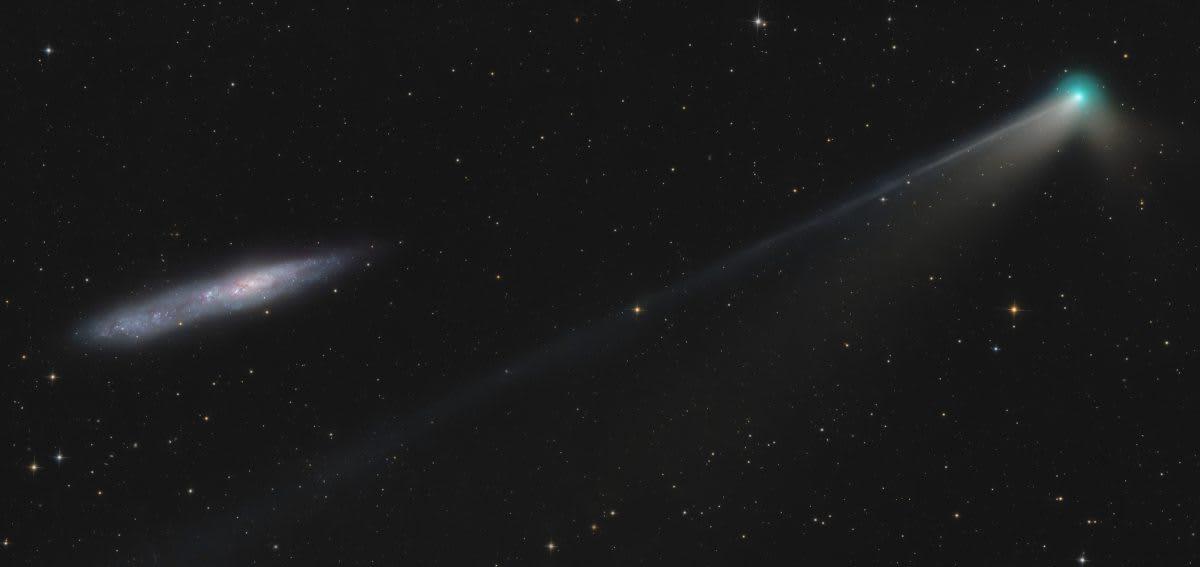
Comet C/2024 E1 (Wierzchos) & Galaxy NGC 55: View from Chile
JWST's initial observation had suggested that the comet comprises a nucleus with a diameter of around 8.5 miles. To put that into perspective, experts compared real-time measurements and found that the comet is about two-thirds the length of Manhattan and about four times the island's width. While the initial observation created waves amongst researchers, a recent study has claimed that the estimation could be wrong. According to the recent study, which is yet to be peer reviewed, the earlier analysis had overestimated the comet's size. The outer edge of the solar system encompasses a massive reservoir for comets called the Oort cloud, and Comet Wierzchoś is believed to have emerged from it. Moreover, the comet is hyperbolic, which means it has an open and flattened trajectory.
The comet doesn't orbit the Sun in cycles, and researchers suspect that it's the first time it has ventured within the solar system. On the contrary, some researchers believe that the comet has been heading towards the Sun for 1 million to 3 million years. But there is one aspect that all researchers could agree on: the comet will be flung outside the solar system. On January 20, the comet approached its closest point to our home star, perihelion. At this point, the comet was about 52 million miles away from the solar surface, according to Space.com. Recently, it lit up the southern skies.
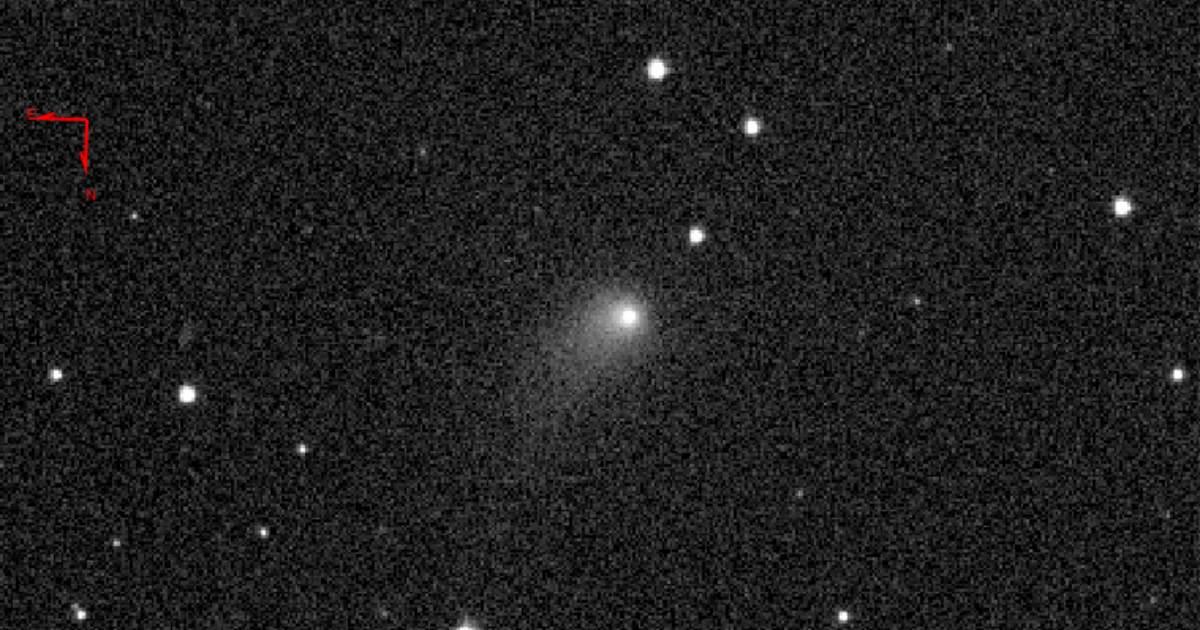
Comet Wierzchoś captured in the sky.
“This lovely comet is gracing southern skies,” reports Ian Griffin, who photographed Comet Wierzchoś (C/2024 E1) last week from Middlemarch, New Zealand, as per Spaceweather.com. On February 17, the comet turns its face to Earth, making its closest approach to our planet from an approximate distance of 94 million miles, roughly the same as the Sun. Since it passed by perihelion, the comet has begun to appear brighter in the sky. The green comet with an explicitly long tail of dust and gas has allowed astronomers to spot it easily and capture its beauty. The photos captured of the comet highlighted its stunning green coma. The rare hue is courtesy of the large amounts of present within it. Although the emerald iceball won't be visible to the naked eye, it can easily be spotted through telescopes or stargazing binoculars.
The sad part about the comet's visit is its inevitable expulsion into space, but scientists believe that the cosmic neighbor will float around for quite some time in the Milky Way before making its exit into the unknown. It could take the comet decades or even centuries to leave the solar system forever.