
What if Your Sweat Could Power Your Wearable Devices? Japanese Scientists Made It Possible
Published March 5 2026, 8:11 a.m. ET

(L) Young woman runner in sportswear uses a smart tracker on the beach; (R) Fuel or power generation cell (Representative Cover Image Source: Getty | (L) Nastasic; (R) Just_Super)
Thanks to a team of Japanese researchers, the time has come when every droplet of sweat you shed on the treadmill and every muscle you exert in the push-ups may turn you a little more 'electric' instantly. For every sweat drop your body sheds, a tiny tattoo-like strip will generate electricity. The more you exercise, the more electricity it’ll generate. The idea might sound like it's coming straight from a Marvel Superman character, but thanks to a mold-breaking innovation, all it takes for this to happen is a water-based enzyme ink. In a study published in ACS Applied Engineering Materials, scientists documented the mechanism behind this extraordinary gadget, also called wearable enzymatic biofuel cells (EBFCs).
The concept of EBFCs itself is not new. For years, scientists have used enzymes as catalysts to convert chemicals in body fluids, such as glucose or lactate, into electrical energy. It’s like a little bandage or temporary tattoo on the skin. Each time the bodily fluids come in contact with this strip, the resulting chemistry alchemizes the fluids into electricity. In this case, it’s the lactate that will be converted.
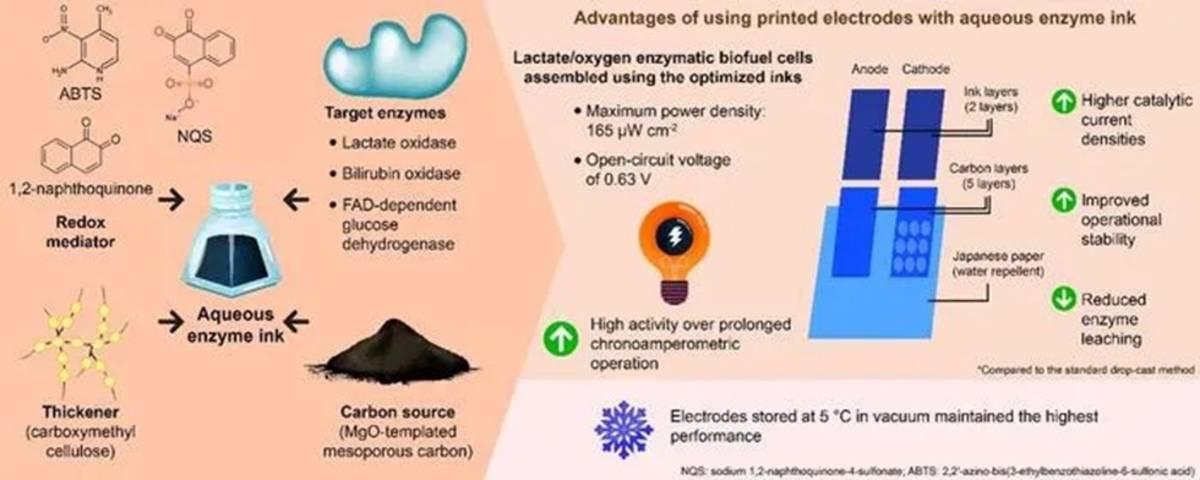
Chemical process that converts sweat drops into electricity
Not that the idea has remained impossible to implement until now, but it’s the manufacturing that was regarded as infeasible, seemingly impractical. Japanese scientists streamlined the process into a single screen-printing step that uses a special enzyme ink that enables lightweight biofuel cells to generate electricity, as the Japan Research Report also explains. “This marks the first report of a screen-printable enzyme ink for the cathode side of a biofuel cell, a component that has historically proved more difficult to fabricate than the anode,” the report said.
The traditional fabrication has been a lingering obstacle, slow, variable, and difficult to scale. Differences in the chemistries of components often resulted in inconsistencies and disruptions in the electricity-generation process. This time, astonishingly, scientists have condensed the entire process into a single step, preventing the hassle of layering components. The device consists of materials like enzymes, porous carbon, electron-shuttling mediators, and a water-based polymer binder. This mixture can be screen-printed in one step onto the Japanese lightweight paper, forming both the bioanode and the biocathode of the cell.
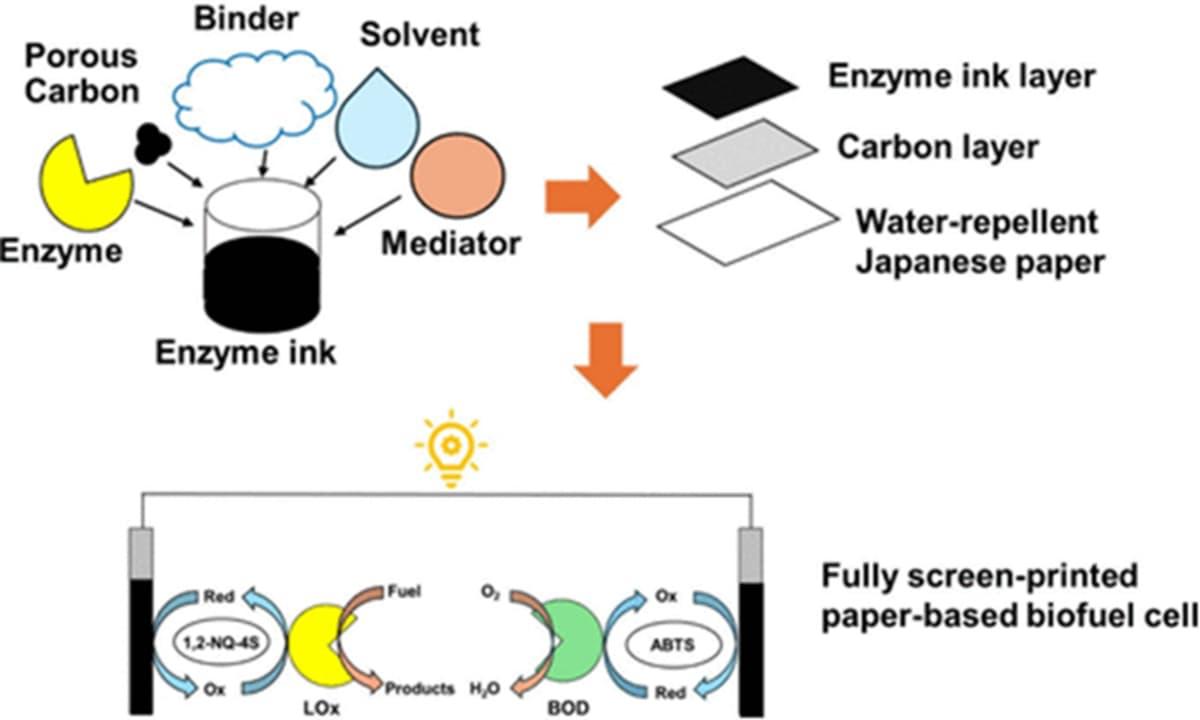
Japanese scientists designed a new enzyme ink that can convert sweat into electricity
Dr. Isao Shitanda, co-first author from the Tokyo University of Science, said they felt a strong need for creating an ink that would facilitate both the generation of electricity and mass production when used in wearable patches or devices. It’s quite like a printer that derives fuel from your body’s fluids and mixes it with the enzyme ink to print out an image on the paper. The moment the sweat drops hit the sensor, the lactate enzyme undergoes an oxidation process, which releases electrons and protons. This soup of electrons and protons travels to the cathode. Their journey from anode to cathode generates an electric current. The more you exercise, the more this loop repeats and continues to produce electric power.
In a laboratory test, the team noticed that one lactate-fueled cell produced “enough power to operate low-energy electronics and transmit data wirelessly,” precisely a maximum power density of 165 microwatts per square centimeter at 0.63 volts. Athletes and coaches would be able to record their glucose levels while they reach the muscle-fatiguing territory without the hassle of finger pricks. In hospitals and medical centers, doctors would be able to keep track of and monitor a variety of readings in patients, such as heat stress, dehydration, and infection. All this without relying on conventional batteries. Future wearable biosensors could draw energy directly from the sweat to produce electrical energy for low-power applications.