
Tourists Rush to See Melting Glaciers Before They're Gone. But Their Presence Is Making Things Worse
Published Feb. 10 2026, 6:51 a.m. ET

Rhône glacier in Switzerland
Perhaps it's ecological mourning, among other things, that's attracting a large number of tourists to melting glaciers. The increasing global warming is melting away the ice, but the landscape continues to appear stunning, making it a great site for recreation and tourism. However, the consequences of the increased visitation are far from picturesque. An international team led by the University of Lausanne (UNIL) has released a warning, published in the journal Nature Climate Change, about tourism's impact on melting glaciers. The researchers have claimed that the glacial landscape would be "loved to death" by tourists if this continues, as per Blue News. While the icy landscapes have always attracted scientists, mountaineers, and nature enthusiasts for centuries, the population has increased in recent years.
They emphasized that extensive tourism is an added stressor for vulnerable places such as the melting glaciers. According to the research, over 14 million visitors travel to the world's famous glaciers every year. Primary reasons behind this shift could be scientific intrigue, fascination, and fear that the landscape won't remain the same in the coming years. While the increased tourism has been a boon for revenue generation, it's gradually making the deteriorating glacier worse, adding pressure on fragile regions. The article published by global experts on glacier tourism, including Emmanuel Salim, an associate researcher at UNIL’s Institute of Geography and Sustainability, sheds light on the often-overlooked dark side of tourism in vulnerable areas.
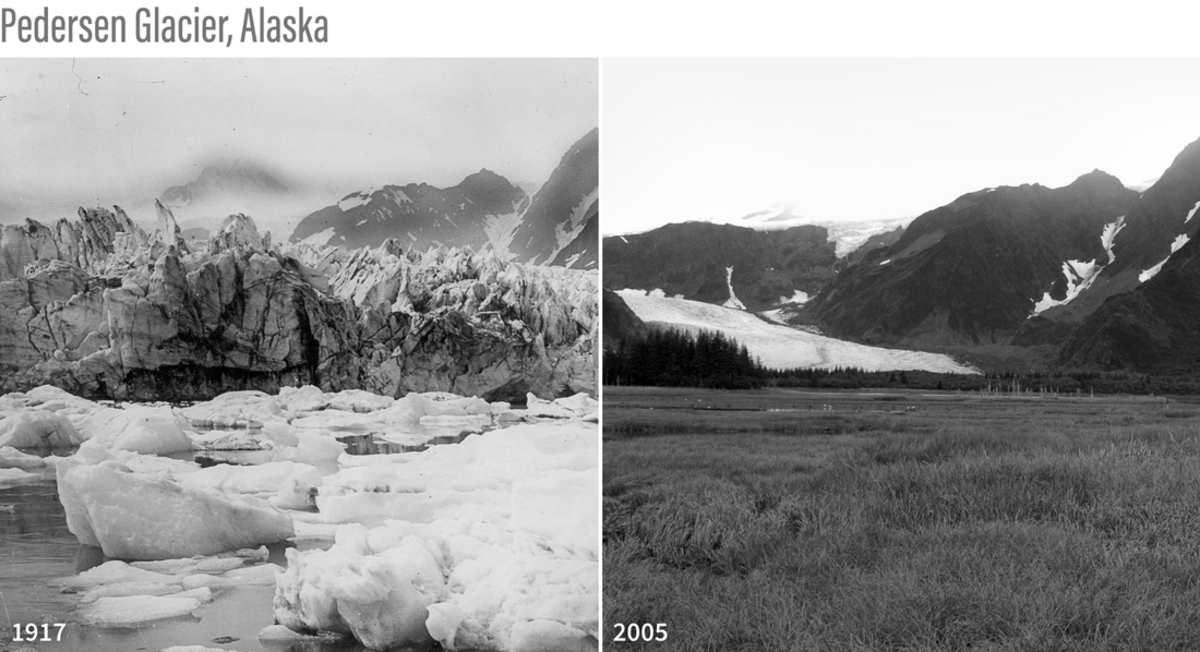
Pedersen Glacier in Alaska’s Kenai Mountains. In the early 20th century, the glacier met the water and calved icebergs into a marginal lake near the bay. By 2005, the glacier had retreated, leaving behind sediment that allowed the lake to be transformed into a small grassland. (Image Source: Louis H. Pedersen (1917) and Bruce F. Molina (2005), obtained from the Glacier Photograph Collection, Boulder, Colorado USA: National Snow and Ice Data Center/World Data Center for Glaciology)
Dubbed "last chance tourism," the researchers emphasize that the sudden surge in visitation has more to do with people's emotions. Ironically, the inevitable retreat of glaciers has triggered an increase in tourism, which in turn threatens the very landscapes that attracted people from around the world. Simply put, "last chance tourism" might be bringing the glaciers to their doom sooner rather than later. The report revealed that the surge in population has led some locations to build new access walkways for easy commuting. Installation of geotextile covering and helicopters for touring around the glaciers has also been initiated in some sites. These developments might be beneficial economically, but they can escalate glacier melting.
Moreover, these solutions are not useful in raising awareness of the underlying causes of glacial melt, safety concerns, water access to local communities, and other aspects that might be affected by tourism. "It is particularly the case in regions such as Alaska, Greenland, and Antarctica," Salim said. “Many tourists will simply move on to the next popular destination once the glaciers are gone," he added. However, tourism at glaciers is no longer restricted to conventional sightseeing. Today, more people are headed to these locations with a sense of understanding and concern for climate change, which researchers have called "dark tourism." Similar to visits to disaster sites or war memorials, some of the famous glaciers have become sites for commemoration.
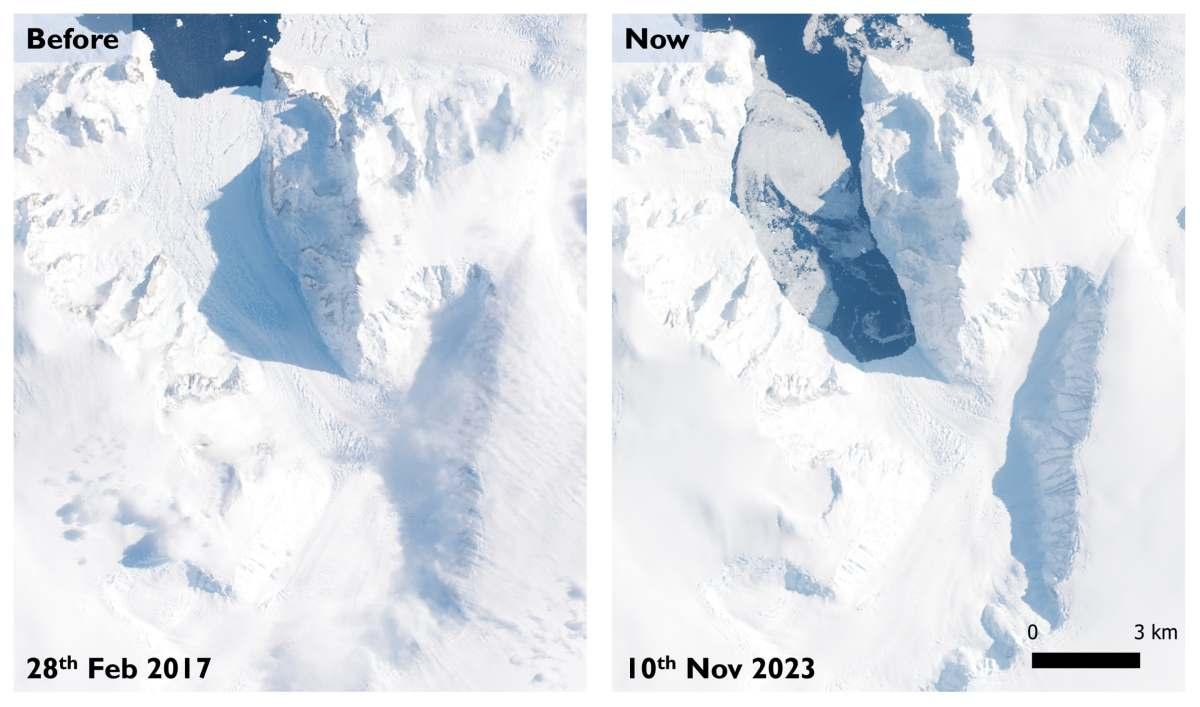
The Cadman Glacier in the Antarctic before and after the collapse of the ice shelf. The image on the left was taken in 2017 and shows the ice shelf. An image taken in 2023 shows the loss of the ice shelf.
From awareness-raising sporting events like the Glorious Glacier Ride to funeral ceremonies (in Switzerland, France, Nepal, or Iceland), such events have increased in recent years. Glaciers have gone beyond their giant icy structures and have become a symbolic representation of climate change. The experts urge the reassessment of tourism and cultural adaptation strategies to cater to the urgency of glacier loss. “In a world where 60% of ice volumes could be gone by 2100, we also need to evaluate and anticipate how recently deglaciated areas can be managed and protected,” Salim said. "A key question will be whether, and how, the disappearance of these icons can truly trigger systemic change, transforming sadness, anxiety, and curiosity into collective responsibility," he added.