
Climate Change Is Rewriting the Life Cycle of a Major Greenhouse Gas, Study Finds
Published Feb. 4 2026, 8:49 a.m. ET

Smoke billowing from factories showing human-caused climate change
Nitrous oxide, this faintly sweet-smelling three-atom gas, is a ghost that quietly, slowly creates perturbances in Earth’s atmosphere, first by choking it with greenhouse emissions and second, by weakening its protective ozone layer. When it flits through the atmosphere and travels to the stratosphere, an equal assault of sunlight’s radiation and chemical reactions breaks it down. This lifetime is usually hundreds of years, 117 precisely. But nowadays, a bulk of carbon dioxide sitting in the atmosphere heats up the planet. As a result, the atmosphere is trapping an unusually enormous amount of heat while the stratosphere is cooling down to equal proportions. In research published in the Proceedings of the National Academy of Sciences (PNAS), scientists outlined a surprising discovery.
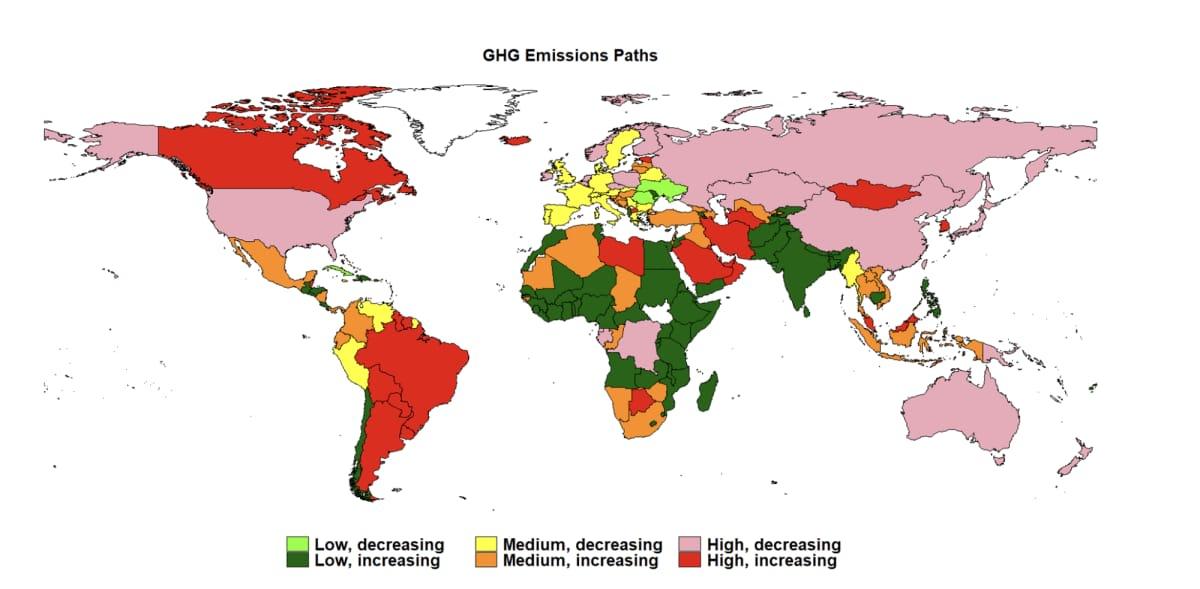
Map classifying countries by greenhouse gas emissions per capita in 2023
The current lifetime of this ozone-eating gas has reduced by approximately a year and a half per decade. Interestingly, the climate change itself is propelling this shift, which means it is self-destructing. However, the uncertainty itself poses a danger for climate scientists. The discovery has injected a mark of hesitation in their future climate projections. They can no longer project the future climate with certainty.
The finding about the shift in nitrous oxide’s lifetime was made through observations extracted from NASA's Microwave Limb Sounder satellite over two decades, from 2004 to 2024. Nitrous oxide, the third-most dominant greenhouse gas after carbon dioxide and methane and an ozone-depleting substance, is disintegrating more quickly than previously thought. This change in the life cycle of atmospheric nitrous oxide is a critical piece of the puzzle that has been largely overlooked in previous studies.

Michael Prather, UC Irvine professor of Earth system science and co-author of the new paper on the longevity of nitrous oxide in Earth’s atmosphere.
The shift, as UC Irvine professor of Earth system science and study co-author Michael Prather put it, is largely based on the stratospheric circulations and temperature changes ongoing on the planet as a result of climate change. Co-author and a graduate student researcher in Earth system science at the University of California, Irvine, Calum Wilson calls it a “feedback loop.” The cooling in the stratosphere, combined with changes in atmospheric circulation patterns, is speeding up the transport of nitrous dioxide to the regions where it is destroyed, explained Wilson. The loop, he reflected, adds another layer of complexity to climate projections for the rest of the 21st century.
The shift due to climate change is comparable in magnitude to the differences across various emission scenarios currently used by the Intergovernmental Panel on Climate Change for climate assessments. Meanwhile, the atmospheric lifetime of the gas continues to decrease at a rate of 1.4 percent per decade.
The finding made Prather realize a stunning gap that exists in the current Earth system models but was not highlighted earlier. The stratospheric chemistry and dynamics present uncertainties in projecting nitrous oxide. Inclusion of these uncertainties into climate models could offer fresh perspectives and new insights into various international climate assessments and in deriving the global warming potential (GWP). The future of how nitrous oxide will behave in the coming years remains a mystery, but after this study, at least the scientists are aware of its mysterious nature.